
English Linking Words and Discourse Markers
Published on April 13, 2026 • 14 mins read
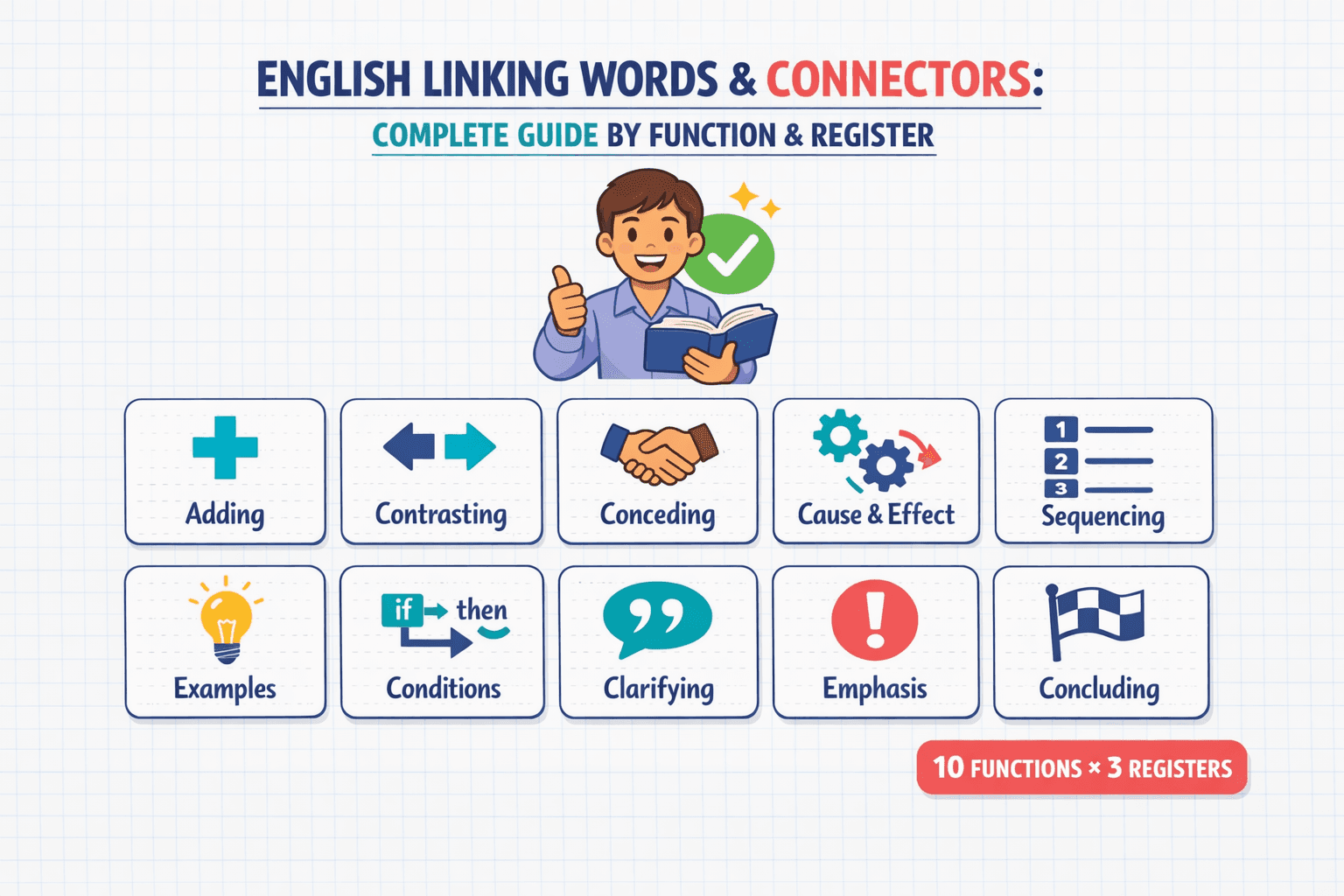
Every table below organises English linking words by what they do — adding, contrasting, conceding, explaining cause, sequencing, giving examples, stating conditions, clarifying, emphasising, and concluding — then sorts them by register so you can pick the right one for a formal essay, a business email, or a spoken answer. If you're preparing for IELTS, this maps directly to the "Coherence and Cohesion" band descriptor, where using a range of cohesive devices appropriately is what separates Band 5 from Band 7+. But the guide works for any context where you need your English to flow. Once you've read through the tables, you can test yourself with our linking words and connectors quiz.
Before we get to the tables: three mistakes that will undermine your connector use no matter how many you memorise.
Three Mistakes to Avoid From the Start
1. Using connectors as decoration. If you remove the linking word and the sentence still makes perfect sense with the same meaning, the connector is doing nothing. "I enjoy swimming. Furthermore, I enjoy reading." — that "furthermore" isn't connecting ideas; it's just sitting there. Compare: "Regular exercise improves mood. Furthermore, recent studies suggest it may slow cognitive decline." Now the connector signals that the second point builds meaningfully on the first.
2. Mismatching register. An academic essay that uses "plus" and "basically" sounds underprepared. A speaking test answer that uses "nevertheless" and "notwithstanding" sounds rehearsed. But register isn't just about formality — it's about precision. Take "in fact" and "indeed": both emphasise, but "in fact" introduces something surprising ("He seemed calm. In fact, he was terrified."), while "indeed" confirms what was already said ("The results were significant — indeed, unprecedented."). Swapping them isn't a grammar error, but it blunts your meaning. Every table below has a register column — find the row that matches your task and stay in it. If you're unsure about when to use formal vs. informal English more broadly, our formal vs. informal English guide covers the full picture beyond connectors.
3. Front-loading every sentence. Beginning every sentence with a connector ("However, … Moreover, … In addition, …") creates a robotic rhythm. Vary the position: some work mid-sentence ("The results, however, were inconclusive"), some work at the end ("It wasn't the best solution, though"), and some sentences don't need a connector at all. Strong writing uses connectors in maybe 40–50% of sentences — not 100%.
Adding Information
These tell the reader you're building on the previous idea, not changing direction.
| Register | Linking word / phrase | Example |
|---|---|---|
| Casual / spoken | plus, also, on top of that, and another thing | "The commute is long. Plus, there's no parking." |
| Neutral | in addition, as well as this, what's more | "The study found higher engagement. In addition, dropout rates fell." |
| Formal / written | furthermore, moreover, additionally | "The policy reduced costs. Moreover, it improved staff retention." |
The trap to avoid: Don't stack additive connectors. Writing "Furthermore, moreover, additionally" in consecutive sentences doesn't show range — it shows you only know one function. Use one, then let the next sentence connect through meaning alone before reaching for another.
A subtlety worth knowing: "moreover" doesn't just add information — it adds information that's more important than what came before. If your second point is weaker than your first, "in addition" is more honest. Examiners and experienced readers notice when "moreover" introduces a lesser point, even if they can't articulate why it feels off.
Contrasting Ideas
These signal a change of direction — the reader should expect something that pushes against the previous statement.
| Register | Linking word / phrase | Example |
|---|---|---|
| Casual / spoken | but, though (end of sentence), still, then again | "I liked the job. The hours were brutal, though." |
| Neutral | however, on the other hand, yet, whereas | "Sales rose in Q1. However, Q2 showed a sharp decline." |
| Formal / written | nevertheless, nonetheless, conversely, by contrast | "The initial results were promising. Nevertheless, the trial was discontinued." |
The "however" problem: It's the most overused connector in ESL writing. If every paragraph turn uses "however," try "yet" (shorter, works mid-sentence), "whereas" (great for comparing two subjects directly), or restructure the sentence so the contrast is grammatical: "While the policy reduced costs, it created new logistical challenges."
Notice how "though" at the end of a spoken sentence does the same job as "nevertheless" in a formal paragraph — but they'd sound ridiculous if swapped. That's register awareness, and it's what separates a B1 answer from a C1 answer on any English assessment, IELTS or otherwise. If you want to test how well you handle that distinction, C1 use-of-English exercises are built for exactly this kind of precision.
Conceding a Point
Concession is one of the most powerful moves in formal writing, and most learners underuse it. You acknowledge that the other side has a valid point — then steer back to your argument. It's what makes writing sound balanced rather than one-sided.
| Register | Linking word / phrase | Example |
|---|---|---|
| Casual / spoken | sure … but, I mean … still, fair enough … though | "Sure, it's expensive, but the quality is worth it." |
| Neutral | although, even though, while it's true that, admittedly | "Although renewable energy costs have fallen, infrastructure remains a barrier." |
| Formal / written | notwithstanding, granted, albeit, while acknowledging | "Granted, the sample size was small. The trend, however, was consistent." |
In IELTS Task 2 essays specifically, concession is where Band 7 and 8 writers pull ahead. A structure like "While it is true that [opposing argument], [your counterpoint] suggests that…" signals mature, well-organised thinking. But this applies equally to any academic essay or business proposal — any time you need to show you've considered the other side.
Watch out for "albeit." It means "although" but it's followed by a phrase, not a full clause. You can write "The results were positive, albeit modest" — but not "Albeit the results were positive." This is a common error that stands out because it shows you reached for a high-level word without fully understanding its grammar.
Showing Cause, Effect, and Purpose
These explain why something happened, what resulted, or what it was intended to achieve.
| Register | Linking word / phrase | Example |
|---|---|---|
| Casual / spoken | so, because of that, that's why | "They cancelled the event. So we just stayed home." |
| Neutral | therefore, as a result, consequently, due to | "Demand exceeded supply. As a result, prices rose sharply." |
| Formal / written | hence, thereby, accordingly, owing to | "Funding was reduced, thereby limiting the scope of the research." |
"Therefore" vs. "so": they mean the same thing, but "so" belongs in conversation and informal writing while "therefore" belongs in essays and reports. Using "so" in a formal essay won't lose you marks on its own, but it signals a narrower register than skilled writing demands at B2+.
A useful trick: vary the position of your causal connector. "Consequently, the program was suspended" and "The program was, consequently, suspended" both work — and alternating between front-position and mid-position creates natural rhythm without extra effort.
Stating Conditions
These set up a requirement or hypothetical scenario that the rest of the sentence depends on.
| Register | Linking word / phrase | Example |
|---|---|---|
| Casual / spoken | if, as long as, unless | "I'll come as long as it's not too late." |
| Neutral | provided that, assuming that, on condition that | "The offer stands, provided that both parties agree to the terms." |
| Formal / written | in the event that, on the assumption that, should (+ inversion) | "Should the committee reject the proposal, a revised version will be submitted." |
The "if" trap: There's nothing wrong with "if" — it works in every register. But in formal writing, leaning on "if" for every condition makes your prose sound flat. "Provided that" implies a stricter requirement than "if." "Should" with inversion ("Should you require further assistance…") signals high formality and works well in business correspondence — you'll see it constantly in our business email reading exercises. These aren't just synonyms — they carry different weights.
Clarifying and Reformulating
These tell the reader you're about to say the same thing in a different, usually simpler way — or make a vague point more precise.
| Register | Linking word / phrase | Example |
|---|---|---|
| Casual / spoken | I mean, basically, what I'm saying is | "It was a disaster — I mean, nothing went as planned." |
| Neutral | in other words, that is, to put it differently | "The market corrected itself — in other words, prices returned to pre-surge levels." |
| Formal / written | that is to say, to put it another way, more precisely | "The policy applies to all stakeholders — that is to say, employees, contractors, and vendors." |
Reformulation connectors are underrated in essay writing. When you've made a complex argument, following it with "In other words" and a simpler restatement makes your reasoning clearer and shows the examiner (or your reader) that you can express the same idea at multiple levels of complexity. That's a sign of genuine command, not just vocabulary.
Emphasising
These strengthen a point — signalling that what follows is particularly important or surprising.
| Register | Linking word / phrase | Example |
|---|---|---|
| Casual / spoken | seriously, honestly, the thing is | "Honestly, I didn't expect it to work." |
| Neutral | in fact, as a matter of fact, indeed | "The team met the deadline. In fact, they finished two days early." |
| Formal / written | above all, most notably, it should be stressed that | "Above all, the reforms must protect the most vulnerable populations." |
Quick reminder: As mentioned above, "in fact" and "indeed" aren't interchangeable — "in fact" surprises, "indeed" confirms. Getting this right is a small move that signals real precision to any reader or examiner.
Sequencing and Organising
These keep your reader oriented in longer pieces of writing.
| Register | Linking word / phrase | Example |
|---|---|---|
| Casual / spoken | first off, then, next, after that, last thing | "First off, let me explain how this works." |
| Neutral | firstly, secondly, subsequently, at this point, finally | "Firstly, the team identified the key risk areas." |
| Formal / written | to begin with, in the first instance, thereafter, in conclusion | "In the first instance, the regulations applied to domestic firms only." |
The "firstly, secondly, thirdly" crutch: There's nothing grammatically wrong with it, but it's the most mechanical way to organise an essay and examiners see it in every other paper. Stronger alternatives: "The most significant factor is…" followed by "Equally important is…" followed by "A further consideration…". Same structure, more varied language, and it works in any formal writing context — not just exams.
Giving Examples
You've made a claim. Now you need to prove it. These signal that proof is coming.
| Register | Linking word / phrase | Example |
|---|---|---|
| Casual / spoken | like, say, for example | "Some apps are really useful — like budgeting tools." |
| Neutral | for instance, such as, to illustrate | "Several countries have adopted this model — for instance, Denmark and Finland." |
| Formal / written | namely, a case in point, as exemplified by | "Certain industries were disproportionately affected, namely tourism and hospitality." |
Precision matters: "such as" introduces examples from a larger group (implies there are more). "Namely" introduces a complete list (implies these are the only ones). Writing "Several factors contributed, namely climate change" is wrong — you said "several" but named one.
Concluding and Summarising
These signal you're pulling things together — the final move in an argument or essay.
| Register | Linking word / phrase | Example |
|---|---|---|
| Casual / spoken | so basically, all in all, at the end of the day | "All in all, it was a good experience." |
| Neutral | in summary, to sum up, overall | "Overall, the evidence supports early intervention." |
| Formal / written | in conclusion, to conclude, on balance, taking everything into account | "On balance, the benefits outweigh the risks." |
Quick tip: "In conclusion" is fine, but if every essay ends with it, you're missing a chance to show range. "On balance" works well for opinion essays. "Taking everything into account" suits discussion essays. Match the phrase to the task type.
Weak vs. Strong: The Same Paragraph, Two Ways
Here's a paragraph with poor connector choices, followed by the same argument with each swap annotated.
Before (weak):
"Firstly, remote work has increased productivity. Moreover, employees save time on commuting. Furthermore, companies can reduce office costs. But some managers worry about accountability. In conclusion, remote work is mostly positive."
The problems: three additive connectors stacked in a row (firstly → moreover → furthermore), none of them earning their place. "But" is too casual for the register. "In conclusion" after four sentences is premature. The paragraph reads like a list, not an argument.
After (stronger):
"Remote work has measurably increased productivity in several industries, and the time employees save by not commuting contributes to both output and job satisfaction. Companies benefit too — office costs drop significantly when teams work remotely even two days a week. Admittedly, some managers worry about accountability without in-person oversight. On balance, however, the evidence favours flexible arrangements over a full return to the office."
What changed: The additive relationship between the first two points is handled with "and" and natural sentence flow — no heavy connector needed. "Admittedly" does real concession work, acknowledging a genuine counterargument. "On balance, however" combines a conclusion marker with a contrast, making the final sentence do two jobs at once. No connector is decorative. Every one earns its place.
If you want to test whether you can make these choices under time pressure, B2-level use-of-English practice gives you gap-fill and multiple-choice exercises that force exactly this kind of decision — picking the right connector from four plausible options, with a clock running. Not sure which level to start at? A quick English level assessment will show you where your gaps are.
Bookmark this page if you're preparing for an exam or working on your formal writing. The tables above cover every function you'll need. The real skill isn't memorising them — it's reaching for the right one automatically, in the right register, at the right moment. That only comes from practice.