
English Test for Job Interviews
Published on April 11, 2026 • 8 mins read
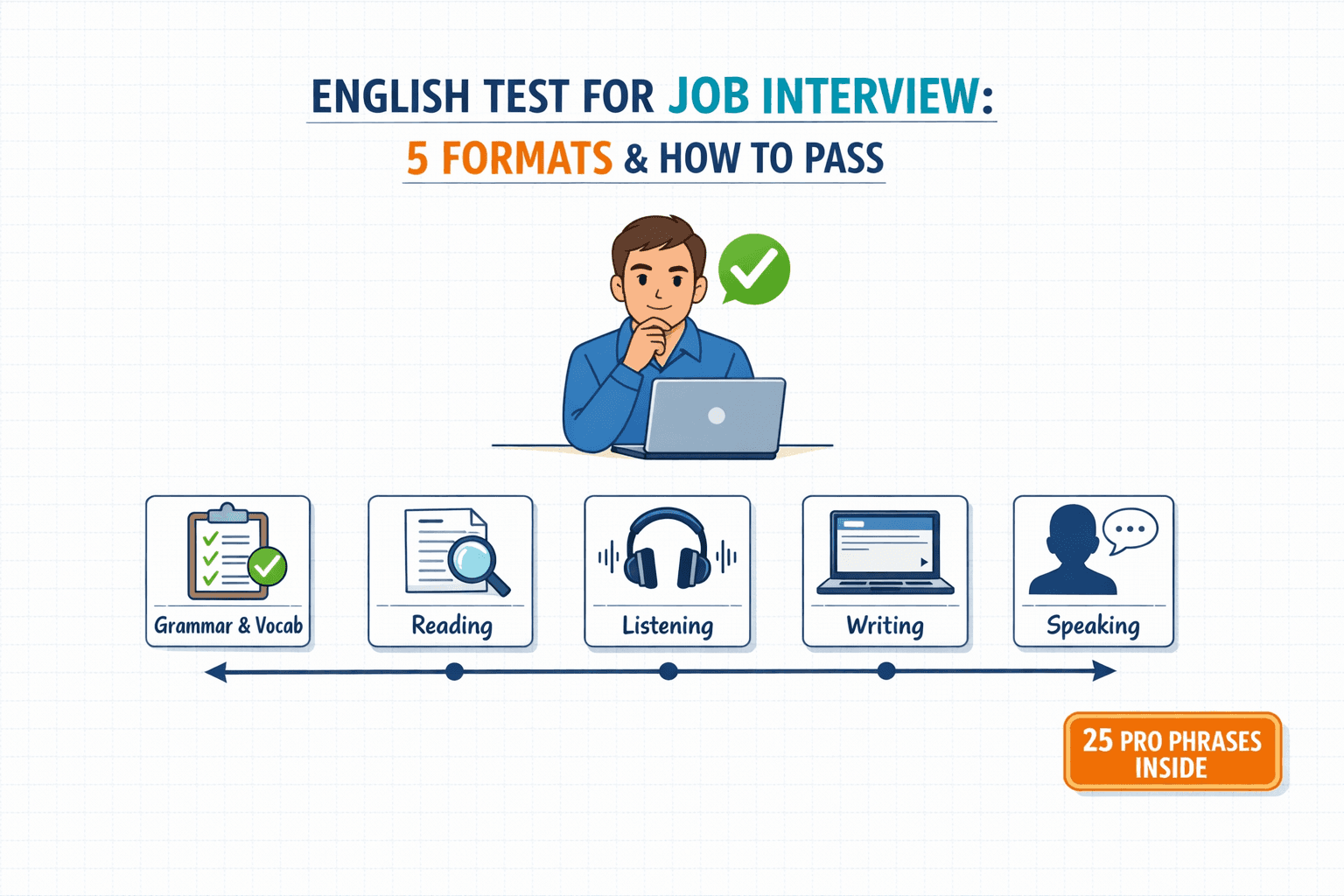
You've made it past the résumé screen. The hiring manager likes your experience. Then the recruiter's email arrives: "Before the next round, we'll need you to complete a short English assessment." Suddenly, the job isn't about your skills anymore — it's about proving you can communicate in English under pressure, on a timer, with stakes attached.
The problem is that these English proficiency tests for jobs come in wildly different formats, and most candidates prepare for one type while getting blindsided by another. This post breaks down every major format, gives you a prep strategy for each, and hands you 25 professional phrases that show up constantly in workplace English. If you're not sure where your English stands right now, take a quick level test to get a baseline before you start prepping.
Format 1: Multiple-Choice Grammar and Vocabulary
This is the most common English test format for interviews, especially in high-volume hiring. You'll get 30–60 questions, a ticking clock, and four answer choices per item. The questions test grammar accuracy and vocabulary range — particularly professional and semi-formal words.
These tests feel deceptively simple. Two options will be obviously wrong; two will be close — and the difference often comes down to one subtle grammar rule or one shade of meaning.
How to prep
Don't study grammar rules in isolation. Work through B2 use-of-English exercises or C1-level practice tests that force you to choose the right structure within a sentence. Pay special attention to subject-verb agreement with complex subjects, present perfect vs. past simple in professional contexts, and collocations (we say "make a decision," not "do a decision"). Time yourself — most real assessments give you about 60–90 seconds per question.
Format 2: Reading Comprehension
A reading comprehension test for job interview screening typically presents a business-related passage — an internal memo, a market report extract, a policy document — and asks questions about it. This is one of the most common English tests for hiring in corporate environments. You might need to identify the main argument, infer the writer's intention, or decide whether statements are true, false, or not mentioned.
The key skill here isn't understanding English in general. It's answering questions about what the text says, not what you think or already know. The answer is always in the passage.
How to prep
Read business content in English regularly — The Economist, Harvard Business Review, even well-written company blogs. Then practice answering comprehension questions under timed conditions. For structured practice, work through business reading comprehension tests and focus on the questions you got wrong. Was it a vocabulary gap, or did you misread the question itself?
Format 3: Listening Exercises
Some assessments include an audio component: a short workplace conversation, a voicemail, or a presentation excerpt, followed by comprehension questions. The audio usually plays once.
This format trips people up because spoken professional English sounds different from written English. Speakers contract words, talk over each other, and sometimes mumble the most important detail. If you've mostly practiced English through reading, you may understand every word on paper but miss it at natural speaking speed.
How to prep
Listen to business podcasts, earnings calls, or interview-format shows daily. Don't just listen passively — after a segment, pause and ask yourself: What was the main point? What specific details were mentioned? For test-format practice, work through advanced listening comprehension exercises that require answering questions after a single play.
Format 4: Written Response or Email Simulation
Instead of choosing from options, you produce English. A typical prompt: "Write an email to a client explaining a project delay" or "Summarize this report in 100 words." Some tests simulate an inbox where you respond to several messages in sequence.
They're evaluating clarity, tone, and structure — not creative writing. Can you get to the point quickly? Do you sound professional without being stiff? Do you make grammar errors that change meaning?
How to prep
Practice writing professional emails daily for two weeks before your test. Give yourself prompts: apologize for a delay, request a meeting, follow up on unanswered mail, politely disagree with a proposal. Set a ten-minute timer per email. Then review: Would a native-speaking manager find this clear? Is it too long? Did you bury the key information?
If grammar under pressure is your weak spot, drill the structures that matter most in business writing: conditional sentences ("If we proceed with this option, we would need…"), passive constructions for diplomacy ("The deadline was missed" rather than "You missed the deadline"), and connectors that show logical flow (however, as a result, in addition).
Format 5: Live Speaking Assessment
Some companies assess your English through the interview itself. Others add a dedicated 15-minute speaking component where an assessor rates fluency, pronunciation, vocabulary range, and your ability to structure a coherent answer.
They're not expecting a BBC accent. But "fluent" doesn't just mean "fast." They're listening for whether you can express complex ideas without falling apart mid-sentence, self-correct when you make a mistake, and handle unexpected follow-up questions without long silences.
How to prep
Record yourself answering common interview questions in English, then listen back. You'll notice things you'd never catch in real time — filler words you overuse, sentences that trail off, moments where you downgraded your vocabulary because the right word wouldn't come fast enough.
Practice the STAR method (Situation, Task, Action, Result) in English for behavioral questions. Having a structure to lean on gives you thinking time and keeps your answers from wandering. Don't memorize scripts — interviewers can tell. Memorize key phrases and transitions, then improvise around them.
25 Phrases That Signal Professional English
These show up constantly in workplace communication. They're useful for written tests, email simulations, and speaking assessments alike. Don't just read them — practice using them in sentences.
| Situation | Phrase | When to use it |
|---|---|---|
| Structuring your points | I'd like to highlight… | Drawing attention to something important without being blunt |
| To give you some context… | Providing background before making a point | |
| Building on that… | Connecting your idea to something already said | |
| From my perspective… | Offering your view diplomatically | |
| If I understand correctly… | Confirming what someone said before you respond | |
| Agreeing & disagreeing | That's a fair point, and I'd add that… | Agreeing while expanding the idea |
| I see where you're coming from, but… | Disagreeing without being confrontational | |
| I'd suggest a slightly different approach. | Redirecting politely | |
| We're aligned on the goal; it's the method I'd reconsider. | Nuanced pushback | |
| I think we're on the same page regarding… | Finding common ground | |
| Emails & written tasks | Please find attached… | Standard opener for document emails |
| I wanted to follow up on… | Nudging without nagging | |
| Could you clarify… | Asking questions without implying someone was unclear | |
| I'd appreciate your input on… | Requesting feedback politely | |
| Please don't hesitate to reach out. | A solid professional closer | |
| Interviews & speaking | In my previous role, I was responsible for… | Clean way to start a STAR answer |
| One challenge we faced was… | Setting up a problem-solving narrative | |
| The outcome was… | Landing your result clearly | |
| That experience taught me… | Showing reflection (interviewers love this) | |
| I'm particularly drawn to this role because… | Answering "Why this job?" with specificity | |
| Hedging & diplomacy | It might be worth considering… | Making a suggestion without pushing |
| I'd need to look into that further. | Buying time honestly instead of guessing | |
| That's not my area of expertise, but… | Being honest about limits while still contributing | |
| Based on the data available… | Qualifying a claim professionally | |
| To the best of my knowledge… | Hedging when mostly sure but not certain |
Test Day: What Actually Helps
- Switch your inner monologue to English that morning. Think in English while you're getting ready. It primes your brain. If you've been thinking in your native language all morning and suddenly need to produce English under pressure, there's a noticeable lag.
- For timed tests, don't get stuck. If a question is taking too long, mark it and move on. Coming back with fresh eyes often makes the answer obvious.
- For writing tasks, plan before you type. Spend 60 seconds outlining — even just three bullet points. Candidates who start typing immediately tend to ramble and lose structure halfway through.
- For speaking tests, pauses are fine. A two-second pause sounds natural. If you need more time, use a bridge phrase: "That's an interesting question — let me think about that for a moment."
What If You Don't Pass?
It happens. And it's not the end of the process — or your career.
Most companies allow retakes after a waiting period, typically 30 to 90 days. Some will let you retest sooner if you ask politely and explain what you've done to improve. Many candidates assume a failed test means automatic rejection, but hiring processes have more flexibility than people realize, especially if the rest of your profile is strong.
If you don't pass, request specific feedback. Not all companies provide it, but some will tell you which section you scored lowest on — and that tells you exactly where to focus.
How to use the waiting period
A low grammar score is a different problem than a low listening score, and they need different fixes. If reading was the weak link, spend 20 minutes a day on timed comprehension practice. If grammar tripped you up, do focused drills on the specific structures you missed. Targeted practice over four weeks beats vague "study more English" every time. If your score suggests you need to move up a full CEFR level, the B2 to C1 in 60 days plan gives you a structured roadmap for exactly that.
Your Next Step
Pick the format you're most likely to face — or the one that worries you most — and do one timed practice session today. Not tomorrow. Even 15 minutes under realistic conditions will teach you more about your readiness than an hour of reading advice. Start with a grammar assessment or a vocabulary level check, see exactly where the gaps are, and work from there.