
How to Improve English Listening Comprehension
Published on April 10, 2026 • 8 mins read
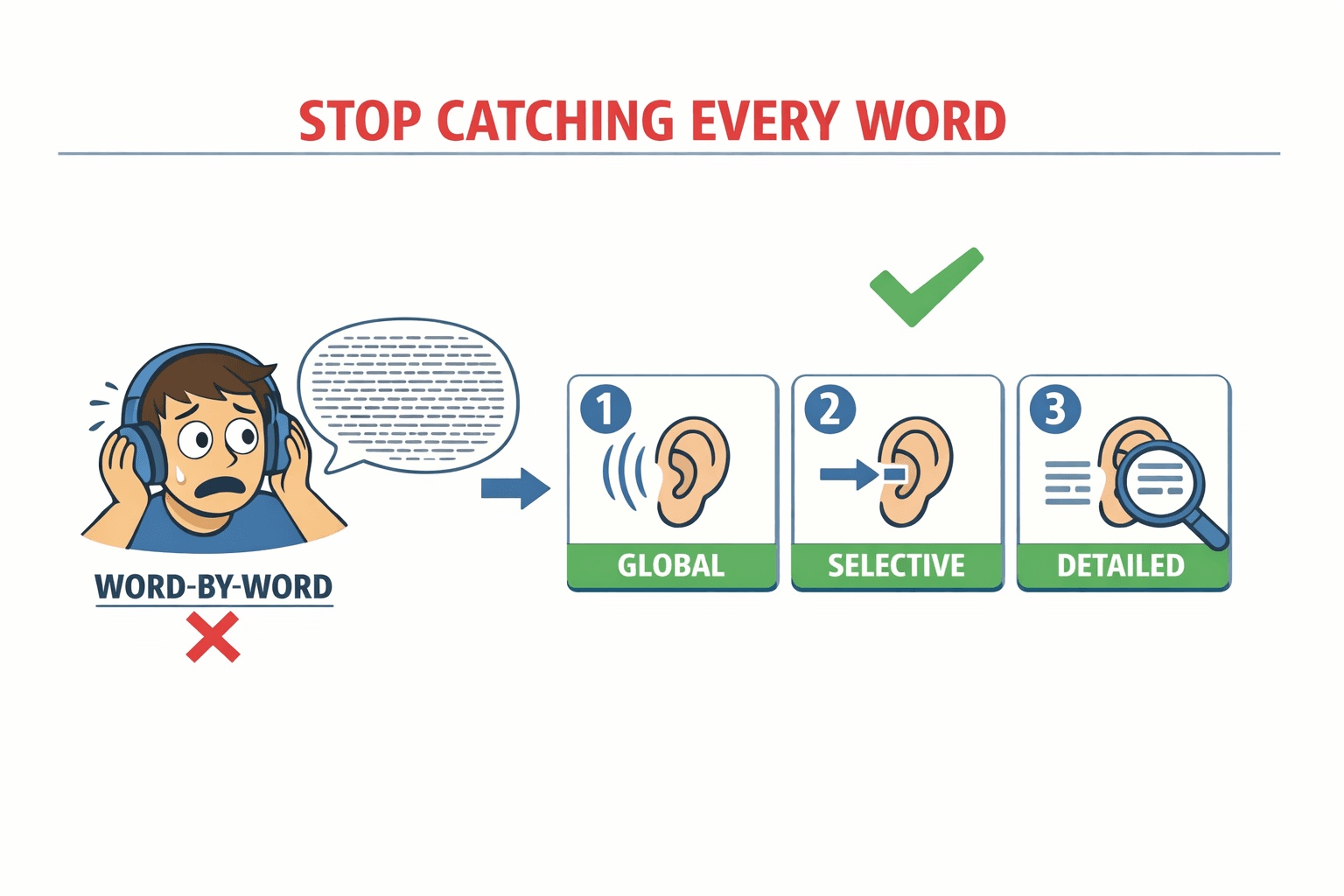
Trying to understand every word in English is the wrong goal. That's not a motivational quote — it's how listening actually works. Native speakers miss words constantly. They mishear things, zone out, tune back in. And yet they follow conversations just fine, because they're not decoding individual sounds. They're catching meaning from context, stress patterns, and rhythm.
If you've ever paused and rewound the same ten seconds of a YouTube video five times, you know what the opposite approach feels like. Exhausting. Demoralising. And ultimately ineffective, because by the time you've decoded one sentence, the speaker is three ahead.
The fix isn't "listen more." It's listen differently. This post breaks down three distinct listening modes — global, selective, and detailed — explains when each one matters, and maps out a 30-day plan to train all three. The framework works whether you're at B1 or pushing into C1, and everything here is built around practice you can start today.
Why "understand everything" is the wrong target
Think about how you listen in your native language. Someone tells you a story at a party, and you catch maybe 80% of the words. There's background noise, they mumble, they use slang you've never heard. But you still understand the story perfectly — because you're listening for meaning, not performing a transcription.
English listening works the same way. Research in second-language acquisition — work by listening scholars like John Field and Michael Rost, among others — suggests that learners who fixate on individual words experience higher cognitive load and, paradoxically, worse comprehension. Their working memory gets overwhelmed trying to decode sounds, leaving nothing left for actually processing what those sounds mean together.
The alternative? Train yourself to listen in layers. That's where the three listening modes come in.
The three listening modes (and when to use each one)
Not all listening tasks require the same depth of attention. A weather forecast, a university lecture, and a casual chat with a friend each demand a different strategy. The problem is that most learners apply the same panicked "catch everything" approach to all three. Instead, think of listening as having three gears.
1. Global listening — what's the big picture?
Global listening means tuning in for the overall topic, the speaker's attitude, and the general direction of what's being said. You're not worrying about specific details. You're asking: What is this about? Is the speaker happy, frustrated, persuading, explaining?
This is the mode you'd use when overhearing a conversation, listening to a podcast for pleasure, or watching the news to get the headline story. You're skimming with your ears. To train it, play an audio clip once — just once — and write down in one or two sentences what it was about. Don't replay it. Don't look at a transcript. The point is to build your tolerance for incomplete understanding and train your brain to extract the gist.
2. Selective listening — fishing for specifics
Think of listening to airport announcements. You don't care about most of them — you're waiting for your flight number and gate. That's selective listening: you already know what information you need, and everything else is background.
This skill is especially critical for exam settings — IELTS, Cambridge, TOEFL — where you're given questions before the audio plays. But it's just as useful in everyday life. Listening to a voicemail for a callback number, catching a meeting time from a rambling colleague, picking out the one relevant detail from a long explanation. Before pressing play on any practice material, give yourself a specific question: What time does the meeting start? What reason does the speaker give for the delay? Then listen with that question as your filter and let everything else wash past.
3. Detailed listening — the three-pass method
Detailed listening is the closest to what most learners think they should be doing all the time. You're paying attention to exact wording, specific phrases, tone shifts, and precise information. This is the mode for studying a lecture, following complex instructions, or preparing a summary.
The key insight: you should only use detailed listening after you've already used global listening to get oriented. If you jump straight into detailed mode on unfamiliar audio, you'll drown. Here's the sequence that works. First listen: just get the gist — don't pause, don't stress, just absorb the shape of what's being said. Second listen: pause after each section and check your understanding against specific questions. Third listen: follow along with a transcript and note any words or phrases you missed. This three-pass approach is dramatically more effective than replaying the same clip fifteen times in a panic, because each pass has a clear purpose.
The real reasons listening feels so hard
Before we get into the 30-day plan, it helps to name the specific obstacles. "Listening is hard" isn't actionable. But these are.
1. Connected speech. This is probably the single biggest surprise for learners who've mostly studied from textbooks. In written English, you see "Do you want to go?" In real speech, you hear something closer to "D'ya wanna go?" That's not sloppy talking — that's normal connected speech, and it follows predictable patterns.
A few of the most common ones: function words like "him," "her," "them," and "can" get reduced to near-silence in natural speech — "I told him" sounds like "I told 'im," and "she can swim" sounds like "she c'n swim." Sounds blur across word boundaries through linking — "turn off" becomes "tur-noff," "go on" becomes "go-won." And some sounds disappear entirely through elision — "next day" loses its "t" and becomes "nexday," "handbag" becomes "hanbag." Once you know these patterns exist, you start hearing them everywhere, and audio that sounded like gibberish starts resolving into recognisable words.
2. Speed and no rewind button. Reading lets you go at your own pace. Listening doesn't. The audio moves forward whether you're ready or not, and in real conversations, you can't hit pause. This creates anxiety, and anxiety itself makes comprehension worse — your brain starts allocating resources to stress instead of processing.
3. Vocabulary gaps that compound. If you miss one key word in a sentence, you sometimes lose the thread for the next three sentences while your brain is still trying to figure out what that word was. Imagine hearing: "The landlord said the [unknown word] was included in the rent." Was it heating? Parking? Internet? While you're puzzling over that gap, the speaker has moved on to talking about the deposit, and now you've lost two pieces of information instead of one. This cascading effect is the single biggest reason learners feel "lost" during longer listening passages.
4. Accent variation. You might understand your teacher perfectly but struggle with a Scottish podcast host or an Australian news anchor. Every new accent feels like starting over, and it can be demoralising. But the fix isn't to avoid different accents — it's to expose yourself to them deliberately, starting with ones closer to what you're used to and gradually branching out.
Your 30-day listening plan
This plan is built around three phases that match the three listening modes. The day counts below are guidelines, not rigid rules — if you need twelve days on global listening instead of ten, take twelve. The point is the progression, not the calendar. And if you can only manage 10 or 15 minutes some days instead of the ideal 20–30, that still counts. Short, focused sessions beat long, distracted ones every time.
Days 1–10: Build your foundation (global listening)
The goal here is simple: get comfortable not understanding everything. That probably sounds counterintuitive, but it's the most important skill you'll develop.
Start each session with a short listening exercise at or slightly below your level — something with clear, moderately-paced speech on an everyday topic. The beginner listening exercises on this site work well for this, or you can use any graded listening material you have access to. Listen once without pausing, then answer whatever comprehension questions are available based purely on what you caught on that single listen. Don't worry about your score — you're training a habit, not taking a test.
After the exercise, spend 10 minutes listening to something you genuinely enjoy in English — a podcast, a YouTube channel, a TV show. No subtitles, no transcript. Just listen. When your mind wanders or you lose the thread, that's fine. Gently bring your attention back and keep going.
By the end of this phase, you should notice that the urge to pause and rewind has weakened. You're building what linguists call "listening stamina" — the ability to keep processing even when comprehension isn't perfect. If you're not sure what level to start at, try a quick listening level test before Day 1.
Days 11–20: Sharpen your focus (selective listening)
Now you're going to add a purpose to every listening session. Before pressing play on anything, write down one to three specific questions you want answered.
For structured practice, use material that presents real-world scenarios — workplace conversations, announcements, discussions — where you need to pick out specific information. The intermediate listening exercises are designed around exactly this, but any material with comprehension questions will work. Read the questions first, then listen with those questions as filters.
After the exercise, apply the same technique to your "fun" listening material. If you're listening to a podcast, set yourself a question before each segment: What's the host's main argument? What example do they use? Then listen specifically for those answers.
This phase often feels harder than the first one, which might seem strange. That's because you're now asking your brain to do two things at once — process the incoming audio and hold a question in working memory. It's a workout, and like any workout, it gets easier with repetition.
Days 21–30: Go deep (detailed listening)
The final phase is where everything comes together. You'll use the three-pass method on increasingly challenging material.
Choose something at or slightly above your current level — a news report, a short lecture, an interview. The advanced listening exercises work well here if you're at B2 or above. On your first listen, just get the gist. On your second, focus on specific questions. On your third, follow along with a transcript and identify exactly where you lost the thread.
Keep a small notebook or a notes app where you log recurring problems. Maybe you consistently miss reduced vowel sounds. Maybe you lose focus after 90 seconds. Maybe certain accents throw you off. These patterns are gold — they tell you exactly what to target next.
For your "fun" listening in this phase, try material slightly above your comfort zone. A news segment that's a bit fast, a conversation with some unfamiliar slang, a lecture on a topic you know nothing about. The three-pass method means you won't drown — you'll just stretch.
What to do after the 30 days
The plan doesn't end on Day 30. What changes is that by then, you'll have internalised the three listening modes and you'll naturally shift between them depending on the situation. That's the real skill — not understanding every word, but knowing which kind of listening a moment requires.
From here, a few concrete next steps. First, revisit your notebook of recurring problems and turn each one into a focused mini-project — if weak forms tripped you up most, spend a week doing dictation exercises specifically targeting reduced speech. Second, if you're preparing for an exam, pair your listening practice tests with reading comprehension at your level, because the two skills reinforce each other more than most people realise; both depend on predicting what comes next from context. Third, take a general English level test to see where listening sits relative to your other skills — you might discover that grammar or vocabulary is the actual bottleneck holding your comprehension back, which changes where you should invest your study time.
If you take nothing else from this post, take this: the goal of listening practice isn't perfection. It's flexibility. A good listener isn't someone who catches every syllable — it's someone who knows when to zoom out for the big picture, when to zero in on a detail, and when to let the unclear parts go without panicking.
So here's your homework, right now, before you close this tab: find something in English — a podcast, a news clip, a YouTube video — and listen to it for five minutes straight without pausing. Don't translate. Don't rewind. Just ride the wave and see how much meaning you catch. That's where fluency starts.