
Gerunds vs Infinitives: Why English Learners Keep Getting It Wrong
Published on April 3, 2026 • 5 mins read
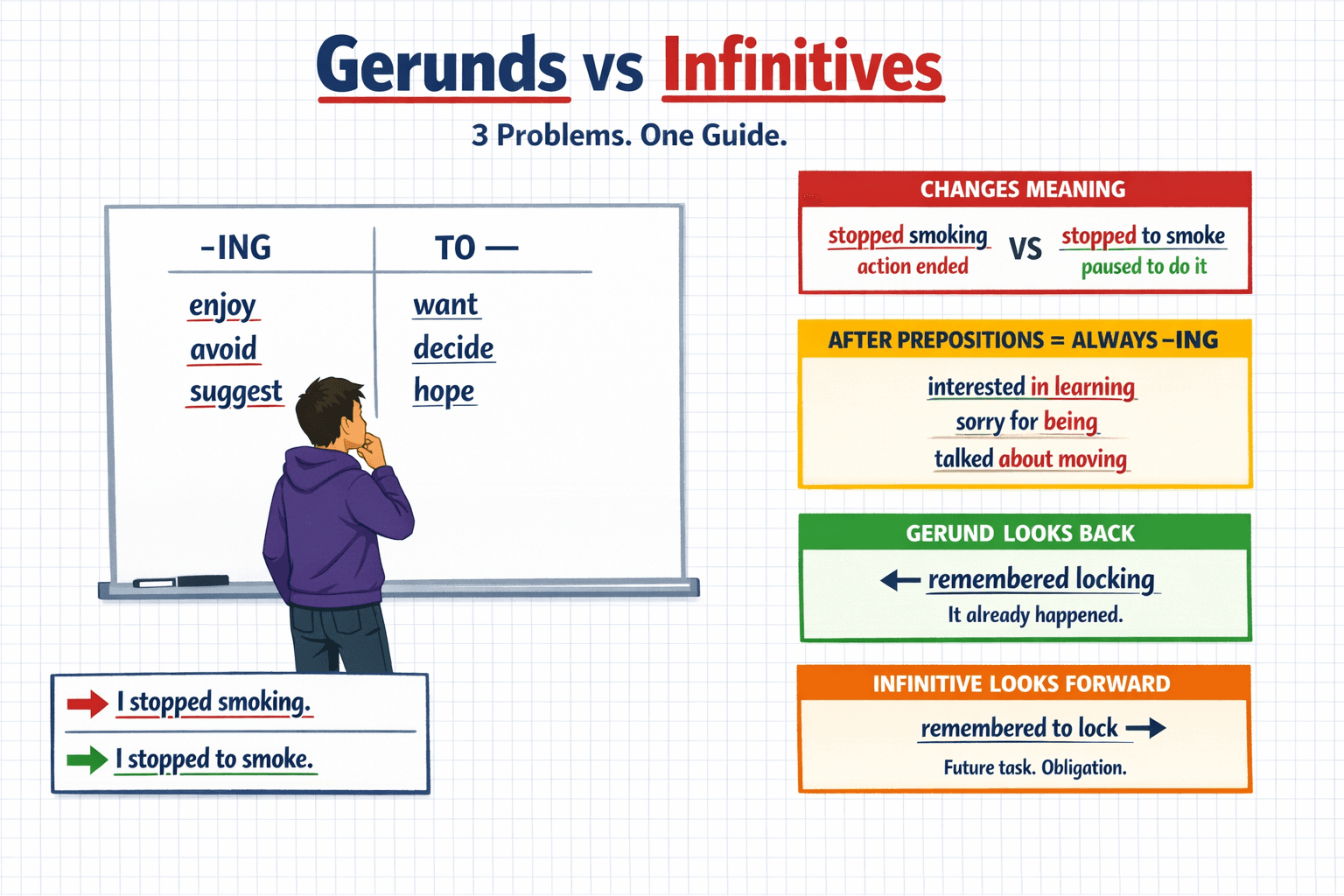
Most learners have memorized the verb lists. Enjoy, avoid, consider take a gerund. Want, decide, hope take an infinitive. They learned this at B1, they know it at B2, and they're still making errors at C1. Which means the lists aren't the problem — or at least, not the whole problem.
The thing the lists don't teach you is that gerunds and infinitives aren't random. There's a logic to most of them, and once you see it, a large category of errors stops being a memory problem and becomes a comprehension problem — which is a much easier thing to fix.
Here it is: gerunds tend to look backward; infinitives tend to look forward.
A gerund (-ing form used as a noun) usually refers to an action that is real, ongoing, or already happened. An infinitive (to + verb) usually refers to an action that is intended, potential, or yet to occur. That's not a universal rule — nothing in English grammar is universal — but it holds across enough cases to be genuinely useful, and it's the key to understanding why the same verb can mean two completely different things depending on which form follows it.
The verbs where form changes meaning
This is where the backward/forward model does its most useful work.
Stop
I stopped smoking . (The action is over — you used to smoke, now you don't)
I stopped to smoke . ( You interrupted something else in order to smoke — it's about to happen )
The gerund looks back at a habit that existed. The infinitive points forward to an action being planned. Both sentences are grammatically correct; they just describe opposite situations.
Remember and forget
She remembered locking the door. ( She locked it — that's a real past event she has memory of )
She remembered to lock the door. ( She had a task ahead of her and didn't forget it )
He forgot meeting her. ( The meeting happened; he just has no memory of it )
He forgot to meet her. ( He was supposed to meet her and didn't show up )
The gerund reaches back to something that already occurred. The infinitive looks ahead to something that was supposed to occur. Get that distinction clear and these pairs become almost impossible to confuse.
Try
Try is worth slowing down on because it gets rushed in most explanations.
Try adding more salt. ( Experiment — you're suggesting someone test whether it improves things )
Try to add less salt next time. ( Make an effort — the implication is it might be difficult )
Try + gerund is a low-stakes experiment: you do the thing and see what happens. Try + infinitive describes an attempt at something that requires effort or may not succeed. The difference is between a suggestion ("give this a go") and a challenge ("do your best at this"). In practice: if you're telling someone to experiment, use the gerund. If you're describing striving toward a difficult goal, use the infinitive.
Like, love, prefer, hate
These are the trickiest, partly because the difference is subtle and partly because it shifts between British and American English.
In British English, the gerund describes a general preference — something you enjoy as an activity:
I like swimming . ( I enjoy it — it's pleasant )
The infinitive describes a habit or deliberate choice, often with a slightly more considered or formal tone:
I like to swim before breakfast. ( I make a point of it — it's a chosen routine )
The gerund is about enjoyment; the infinitive is about intention. In American English this distinction has largely collapsed and the gerund handles both, so if your learners are preparing for British English exams — Cambridge qualifications in particular — the distinction is worth knowing. If not, the gerund is safe in almost every context.
All of these meaning-change pairs appear in the B2 grammar exercises, where they're tested in context rather than in isolation — which is the only way the differences actually stick.
The verb lists: what to actually memorize
The backward/forward model doesn't cover everything. There's a category of verbs — enjoy, avoid, consider, suggest, keep, risk, deny, admit — that just take a gerund, with no corresponding infinitive form and no meaning shift. Similarly, want, decide, hope, manage, refuse, afford, seem just take infinitives.
For these, there's no underlying logic to learn. They're arbitrary, and the honest advice is to build exposure rather than fight for explanations that don't exist.
What does help is knowing which verbs at each level catch people out. At B1, the core list (enjoy doing, want to do) is usually solid, but mid-frequency verbs like consider, manage, afford, and suggest are where errors cluster — precisely because they're common enough to appear in tests but not common enough to have been heard hundreds of times. The B1 gerunds and infinitives exercises are built around these mid-frequency verbs for exactly that reason.
One rule that covers a disproportionate amount of ground: after any preposition, always use a gerund. Always.
She's interested in learning Spanish. He apologized for being late. They talked about moving abroad. I'm tired of waiting .
There are no exceptions to this. Once it's automatic, a large chunk of errors disappear immediately — including the common mistake of reaching for a that-clause instead: interested in that she learns doesn't exist in English; interested in learning does.
A quick note on verbs that genuinely take both
Begin, start, continue, bother, and intend can take either form with no meaningful difference. It started raining and it started to rain mean the same thing. The only small preference: when these verbs are themselves in continuous form, the infinitive sounds more natural — it was beginning to rain flows better than it was beginning raining. That's a rhythm observation, not a rule to memorize. Exposure sorts it out.
Where this leaves learners at each level
At B1, the priority is the preposition rule and the mid-frequency verb list. Those two things cover the majority of errors at that level. The B1 grammar section has the practice volume needed to make the core combinations automatic.
At B2, the verb lists are mostly secure and the meaning-change pairs are the remaining gap — particularly stop, remember, and forget in writing, where there's time to second-guess. If you can articulate the backward/forward logic for each pair, you're past the most common error zone. The B2 grammar section covers these alongside the more complex structures that start appearing at this level.
At C1, the basic patterns are automatic but advanced forms cause new errors: verb + object + infinitive (She wanted him to stay), perfect gerunds (He denied having taken it), and passive infinitives (The report needs to be revised). These aren't extensions of the beginner problem — they're structurally distinct, and they're covered separately in the C1 gerunds and infinitives section.
The thing most guides don't say
Gerunds and infinitives feel arbitrary because learners encounter them as a vocabulary problem — a property of individual verbs to be recorded in a notebook. Enjoy = gerund. Want = infinitive. End of entry.
But form encodes meaning. Gerunds package an action as a thing — something complete, real, noun-like. Infinitives keep an action open — something directed, potential, not yet realized. That's why I stopped smoking sounds final and I stopped to smoke sounds purposeful. That's why I remembered locking the door is a memory and I remembered to lock the door is a responsibility. The grammar isn't decoration around the meaning. It is the meaning.
Once you start reading that way — paying attention to what the form is doing, not just which form a verb happens to take — these choices stop feeling like traps and start feeling like tools.
The infinitives and gerunds hub has exercises at every level if you want to test whether that's clicked yet.