
Present Perfect vs Past Simple: The Complete Guide with 50 Real-Life Examples
Published on March 30, 2026 • 10 mins read
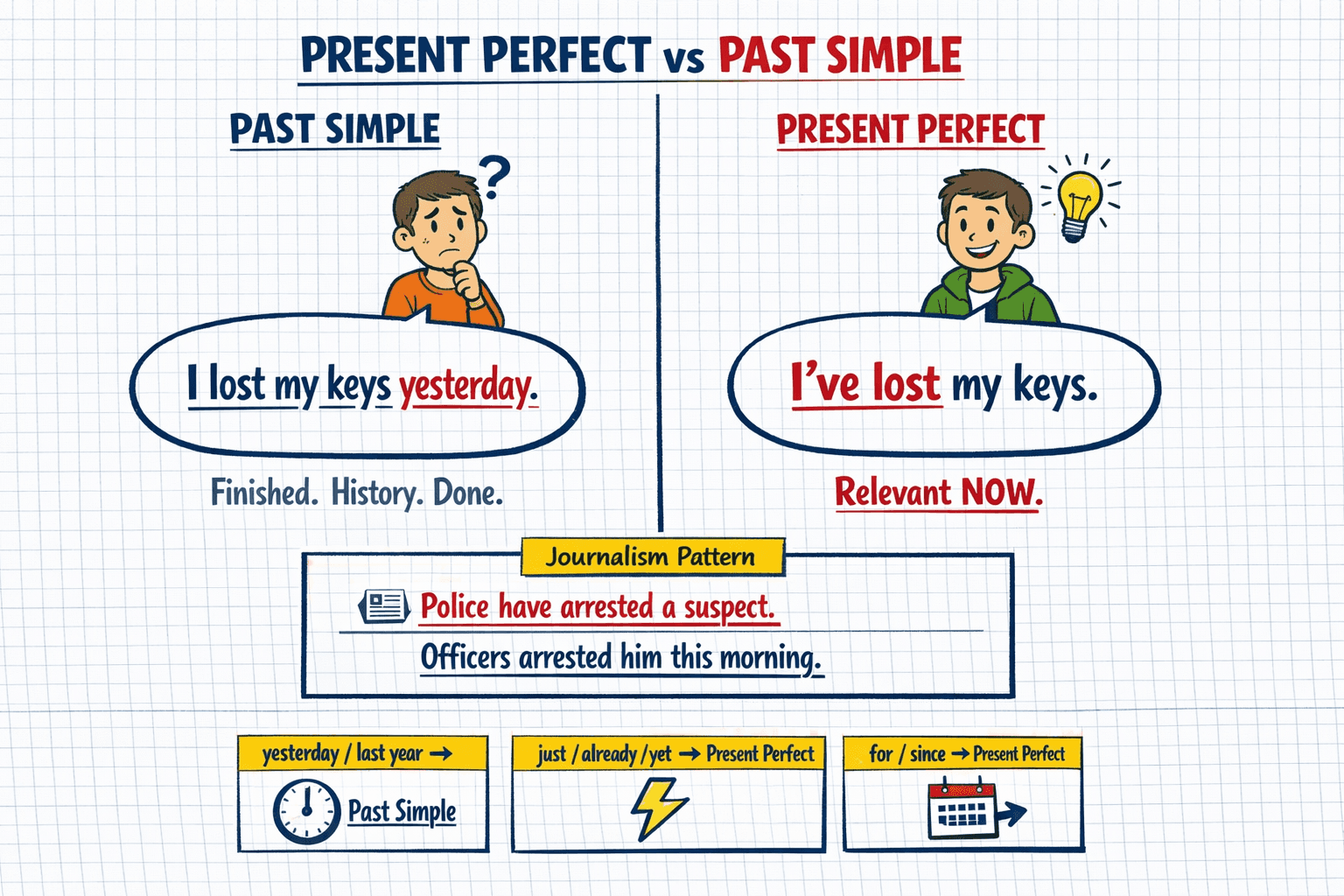
Here's the sentence that breaks most learners: I've lost my keys.
Read it again. Notice what it doesn't tell you: when you lost them, where you were, how long you've been looking. None of that. What it does tell you — the only thing it tells you — is that right now, in this moment, you don't have your keys and that matters.
Swap the tense: I lost my keys yesterday. Now the focus has shifted. The losing happened at a specific point in the past. It's over. Maybe you found them since, maybe you didn't — the sentence doesn't say. It's just reporting what happened.
That difference — relevance to the present moment versus a completed event in finished time — is the entire engine of this grammar point. Everything else is detail.
The One Rule That Explains Everything
The present perfect connects the past to now. Use it when the result, consequence, or relevance of something past still exists at the moment of speaking.
The past simple reports a finished action in finished time. Use it when the event is complete and you're treating it as history — something that happened, full stop.
This is why time expressions are such a reliable signal. Yesterday, last week, in 2019, three hours ago, when I was a student — these place the action in a specific, closed slice of time: past simple. Already, yet, just, ever, never, recently, so far, since, for — these point toward the relationship between past action and present moment: present perfect.
The Practical Test
Before the hard cases, here's a two-question diagnostic you can apply to any sentence you're unsure about.
Question 1: Is there a specific finished time in this sentence — stated or implied?
Yesterday, last year, in 2015, when I was a child, three hours ago — if any of these are present or naturally implied, use past simple. The action belongs to a closed period.
Question 2: Am I communicating something that affects the current situation?
Is the event connected to right now? Does it change what's true at this moment? Is it relevant to this conversation? If yes, use present perfect.
Keep these two questions in mind as you work through the cases below. Most apparent exceptions resolve cleanly once you apply them.
How Native Speakers Actually Choose
Native speakers aren't consciously selecting between tenses — they're choosing between two different ways of framing an event. The tense signals the framing, not the event itself.
When someone says did you eat?, they usually mean: is eating a finished event for you right now? When they say have you eaten?, they mean: at this present moment, is eating something you've done? Both questions refer to the same action; the framing is completely different.
This is why the same event can take either tense depending on context:
- The prime minister resigned. → News report framing the event as historical fact.
- The prime minister has resigned. → Breaking news — this just happened, it's relevant now, the political situation has changed.
Both are correct. The choice depends entirely on whether the speaker is treating the event as past history or as present news.
The Journalism Pattern: Present Perfect for Headlines, Past Simple for Details
This is one of the most practically useful patterns in English, and most learners have never had it explicitly named.
In news writing and broadcasting, the convention is consistent: the present perfect announces the story because the event is current and relevant; the past simple fills in what happened because the specific details belong to finished time.
Watch how this works across different topics:
The government has announced a new climate policy. Ministers met yesterday to finalize the details.
A scientist has discovered a new species of deep-sea fish. The team found the specimen off the coast of New Zealand last month.
Apple has released its latest operating system. The company launched it at an event in California on Tuesday.
The prime minister has resigned. She submitted her resignation to the palace this morning.
The committee has reached a verdict. Jurors deliberated for eleven hours before returning their decision.
The first sentence in each pair is the news — present and relevant. The second sentence is the backstory — events with specific past time. Once you start noticing this pattern in real journalism, you'll see it everywhere. It also gives you a reliable template for your own formal writing.
The Cases That Trip People Up
Just, already, and yet
These three are present perfect territory in standard British English, though American English increasingly allows past simple with already and just in informal speech.
- I've just spoken to her. → Moments ago; the conversation just happened and is relevant now.
- He's already finished the report. → Sooner than expected, and the completion matters now.
- Have you eaten yet? → Up to this present moment; I'm asking about now.
- I haven't booked the tickets yet. → The absence of action is still relevant to what needs to happen.
Ever and never
These work with the present perfect when asking about life experience up to now:
- Have you ever been to Japan? → In your entire life up to this moment.
- I've never tried sushi. → Not at any point in my life so far.
Ever can appear in the past simple when the time period is explicitly finished: Did you ever visit her when you lived in Paris? — the Paris period is closed, so past simple is natural.
For and since
Both connect to the present perfect when describing duration up to the present. For gives the length; since gives the starting point.
- She has worked here for six years. → She still works here.
- She has worked here since 2018. → Same meaning, different anchor point.
- She worked there for six years. → Past simple. She no longer works there; the period is closed.
The tense shifts the meaning fundamentally. I've lived in Berlin for three years means you live there now. I lived in Berlin for three years means you don't anymore. Our for vs since grammar practice goes deeper on this if duration is where you consistently get it wrong.
Unfinished vs finished time periods
Today, this week, this year, this morning can take either tense depending on whether that period is still open:
- I've had three coffees this morning. → It's still morning. Open period: present perfect.
- I had three coffees this morning. → It's now afternoon. Closed period: past simple.
- We've sold forty units this week. → The week isn't over yet.
- We sold forty units this week. → The week has ended; you're reporting on a closed period.
Experiences vs specific occasions
- I've met her before. → At some point in my experience, I've had this encounter.
- I met her at a conference in 2022. → One specific occasion, named time: past simple.
- Have you read this book? → In your reading experience, does this book appear?
- Did you read the book I lent you? → Specific book, specific implied timeframe.
The Present Perfect Continuous
When the action itself — not just its result — is what connects to the present moment, the continuous form steps in.
The distinction is real but subtle: the present perfect simple tends to focus on the completed fact or the result; the present perfect continuous focuses on the activity as an ongoing or very recent process.
Compare these pairs:
- I've read three chapters. → The result: three chapters are now behind me.
- I've been reading all afternoon. → The activity: I've been immersed in it; I can feel it.
- She's worked on this all day. → Fact: the work has happened, the day's effort is done.
- She's been working on this all day. → Process: she's still at it, or she's just stopped, and the sustained effort is what I want to convey.
The continuous form is also the natural choice when explaining a visible present state — when the evidence is in front of you and you want to point to the cause:
- Your eyes are red — have you been crying? → The evidence is there; I'm asking about the activity that produced it.
- Why are your hands dirty? — I've been fixing the car. → The activity explains the current state.
- He's exhausted. He's been travelling since Tuesday. → The ongoing travel explains how he looks right now.
Duration is often emphasized with the continuous in a way the simple doesn't quite match:
- I've been waiting for forty minutes. → I'm still here, and I want you to feel that forty minutes.
- I've waited for forty minutes. → Also correct, but more neutral — a statement of fact rather than an experience.
The continuous can also imply that something is temporary or incomplete, where the simple implies a settled, biographical fact. This distinction trips up advanced learners more than any other aspect of the continuous — and it's one of the subtler ways native speakers signal how they relate to their own experience.
- I've been living in Madrid. → For now; temporary; subject to change.
- I've lived in Madrid. → It's part of my biography; a completed chapter.
- I've been working as a consultant. → Currently; this is what I'm doing at the moment.
- I've worked as a consultant. → At some point in my career; it's part of my history.
- She's been seeing a therapist. → Ongoing, current, possibly still happening.
- She's seen a therapist. → She has this experience; it's biographical fact.
The continuous keeps the door open. The simple closes it.
Fifty Examples by Pattern
Relevance to the present moment vs finished event (1–10)
- Have you finished the report? / Did you finish the report before you left?
- The flight has been cancelled. / The flight was cancelled last Tuesday.
- I've lost my passport. / I lost my passport in Barcelona.
- Something has changed between them. / Something changed at that dinner.
- He's broken his arm. / He broke his arm playing football last Saturday.
- The results have come in. / The results came in late on Friday night.
- Prices have risen sharply. / Prices rose sharply in the third quarter.
- She's left the company. / She left the company in March.
- The situation has improved. / The situation improved after the intervention.
- They've made a decision. / They made their decision after six hours of debate.
Life experience and biography (11–20)
- Have you ever driven a manual car? / Did you drive a manual car when you were learning?
- I've never understood why people like horror films. / I never understood him when I was young.
- She's lived in four different countries. / She lived in France for a year after university.
- We've seen this film twice. / We saw it on opening night in 2021.
- He's never apologised for what he said. / He never apologised, even when pressed.
- I've worked in three different industries. / I worked in finance for the first decade of my career.
- Have you met my sister? / Did you meet her at the conference?
- They've been to Japan twice. / They went in 2018 and again in 2022.
- She's written three novels. / She wrote her first novel while she was still a student.
- I've always found grammar interesting. / I found that chapter particularly useful.
The journalism pattern (21–30)
- The economy has contracted for the third consecutive quarter. / The economy contracted sharply in 2008.
- Researchers have identified a new risk factor for heart disease. / Researchers identified three key factors in the original study.
- The company has filed for bankruptcy. / It filed the paperwork on Thursday.
- The team has won the championship. / They won the final 3–1.
- The museum has acquired a major new work. / It acquired the painting at auction last week.
- Scientists have detected gravitational waves for the first time. / They first detected them using the LIGO observatory.
- The president has signed the bill into law. / He signed it at a ceremony yesterday morning.
- The airline has announced new routes. / It announced the expansion at a press conference on Monday.
- The surgeon has performed the operation successfully. / She operated for nine hours.
- Police have arrested a suspect. / Officers arrested him at his home early this morning.
Just, already, yet (31–37)
These three words almost always trigger present perfect in British English. The contrasts below show how the same event shifts from present relevance to historical report once the time frame closes.
- I've just read your message. / I read it an hour ago and forgot to reply.
- She's already submitted the application. / She submitted it last Thursday, well before the deadline.
- Have you booked the hotel yet? / Did you book the hotel before or after you bought the flights?
- He hasn't responded yet. / He didn't respond to any of the emails we sent that week.
- They've already met — I introduced them at the last event. / They met at a conference in 2023.
- I've just heard the news — is it true? / I heard the news when I got home. Nobody had told me earlier.
- We've already discussed this. / We discussed it at last month's meeting and agreed on a plan.
For and since (38–43)
The key diagnostic: if the situation described is still true now, present perfect. If the period has ended, past simple. For and since with present perfect always point toward an open, ongoing duration.
- They've been married for thirty years. / They were married for thirty years before they divorced.
- I haven't seen her since the wedding. / I didn't see her for months after the argument — we'd fallen out.
- We've worked together since we were students. / We worked at the same company for two years, then both moved on.
- He hasn't spoken to his brother since their father died. / He didn't speak to his brother for months after the argument, but they eventually reconciled.
- The building has been empty since the company moved out. / The building was empty for years before someone finally bought it.
- She's been with the firm for over a decade — longer than almost anyone else there.
Present perfect continuous (44–50)
These examples show the continuous doing its specific jobs: emphasizing ongoing duration, explaining a visible present state, and (in the last two) carrying the temporary-vs-permanent distinction.
- How long have you been learning English?
- I've been trying to reach you all morning.
- They've been arguing about this for weeks.
- She's been applying for jobs since January — she's exhausted.
- It's been raining since Thursday.
- I've been living in Madrid. / I've lived in Madrid. → Open situation vs biographical fact.
- She's been seeing a therapist. / She's seen a therapist. → Ongoing process vs completed experience.
One example worth sitting with beyond the list. I've been thinking about what you said — not I thought about it, which reports a completed mental event. The continuous keeps the thinking alive, present, unresolved. It tells the listener something about the speaker's state right now, not just what they did.
That choice — between treating the past as history and treating it as something still present — is what separates a good English grammar student from a fluent English speaker.