
A1 English Level Guide
Published on April 12, 2026 • 6 mins read
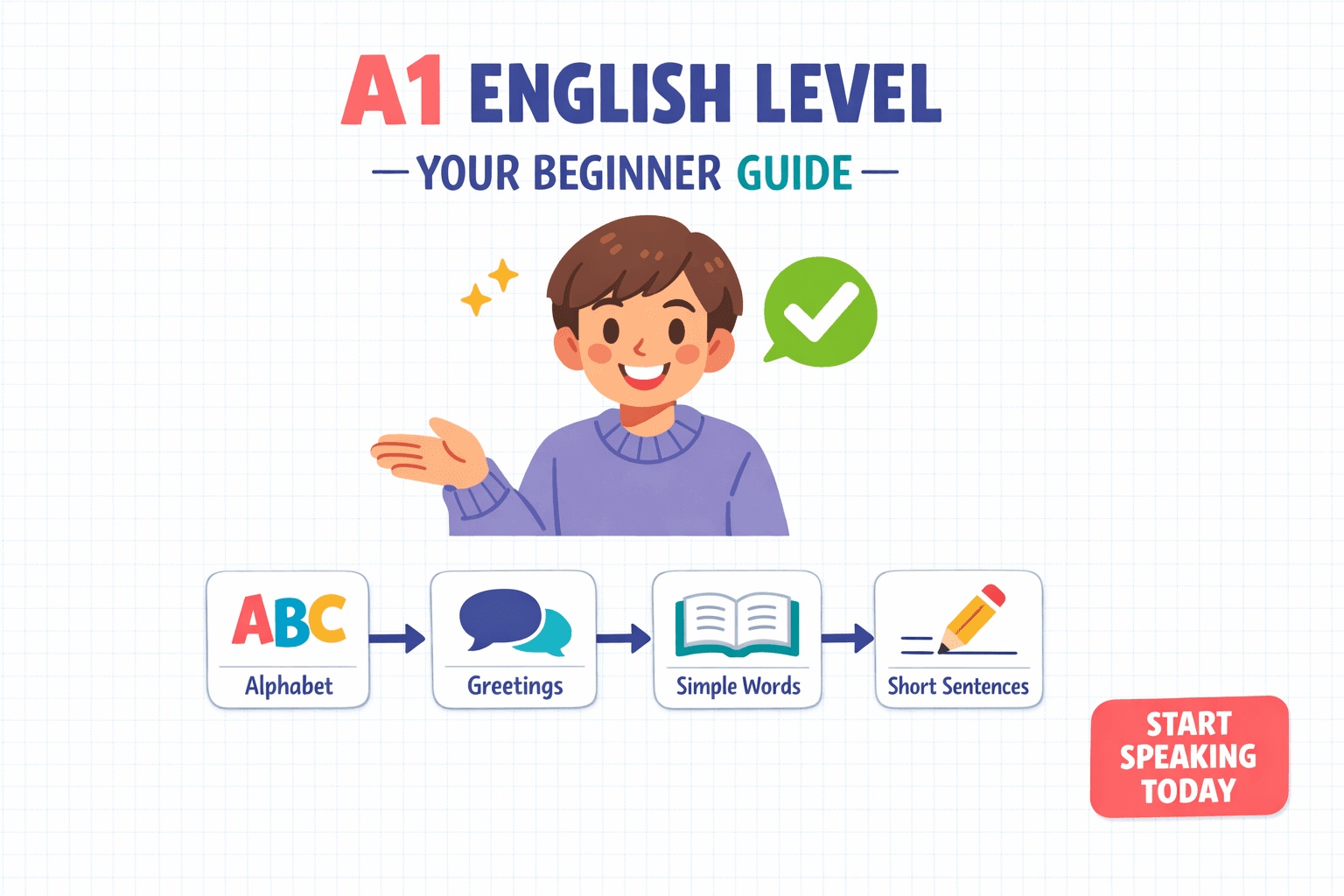
Someone — a teacher, a placement test, a course description — has labelled your English "A1." Now you're Googling what that means. Maybe you're doing this research in your own language and reading through a translator. Maybe you're a teacher planning a syllabus for beginners. Either way, you need a straight answer: what can an A1 learner actually do, what should they study first, and how do they get to A2?
This guide gives you the practical picture. The grammar that matters most, the vocabulary worth prioritising, and a realistic sense of how long the A1 stage lasts.
What can you do at A1?
A1 is the first level on the CEFR scale — the framework used across Europe and increasingly worldwide to measure language ability. Here's what it looks like in real life.
An A1 speaker can introduce themselves, say where they're from, and ask someone's name. They can order food if the waiter speaks slowly and uses simple words. They can read a short sign, a basic menu, or a text message — as long as the vocabulary is familiar. They can fill in a form with personal details or write a few simple sentences about themselves.
What's still out of reach: following a conversation between native speakers, reading a news article, writing an email that explains a problem, or expressing opinions beyond "I like" and "I don't like." Those skills develop at A2 and B1.
If you're helping someone at this level — or if you're here yourself — the most useful thing to understand is that A1 isn't about knowing a lot. It's about using a small set of words and structures reliably. Everything below focuses on building that small, solid foundation.
Five grammar topics to master first
A1 grammar isn't about memorising rules. It's about getting a handful of structures automatic enough to use without freezing mid-sentence.
1. The verb "to be"
"I am tired." "She is from Brazil." "They are students." Positive, negative, question forms — all of them. "Are you a teacher?" "He isn't here today." This verb carries more weight in beginner English than any other. If an A1 learner hesitates on "to be," every other structure feels harder than it needs to.
2. Present simple for routines and facts
"I work in an office." "She doesn't eat meat." "Do you speak French?" This is how beginners describe daily life, habits, and basic truths. The third-person -s deserves extra attention — "he works," not "he work." It's a small detail that trips up learners well beyond A1.
3. Articles: a, an, the
Many languages don't have articles at all, which makes English articles genuinely confusing. At A1, the goal is just the basics: "a" before consonant sounds ("a book"), "an" before vowel sounds ("an apple"), and "the" for something specific both speakers already know ("the bus stop near my house"). Full mastery takes years — even B2 learners slip up — but getting the foundation right early prevents bad habits from hardening.
4. Basic word order: subject + verb + object
"I drink coffee." Not "Coffee drink I." English has stricter word order than many languages. At A1, one pattern does most of the work: who does it → what they do → what they do it to. Questions flip it: "Do you drink coffee?" Once this skeleton feels natural, almost any new vocabulary can hang on it.
5. Prepositions of time and place
"At 9 o'clock." "On Monday." "In the morning." "At the bus stop." "On the table." There's no neat logic here — these combinations just have to be learned. Start with the ten or twelve most common ones and build from there.
If you want a quick snapshot of where your grammar stands, our grammar level test adapts to your answers and gives a clear result.
Which vocabulary to prioritise
You don't need thousands of words at A1. A working target of around 300 carefully chosen words is enough to cover the majority of everyday beginner situations. The key is choosing the right words, not just collecting any words.
An A1 vocabulary should cover these areas:
- People and identity — name, age, country, nationality, family (mother, father, brother, sister, friend), jobs (teacher, doctor, student, driver).
- Everyday objects — phone, bag, key, book, pen, table, chair, door, window, car, bus.
- Places — home, school, work, shop, hospital, airport, restaurant, park, street, city.
- Time — days of the week, months, today, tomorrow, yesterday, morning, afternoon, now, later.
- Food and drink — water, coffee, tea, bread, rice, chicken, fruit, milk. Enough to get through a meal out.
- Core verbs — be, have, go, come, want, need, like, eat, drink, work, live, speak, know, understand, help, buy, see, hear, read, write.
- Adjectives — big, small, good, bad, hot, cold, new, old, happy, tired, easy, difficult, cheap, expensive.
- Question words — who, what, where, when, why, how, how much, how many.
Notice what's absent: abstract nouns, phrasal verbs, idioms, academic vocabulary. Those belong to later levels. At A1, every word a learner studies should be something they could use in a real situation this week.
One effective way to reinforce this vocabulary is through simple reading. Short texts on familiar topics let learners see words in context rather than just memorising translations. Our A1 reading practice tests are designed for exactly this — each one uses controlled vocabulary matched to the level.
Building the four skills at A1
Reading comes first for many A1 learners because it's the least pressured — you control the pace and can re-read anything you miss. Short menus, signs, simple messages, and graded readers are the right materials. Anything longer than a short paragraph will likely cause frustration at this stage.
Listening is where most A1 learners struggle hardest, and it deserves the most deliberate practice. The problem is specific: words that look perfectly clear on a page become unrecognisable at normal speaking speed. "What do you do?" sounds like "Whadyado?" to a beginner's ear. The gap between written English and spoken English is enormous at this level, and it only closes with regular, targeted exposure.
That means ten to fifteen minutes a day of listening — but to the right material. Short, slow, clearly spoken recordings with vocabulary you already know. Not films, not YouTube vlogs, not podcasts aimed at native speakers. Those will come later. Right now, the goal is training your ear to match sounds to words you've already learned on the page. Our beginner listening exercises are built for exactly this stage — short recordings with controlled speed and vocabulary.
Writing gets overlooked at A1, but it's one of the best ways to make grammar and vocabulary stick. It starts with form-filling, but learners at this level can also write short sentences about themselves: "My name is Sara. I live in Istanbul. I am a student." Even five original sentences a day — describing your routine, listing things you like, writing a simple text message — reinforces structures through the act of producing language. It doesn't need to be creative. It needs to be regular.
Speaking benefits most from starting early, even without a conversation partner. Describing your morning out loud, reading sentences aloud, practising introductions alone — all of it counts. The goal isn't fluency. It's getting your mouth used to forming English sounds before self-consciousness has a chance to build up.
A realistic first-week plan
If you're wondering what to actually do tomorrow, here's a framework that respects how memory works. Most retention research points to 8–12 new words per day with regular review as more effective than cramming large lists that fade by the weekend.
Days 1–2: Lock down "to be" in all forms. Learn 10 new words from the people/identity category. Read one short A1 text. Write 3 sentences about yourself.
Days 3–4: Start present simple with 5 common verbs (go, eat, work, live, like). Learn 10 words from everyday objects and places. Listen to one beginner-level audio exercise. Write 3 sentences about your daily routine.
Days 5–6: Practise forming questions with "do/does." Learn 10 words from the food and time categories. Read another short text. Write 3 questions you'd ask a new friend.
Day 7: Review everything. No new material. Say your daily routine out loud. Re-read the week's texts and notice what's already easier.
That's roughly 30 new words learned properly, 3 grammar structures practised, and all four skills touched in a single week. Repeat the cycle with fresh vocabulary and the remaining grammar topics, and A2 gets closer with each round.
How long does A1 take — and what does A2 look like?
Most learners spend between 60 and 100 hours of focused study at A1. "Focused" is the key word — thirty minutes of active reading, writing, or speaking practice counts far more than passive app scrolling.
At A2, the shift is noticeable. Learners handle short conversations on familiar topics without needing the other person to slow down as much. They can write a simple email. They understand short announcements. They describe their background and daily environment in connected sentences rather than isolated words. A2 is just the second of six CEFR levels — our full guide to CEFR levels from A1 to C2 shows the whole progression — but it's the stage where English starts feeling genuinely useful in daily life. If you want a concrete roadmap for getting there, our A2 English study plan lays it out.
Here's something worth remembering: every fluent English speaker you've ever admired once struggled with "he don't" versus "he doesn't." They just kept going. If you're not sure where you stand right now, take our free English level test — and then start with week one.