
Passive Voice in English: When to Use It, When to Avoid It, and How to Form It Correctly
Published on March 31, 2026 • 8 mins read
Every writing guide you've ever read tells you to avoid the passive voice. Use active verbs. Be direct. Don't hide behind weak constructions.
They're not entirely wrong. But they're not entirely right either — and if you apply that advice without understanding why the passive exists, you'll end up with English that's clear in the wrong ways, and unclear in the right ones.
The passive voice isn't a grammatical mistake or a sign of weak writing. It's a tool for controlling what your reader pays attention to. Used well, it's precise and purposeful. Used badly, it obscures, distances, and bores. The difference between those two outcomes is understanding what the passive actually does — and that's what this post covers.
What the Passive Voice Actually Does
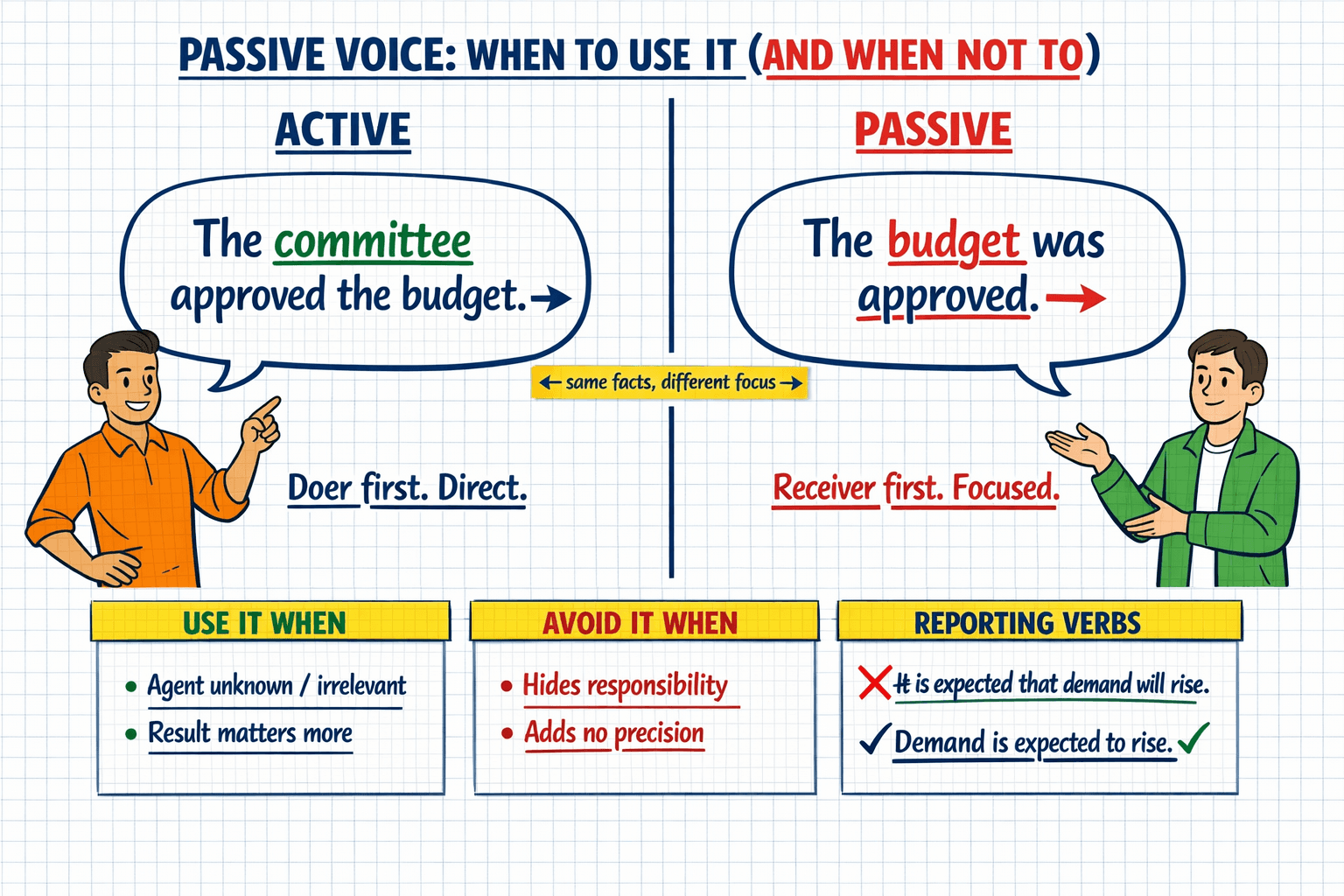
Every sentence has a subject and a verb. In an active sentence, the subject performs the action. In a passive sentence, the subject receives it.
- Active: The committee approved the budget. → The committee did something.
- Passive: The budget was approved by the committee. → The budget had something done to it.
The facts are identical. What changes is focus — specifically, what the sentence puts first. In English, the subject of a sentence carries natural emphasis. The passive lets you choose your emphasis by choosing your subject.
That's the entire mechanism. Everything else follows from it.
How to Form the Passive
The formula is consistent: subject + appropriate form of to be + past participle.
The tense is carried by to be. The past participle stays the same regardless of tense.
| Tense | Active | Passive |
|---|---|---|
| Present simple | They make the cheese in France. | The cheese is made in France. |
| Past simple | Someone stole the painting. | The painting was stolen. |
| Present perfect | They have cancelled the flight. | The flight has been cancelled. |
| Past perfect | Nobody had informed her. | She had not been informed. |
| Future (will) | They will announce the results tomorrow. | The results will be announced tomorrow. |
| Modal verbs | You must submit the form by Friday. | The form must be submitted by Friday. |
| Present continuous | They are renovating the building. | The building is being renovated. |
| Past continuous | Someone was following him. | He was being followed. |
A few patterns worth noting. The present and past continuous passive (is being renovated, was being followed) can sound unwieldy in speech but are standard in formal writing. The modal passive (must be submitted, should be reported, can be arranged) is particularly common in official and professional contexts — instructions, policies, agreements.
With reporting verbs, English also allows a split passive structure that appears frequently in journalism and academic writing. Two forms are standard:
- It is believed that the suspect fled the country.
- He is thought to have fled the country.
The second form — passive subject + reporting verb + passive infinitive — is more concise and slightly more formal. It appears constantly in careful written English, which is why B2 learners who only know the first form sometimes sound unnecessarily wordy in formal contexts.
The same pattern works across a range of reporting verbs:
- It is expected that demand will rise. / Demand is expected to rise.
- It has been reported that three people were injured. / Three people are reported to have been injured.
- It is understood that the negotiations have stalled. / The negotiations are understood to have stalled.
- It was alleged that he had falsified the records. / He was alleged to have falsified the records.
The infinitive form (is expected to, is understood to, is alleged to) is the one to practise — it's the version that shows up in formal reports, quality journalism, and academic prose, and it signals to a reader that you're comfortable at the higher end of written English.
When to Use the Passive
When the agent is unknown, unimportant, or obvious
The most natural use of the passive is when whoever performed the action either isn't known, doesn't matter, or is so obvious it doesn't need stating.
- Three people were injured in the accident. → We don't know, or it doesn't matter, who injured them.
- The bridge was built in 1887. → Who built it is less important than the bridge itself.
- Mistakes were made. → The agent disappears entirely.
- The suspect has been arrested. → Police arrested him; that goes without saying.
- The results will be published next month. → By whom is not the point.
When the action or result matters more than who did it
Science writing, instructions, recipes, and formal reports all tend toward the passive for this reason. The reader wants to know what happened, not who made it happen.
- The samples were heated to 80°C for twenty minutes.
- The mixture is then filtered and allowed to cool.
- All complaints must be submitted in writing within thirty days.
- The data was collected over a six-month period.
Notice that stripping these back to active would force the writer to introduce an agent — researchers heated, you then filter, customers must submit — that adds words without adding information.
When you want to shift emphasis to the receiver of the action
This is the passive at its most deliberate. You put the receiver first because the receiver is what matters in context.
- Over two hundred workers were made redundant. → The workers are the story; who made the decision is secondary.
- The entire neighbourhood was destroyed. → The destruction and its scale is the point.
- She was awarded the prize for her contribution to literature. → The award and the recipient are what this sentence is about; who awarded it is not.
In formal writing to create distance or impersonality
Academic essays, legal documents, official communications, and formal reports use the passive partly to establish register — to signal that this is institutional language, not personal expression.
- It has been noted that attendance has declined.
- This policy was introduced in response to the findings.
- The evidence suggests that the theory cannot be sustained.
Whether you find this tone appropriate depends on context. In an academic paper, this register is expected. In a personal essay, it would read as evasion. And in spoken English, it can sound actively strange — the form must be submitted works in a professional email; said aloud in conversation, it signals either bureaucratic distance or a learner reaching for formality they don't quite need. The passive is primarily a written register tool, and it should be treated as one.
When to Avoid the Passive
When it hides responsibility
The passive's ability to delete the agent is a feature and a bug. Politicians, corporations, and institutions use it to avoid accountability: mistakes were made, it was decided that, the policy has been revised. If you're writing honestly about who did what, the active voice is harder to hide behind.
- Weak: Errors were made in the financial reporting.
- Stronger: The accounts team made errors in the financial reporting.
The passive isn't wrong in the first sentence. It's evasive.
When it makes simple things complicated
In everyday writing and speech, the passive often adds unnecessary weight. If the agent is known and relevant, just say who did it.
- Cluttered: Your application has been received by us and will be reviewed by our team.
- Cleaner: We've received your application and will review it shortly.
- Cluttered: The issue was identified by the technician and has since been resolved.
- Cleaner: The technician identified the issue and resolved it.
When it creates ambiguity about time or cause
Passive constructions without clear agents or time markers can leave readers genuinely confused about what happened and when.
- Unclear: The contract was not renewed.
- Clearer: The client chose not to renew the contract.
- Or: We decided not to renew the contract.
The passive is doing the same grammatical job in all three sentences. What changes is whether the reader understands what actually happened.
When it breaks the rhythm of your writing
A paragraph full of passive constructions has a distinctive flatness. The subject never does anything; things just happen to it. Even when each individual sentence is defensible, the cumulative effect is exhausting. Good writing in English — particularly in narrative, argument, and persuasion — needs active verbs doing work.
When you're using it to sound more formal, not to communicate more precisely
This is the avoidance case that doesn't appear in most style guides, because it's not about grammar — it's about motive. A lot of learners reach for the passive because it feels more sophisticated, more academic, more professional. And it does carry that register. But formality and precision aren't the same thing, and passive constructions chosen for their tone rather than their function tend to produce writing that sounds careful but says less.
The analysis was conducted by the research team over a period of several months sounds formal. The research team spent several months on the analysis is more direct and loses nothing. If the reason you're using passive is to elevate the register, ask first whether active would serve the reader better. Formality is a side effect of good passive use, not a reason for it.
When to Name the Agent — and When Not To
The passive allows you to mention the agent using by: the painting was stolen by the thief, the policy was drafted by a working group. In practice, you include the by-phrase when the agent is genuinely worth naming — when it adds information the reader needs or changes the meaning of the sentence.
- The film was directed by Kubrick. → The director is the information; it matters.
- The letter was signed by the CEO. → Knowing who signed it is the point.
- She was offered the job. → No by-phrase needed — by whom is obvious or irrelevant.
- The window was broken. → By whom may or may not matter; without context, no by-phrase needed.
A by-phrase that adds nothing should be cut. The budget was approved by the committee in a vote might need by the committee if it's not obvious; it probably doesn't need both.
Passive Voice in Practice: B2 and Beyond
At B1, the passive is mostly about formation — getting the tense right, using the correct form of to be, remembering the past participle. At B2 and above, the work shifts to usage: knowing when the passive is the right choice, and when it's a habit or an avoidance.
The B2 advanced passive voice exercises cover the more complex structures — passive with reporting verbs, passive infinitives, passive with modal verbs — that move beyond basic formation into the kind of nuanced use that shows up in academic writing and formal English.
For a broader test of how well these structures sit alongside other B2 grammar points under pressure, the Use of English B2 tests include transformation tasks where knowing when and how to switch between active and passive is exactly what's being tested.
The Real Question
Every time you write a sentence, you're making a choice about focus. What is this sentence actually about? What do you want your reader to pay attention to?
If the answer is the person or thing performing the action, make them the subject. Use the active. If the answer is the person or thing receiving the action — or if the performer is unknown, irrelevant, or better left unstated — the passive puts the right thing first.
The passive isn't weak grammar. It's grammar that requires a reason. Find the reason, and you'll use it exactly right.