
The Complete B2 English Guide
Published on April 9, 2026 • 9 mins read
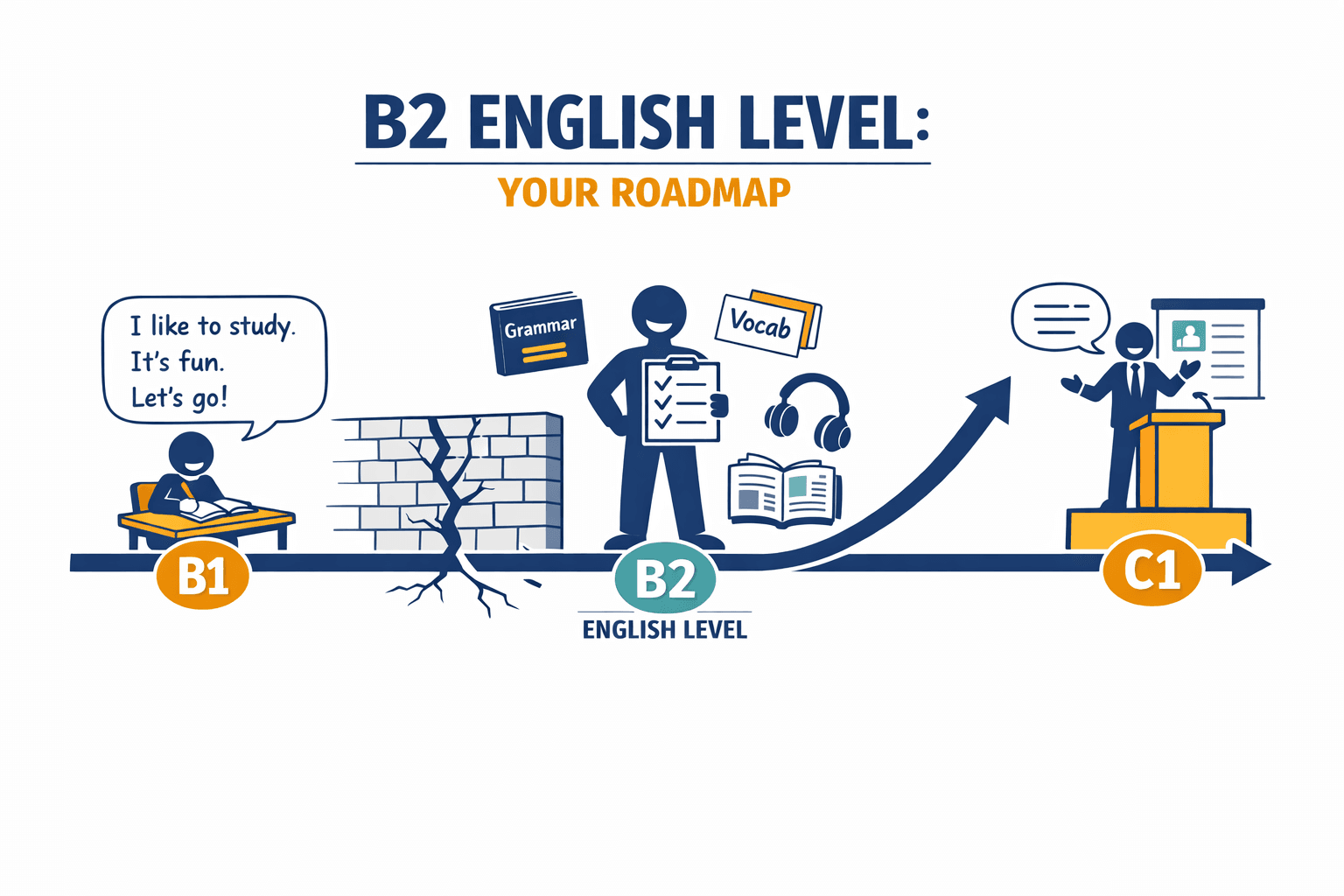
You can hold a conversation about most everyday topics. You follow the news in English without subtitles — mostly. You even caught that joke in the last TV show you watched. And yet, something still feels off. Your grammar breaks down when you try to explain a complicated idea. You reach for a word and grab the same safe one you've used a hundred times. You're stuck at upper intermediate B2, and you're not sure what's actually holding you back.
That plateau is one of the most common places for English learners to stall. The jump from B1 to B2 felt like progress you could measure — new tenses, bigger vocabulary, longer conversations. But once you're inside B2, the path forward gets blurry. What exactly are you supposed to improve? Which grammar structures separate a shaky B2 from a confident one? Which vocabulary actually matters?
This post is the roadmap. Not a vague description of what B2 English means on paper, but a concrete guide to the grammar, vocabulary, and skills that define this level — plus a self-assessment checklist so you can figure out where your gaps actually are.
What does B2 English actually look like in practice?
Forget the textbook definitions for a moment. A solid B2 speaker can do things like:
Explain why they disagree with a policy, not just that they disagree. Follow an English podcast at natural speed and catch most of the nuance. Write an email to a colleague that sounds professional without being awkward. Read a newspaper opinion piece and identify the writer's stance, even when it's not stated directly.
The CEFR calls B2 "upper intermediate," and it roughly maps to an IELTS 5.5–6.5 or a Cambridge First (FCE) pass. But numbers don't tell you much about where you are day to day. What matters more is how you feel when you use English — and where it starts to fall apart.
If you're not sure whether you're actually at B2 yet, you can take a quick English level test to get a baseline. It tests grammar, vocabulary, reading, and listening separately, which makes it easier to see where your strengths and weaknesses really sit. For a deeper look at how all the CEFR levels compare, this breakdown of the differences between A1 through C2 is worth reading.
The B2 grammar that blocks most learners
At B1, you learned the present perfect and past simple, conditionals up to the second, and maybe some passive voice. At B2, the grammar doesn't just get "harder" — it gets more layered. You're expected to combine structures in the same sentence without losing control.
Here are the grammar areas that trip up more B2 learners than almost anything else:
Mixed conditionals. Most learners can handle "If I had studied harder, I would have passed." That's a clean third conditional. Now compare it with this:
If I had studied medicine, I would be a doctor now.
That mixes a past condition with a present result. It's exactly the kind of sentence B2 speakers need to produce naturally, and it's exactly where many freeze up mid-sentence.
Reported speech with backshifting. Saying "She said she was tired" is fine. But what happens when the original statement is already complex? You might hear someone say, "I've been waiting for two hours, and if you hadn't called, I would have left." Now try reporting that accurately: "He told me he'd been waiting for two hours and that if I hadn't called, he would have left." You have to shift multiple tenses backward and keep the logic intact. It's a common weak spot — and one that shows up on virtually every B2 grammar test.
Now here's one that looks simple but causes constant errors:
Relative clauses — defining vs. non-defining.
The colleague who speaks French got the promotion. (Defining —
tells you which colleague.)
My colleague, who speaks French, got the promotion. (Non-defining —
adds extra info about a specific person.)
That comma changes everything. In the first sentence, speaking French is the reason you're identifying that particular colleague. In the second, it's just a bonus detail. B2 learners frequently leave out the commas, or use "that" where only "who" or "which" works. If you're unsure which version you'd naturally produce in your own writing, that's a signal to practise.
Wish / If only + past perfect. A B1 learner says "I'm sorry I didn't know." A B2 learner says "I wish I had known about this earlier" or "If only I hadn't said that." The difference isn't just grammar — it's emotional precision. These structures express regret about the past, and in real-time conversation, many B2 learners default to simpler forms and lose that nuance entirely.
Passive constructions beyond the basics. At B2, you're expected to handle sentences like "The building is believed to have been designed by a famous architect" — a passive with a perfect infinitive. These show up constantly in formal writing and news English, and they're the kind of structure that separates someone who reads English well from someone who can also write it well.
The best way to test whether these structures are solid or shaky is to try producing them under pressure. A B2 Use of English test forces you to choose the correct form in context, which is much more revealing than reviewing rules in a textbook. If you want to start with grammar specifically, the grammar level test isolates that skill and gives you a clear score.
B2 vocabulary: the topics and collocations that matter most
Vocabulary at B2 isn't about memorising obscure words. It's about having enough range in the topics you'll actually encounter — at work, in exams, in the news — to express yourself with precision instead of vague approximation.
Here's a practical way to think about it. If you can talk about the topic but keep reaching for the same three adjectives ("good," "bad," "interesting"), your vocabulary isn't at B2 yet. B2 means choosing the precise word, not circling around it and hoping the listener fills in the gap.
What matters most at this level isn't just knowing words — it's knowing how they behave. The difference between a B1 and B2 vocabulary is collocations: the natural word partnerships that native speakers use without thinking. Here are the topic areas that come up most, with the collocation traps that catch learners off guard:
Work and professional life. Words like deadline, negotiate, implement, resign, promote, collaborate. You meet a deadline, not do a deadline. You hand in your resignation, not give your resignation. You implement a strategy, not make a strategy.
Health and wellbeing. Symptoms, diagnosis, prescription, side effects, chronic, recovery. You develop symptoms, not get symptoms (though "get" works in casual speech). A doctor makes a diagnosis, not does a diagnosis. You make a full recovery — and the side effects wear off, not go off.
Media and communication. Bias, headline, source, coverage, broadcast, editorial. A story receives coverage or gets wide coverage — it doesn't have coverage. A journalist cites a source, not uses a source.
Environment and society. Emissions, renewable, sustainability, carbon footprint, conservation, inequality. You reduce your carbon footprint and reduce emissions — you don't decrease them (in standard usage). You address inequality, not solve inequality. This is one of the most tested topic areas at B2 in both Cambridge and IELTS exams.
Education and learning. Curriculum, enrol, scholarship, assessment, tuition, qualification. You enrol on a course (British English) or enrol in a course (American English) — never enrol to. You earn a qualification, not get a qualification (in formal writing, at least). If you're studying in English or planning to, this vocabulary is non-negotiable.
The gap between passive and active vocabulary is one of the biggest barriers at this level. You might recognise all the words in a reading passage but struggle to use half of them — with the right collocations — in your own writing. If you want a focused check, the vocabulary level test measures both recognition and usage.
For a more structured approach to expanding your word bank, this guide to improving English vocabulary walks through methods that actually work at the upper-intermediate stage — not just "read more," but specific techniques for retention and active use.
B2 reading comprehension: from facts to meaning
At B1, you read for information. At B2, you read for meaning. That sounds abstract, so here's what it looks like concretely.
A B2 reader can pick up an article about, say, the gig economy and understand not just the facts but the writer's argument. You notice when an author is being sarcastic. You can identify the purpose of a paragraph even when it doesn't state its point directly. You can distinguish between a fact and an opinion in the same passage.
This is exactly the skill that B2 reading tests assess, and it's where many learners discover they've been reading in English without actually developing reading comprehension at a higher level. Practising with B2 reading comprehension passages — the kind that ask you to infer meaning, match headings, or identify the writer's attitude — builds this skill much faster than reading casually on your phone.
B2 listening skills: why you understand less than you think
Listening is often the skill that B2 learners feel most confident about — right up until they take a test and realise they've been filling in gaps with guesswork.
Here's what that guesswork actually looks like. You're listening to two people discuss weekend plans. One says, "I was going to head to the coast, but it's meant to chuck it down all day Saturday." You catch "coast" and "Saturday," you register a negative tone, and your brain fills in: they're not going to the coast because of bad weather. That's correct — but you didn't actually understand "chuck it down" (British slang for heavy rain). You inferred the meaning from context. At B1, that's a useful survival strategy. At B2, it's a ceiling. Because the next time someone says "chuck it down" in a different context — without the helpful clues around it — you'll be lost.
At B2, you should follow extended speech on familiar topics even when the speaker doesn't structure their ideas perfectly. Think about a lecture where the professor goes off on a tangent and then comes back to the main point — can you still track the argument? Or a conversation between two native speakers where they interrupt each other, use idioms, and shift topics without warning?
The gap usually shows up in specific, predictable ways. Connected speech is one: native speakers blend words together, so "would have been" becomes something closer to "would-uh-bin." Weak forms are another: words like "of," "to," and "have" are almost swallowed in natural speech. And then there's pragmatic meaning — understanding why someone said something, not just what they said. When a colleague says "Well, that's one way to look at it," they're probably disagreeing politely, not agreeing. Catching that tone is a B2 listening skill.
If you're finding that your listening is strong on slow, clearly articulated content but falls apart with natural-speed speech, the intermediate listening practice tests are built for exactly that transition. They use realistic audio at a pace that's challenging but not overwhelming. Once those feel comfortable, the advanced listening exercises push you toward the kind of complex, multi-speaker audio that separates B2 from C1.
B2 self-assessment checklist
This isn't a formal test — it's a way to identify where your effort should go next. Be honest with yourself. "Sort of" counts as "no" here.
Grammar
- I can produce mixed conditionals without pausing to think about the structure.
- I can use reported speech accurately when the original statement was in a complex tense.
- I can form passive sentences with infinitives and gerunds.
- I can use "wish" and "if only" to talk about both present and past regrets.
- I can handle defining and non-defining relative clauses correctly in writing.
Vocabulary
- I can discuss a news article using specific vocabulary, not just general terms.
- I can describe a workplace problem with precise language (not just "there was a problem with the project").
- I can explain a health issue clearly enough for a doctor to understand.
- I use collocations naturally — "make a decision," not "do a decision."
Reading
- I can identify a writer's opinion even when it's implied, not stated.
- I can read a 500-word article and summarise it in two or three sentences.
- I can understand the function of a paragraph within a longer argument.
Listening
- I can follow a five-minute conversation between two native speakers without replaying.
- I catch the main points of a news report at normal speed.
- I understand idiomatic language in context, even if I haven't seen the specific phrase before.
- I can tell when a speaker is being sarcastic, hesitant, or indirectly disagreeing.
Every "no" on this list is a specific area to work on. That's the advantage of self-assessment at B2 — you don't need to study everything, you need to find the cracks and fill them.
How to actually move through B2 (and beyond)
The biggest mistake at this level is studying broadly instead of deeply. Doing a little bit of everything — a grammar exercise here, a podcast there — keeps you busy but doesn't close gaps. Instead, pick one weak area from the checklist above and spend two to three weeks focused on it before rotating.
For grammar, that means doing targeted practice where you produce the structure, not just recognise it. The B2 Use of English tests are designed around this idea — they test whether you can apply grammar rules in realistic sentence contexts, which is far more effective than filling in blanks in a workbook. If you want broader tips on how to approach grammar study, this guide to studying grammar effectively is a solid companion read.
For vocabulary, active recall beats passive review every time. Don't just reread word lists. Write sentences using new words, test yourself with the definitions covered, and — this part matters — actually use the words in conversation or writing within 48 hours of learning them.
For reading and listening, push slightly above your comfort zone. If you understand 95% of what you read or hear, the material is too easy to grow from. Aim for content where you understand about 80% and have to work for the rest. That's where learning happens.
If you've been at B2 for a while and feel ready to push toward C1, this 60-day upgrade plan from B2 to C1 lays out a structured, week-by-week approach. But don't rush it — a strong B2 is worth more than a shaky C1.
The one thing to take away from this entire guide: B2 is not a place to drift. It's a level where focused, targeted practice on your specific weaknesses produces faster progress than any general study plan. Figure out where you're weakest, work on that, test yourself, and repeat. That's the roadmap.