
How to Read English Texts Faster: A Strategy Guide for B1–C1 Learners
Published on April 1, 2026 • 6 mins read
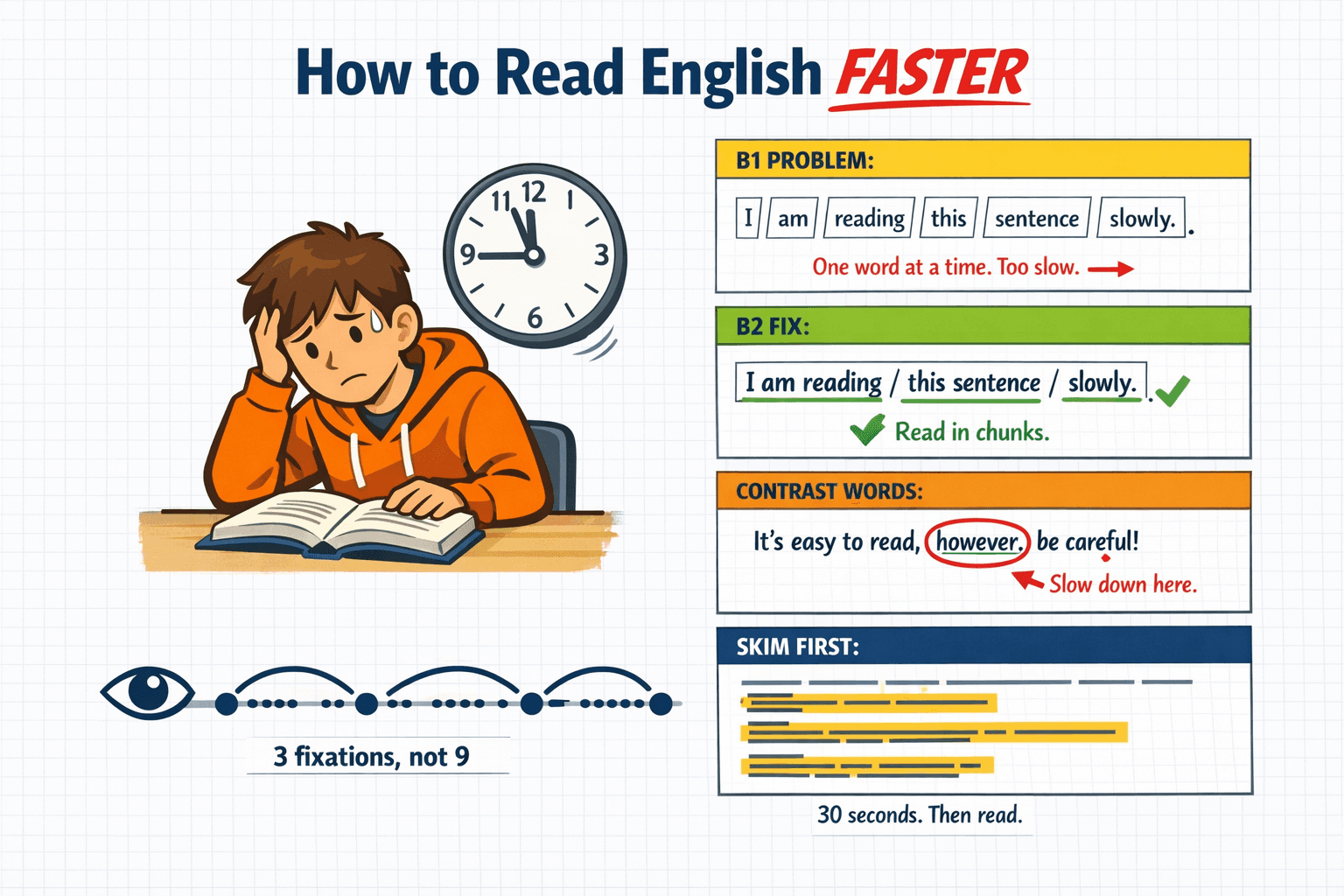
The clock is ticking. You're halfway through the first paragraph of a reading test when you realize you've absorbed almost nothing, so you go back to reread it. Now you're behind and slightly panicked — and somehow reading even slower than before.
Here's the thing that most reading speed guides miss: slow reading at B1 is not the same problem as slow reading at B2 or C1. At B1, the bottleneck is almost always vocabulary — too many unknown words to build any real rhythm. At B2, the words are mostly there, but two anxiety-driven habits are burning your time: going back to reread sentences you've just passed, and silently narrating every word in your head. At C1, those habits are mostly gone, but the eye movement itself — how your brain physically takes in text — still hasn't been retrained from how you first learned to read.
Same symptom. Three different problems. Which means the fix depends entirely on where you are.
This guide works through each layer in order, because they build on each other. The speed that feels out of reach right now is usually sitting behind one specific bottleneck — and once you know which one, the path forward is a lot shorter than it looks.
Start here if you're at B1: the vocabulary bottleneck
Reading speed collapses at unknown words. Not always because you can't work out the meaning — often you can — but because the hesitation fractures your rhythm. One unknown word per paragraph is manageable. Three or four, and you've lost the thread of the argument and have to start again from the top of the paragraph. This is the thing most B1 learners don't realize: the problem isn't that they're reading slowly. It's that they're reading the same paragraph two and three times.
The mistake is treating vocabulary as something to fix during reading: stopping to look words up, hovering over a phrase until it makes sense, trying to work backwards from roots. That's a vocabulary learning activity. While you're doing it, the sentence is sitting there half-parsed, and the meaning you'd built up to that point starts dissolving. You end up learning one word at the cost of losing a paragraph.
The better move is to front-load topic vocabulary before you read, not during.
Before a text on urban planning, spend three minutes reviewing words like density, zoning, infrastructure, gentrification, pedestrianisation. Not memorizing definitions — just making the words visually familiar enough that when they appear mid-sentence, your eye slides over them rather than stopping. The difference between a word you've seen twice and a word you've never encountered is not comprehension. It's processing speed. Your brain retrieves a familiar word in under 150 milliseconds; an unfamiliar one can stall you for a full second or more — long enough for the surrounding sentence to go cold.
This is why the B1 vocabulary section is organized by topic rather than alphabetically. Reviewing the environment cluster before a text on climate policy, rather than drilling random words, means you arrive at the text already primed for what's coming. Three minutes of targeted preview beats thirty minutes of post-reading vocabulary lists.
The B2 wall: two habits that are burning your time
Once vocabulary stops being the main drag, most learners hit a new ceiling and assume their English just isn't good enough yet. It usually is. The ceiling is behavioral, not linguistic.
Regression — going back to reread sentences you've just passed — is the harder habit to name because it feels like careful reading. For a long time, I thought learners who regressed constantly were just being thorough. They weren't. Once you actually track it, the pattern is striking: most regressions happen within a second or two of passing a sentence, before the brain has even finished processing it. The reader didn't fail to understand — they anticipated failure and jumped back preemptively. The regression is a reflex, not a decision.
The fix is uncomfortable: forbid yourself from going back, at least for a paragraph at a time. Read forward even when something feels murky. In most texts, a sentence you only half-parsed becomes clear three or four lines later when the surrounding context fills in what your brain missed. Train yourself to trust that — to let the text carry you forward rather than stopping to verify each sentence before moving to the next.
Subvocalization — the inner voice that quietly says every word as you read — feeds the same reflex. It feels careful and thorough, which is exactly why it's hard to drop. But it caps your reading speed at your speaking speed: around 130 words per minute for most people, roughly a third of what fluent readers manage. The inner voice is mostly a confidence prop. It's not doing the comprehension work; it's just accompanying it.
Try this: while reading, tap your finger on the desk in a slow, steady rhythm, or quietly count "one, two, one, two" under your breath. It occupies just enough of your inner speech mechanism to break the narration. When you first do this and realize you still understood the paragraph — that you were comprehending without the running commentary — you understand for the first time that the voice was optional all along. That's the click: not a technique working, but a false assumption failing.
Both habits get dramatically worse under exam conditions, which is worth knowing before any timed practice. If you're not certain what level your reading is actually at, the English reading level test is worth doing first. If the texts are genuinely above your level, the anxiety isn't irrational — it's accurate, and no behavioral fix will solve a vocabulary problem.
The C1 adjustment: how your eyes actually move
At C1, the vocabulary is there and the anxiety habits are mostly under control — but reading still feels slower than it should. The gap at this level is usually physical: how the eyes move across a page.
Read this sentence and notice what your eyes do:
Regular aerobic exercise has been shown to improve working memory and reduce symptoms of anxiety in adults.
Word by word, that's roughly nine eye movements. A fluent reader takes three — because their eyes are trained to jump in clusters, taking in three to five words per fixation rather than stopping on each one.
Here's the drill: take any paragraph and draw a light slash between every three or four words. Then read the chunks, not the words.
Regular aerobic exercise / has been shown to improve / working memory and reduce / symptoms of anxiety in adults.
It feels like skimming at first. You're not skimming — you're breaking a habit that formed when you first learned to decode text letter by letter. Five minutes a day on B2 reading texts for two weeks, and something shifts: the chunked movement stops feeling like an override and starts feeling like the text is just arriving faster. Not because you sped up — because you stopped pumping the brakes at every word.
One thing to watch: chunking only works reliably when you know most of the words on the page. If unfamiliar vocabulary keeps pulling your attention back to individual words, the motor habit can't settle. Fix the vocabulary layer first, then build the eye movement on top of it.
The technique that cuts across all three levels: skim first
Before reading any text properly, spend 30 seconds scanning it — first sentences of paragraphs, any headings, the final paragraph. Don't read. Scan.
At B1, the preview surfaces the topic vocabulary you need to recognize before you meet it buried in complex sentences. At B2, it gives you a map of where the argument goes, which dramatically reduces the anxiety-driven regression that comes from being surprised by a text's direction. At C1, it lets your eyes settle into chunked movement earlier because your brain isn't spending fixations trying to orient itself.
In a timed test of 600 words, a 30-second skim typically saves two to three minutes on the careful read that follows — because you spend far less time backing up to recover context you missed. Most learners skip it because it feels like burning time they don't have. The mathematics doesn't support that.
It's also the best single preparation for True/False/Not Given questions, which consistently trip up B2 and C1 candidates not because they're conceptually hard, but because they test something specific: whether you can judge what a text didn't say. Holding the entire structure of a text in mind while evaluating individual statements is nearly impossible if you encountered the text linearly and cold.
One more thing: slow down at contrast words
Every time you see however, although, despite, nevertheless, on the contrary, yet — treat it as a gear change. What comes before a contrast word is almost always setup or concession. What comes after it is almost always the main point.
Most learners read both sides of a contrast at the same speed, giving equal attention to the setup and the payoff. Skim the setup; slow down for the contrast clause.
Across a 600-word text, this adjusts where your attention goes without actually changing how fast you read — and it substantially changes how much you retain, because you're spending careful processing on the sentences that carry the argument rather than distributing it evenly across the ones that don't.
Where to practice, matched to your level
If you've diagnosed your bottleneck, the practice follows directly. B1 learners working on vocabulary preview and forward reading should drill on texts just at their ceiling — the B1 reading section has enough volume to build the habit without the texts being so hard they trigger the anxiety loop instead.
B2 learners tackling regression and subvocalization need slightly challenging material — familiar enough that behavioral work is possible, unfamiliar enough to keep the reflex active. The B2 reading section works well here: time yourself, forbid regression for the full text, and check comprehension afterwards rather than sentence by sentence.
For C1 learners doing eye-movement work, the C1 reading section has texts on the attention economy, urban theory, gene editing, and reskilling — dense enough that chunk reading is the only efficient way through them, which makes the habit stick faster than drilling on easier material.
Pick the layer that matches your level. Work on one technique for two weeks before adding another. The stacking is the point — each layer you fix makes the next one easier to build on top of.