
Reported Speech in English: How to Convert Direct to Indirect Speech (with 40 Worked Examples)
Published on March 25, 2026 • 11 mins read
Your colleague walks up to you on Monday morning and says: "Did you hear what the manager announced on Friday?" You weren't there. So she tells you — not by quoting the manager word for word, but by rephrasing what he said. That rephrasing is reported speech. You use it dozens of times a day without thinking about it. The problem is, English has strict rules about how it works, and a few of those rules catch even confident B2 learners off guard.
This guide covers the full system: every tense backshift, modal verb behaviour, reported questions, the say/tell distinction, and the time expressions that quietly change when you shift from direct to indirect speech. Every rule comes with worked examples drawn from realistic contexts — news reports, workplace conversations, emails — so you can see exactly what changes and why.
Why Tense Shifts Happen in Reported Speech
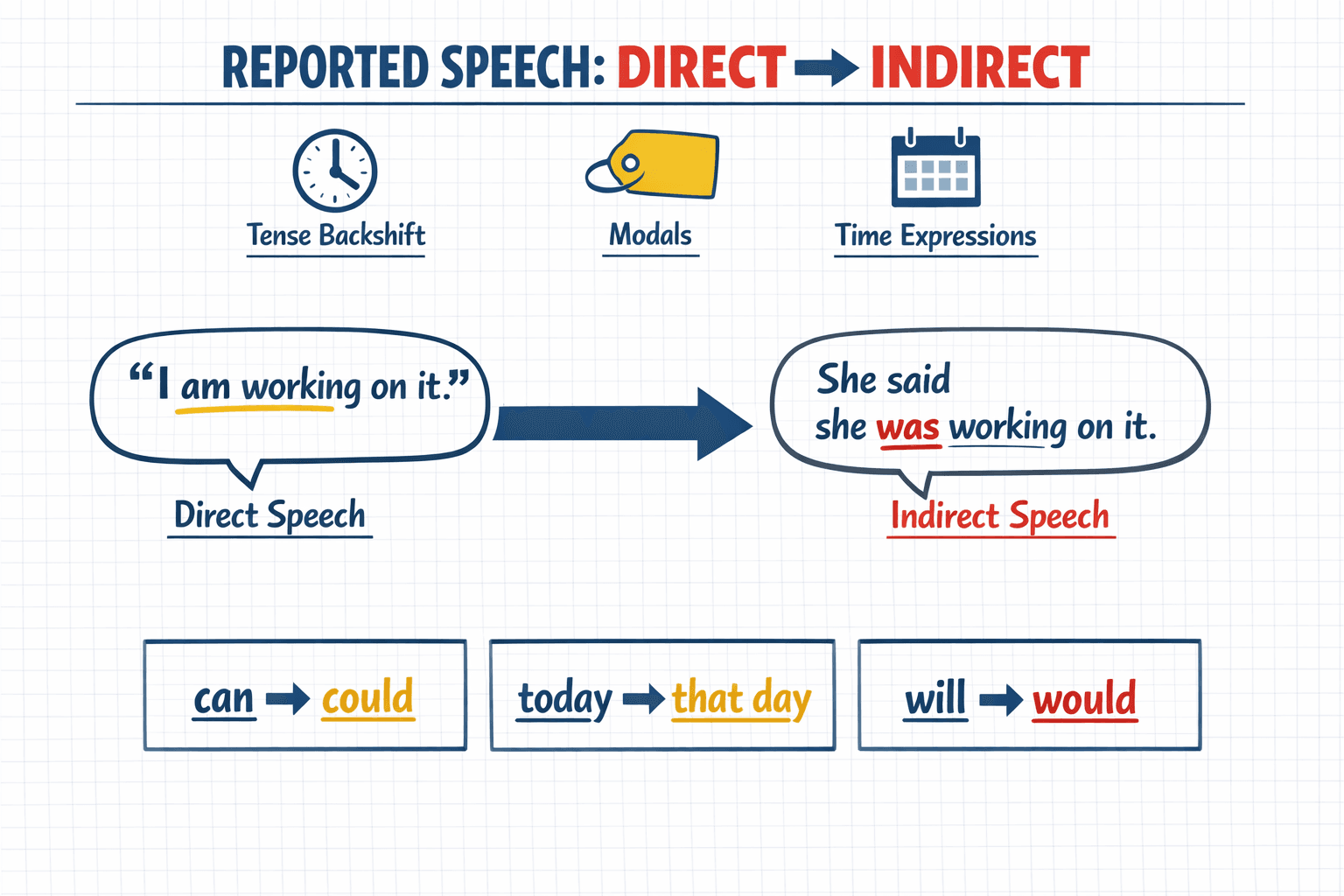
When you report what someone said, you're looking back at their words from a later point in time. English signals this distance by pushing the tense one step further into the past. Linguists call it backshift. Think of it as the grammar equivalent of rewinding a tape: present becomes past, past becomes past perfect, and so on.
Here's the core backshift table:
| Direct speech | Reported speech |
|---|---|
| Present simple | Past simple |
| Present continuous | Past continuous |
| Present perfect | Past perfect |
| Past simple | Past perfect |
| Past continuous | Past perfect continuous |
| Future (will) | Conditional (would) |
| Future continuous (will be doing) | Conditional continuous (would be doing) |
The table is logical once you see the pattern. Each tense moves back one step. Let's run through them with examples from contexts you'd actually encounter.
Tense Backshifts: 20 Worked Examples
Direct speech is shown in italics; reported speech follows. Target shifts are in bold.
Present simple → past simple
- "The factory employs 400 workers." → She reported that the factory employed 400 workers.
- "I don't agree with the proposal." → He said he didn't agree with the proposal.
- "We close at 9 p.m." → The receptionist told me they closed at 9 p.m.
- "The new policy affects all departments." → The CEO announced that the new policy affected all departments.
Present continuous → past continuous
- "The team is working on a fix." → She said the team was working on a fix.
- "We are moving offices next month." → He mentioned that they were moving offices the following month.
Present perfect → past perfect
- "I have never seen anything like it." → She admitted she had never seen anything like it.
- "The results have been published." → The professor announced that the results had been published.
Past simple → past perfect
This shift is the one that trips people up most at B2 level. When someone's original words were already in the past, you push them into the past perfect.
- "We launched the product in March." → He explained that they had launched the product in March.
- "I called the office but nobody answered." → She told me she had called the office but nobody answered. (Once sequence is established with the first past perfect, the second verb can stay in the past simple — "nobody had answered" is technically correct but sounds stilted in natural speech.)
- "The train left before I arrived." → He said the train had left before he arrived. (The conjunction "before" already signals sequence, so the second clause doesn't need backshifting.)
- "They decided against the merger." → The report stated that they had decided against the merger.
Past continuous → past perfect continuous
- "I was preparing the presentation when the power cut out." → She said she had been preparing the presentation when the power cut out.
Future (will) → conditional (would)
- "The event will start at 7." → She confirmed the event would start at 7.
- "I won't be there on Thursday." → He warned me he wouldn't be there on Thursday.
- "We will announce the winners next week." → They said they would announce the winners the following week.
Future continuous → conditional continuous
- "The team will be travelling all weekend." → She said the team would be travelling all weekend.
No backshift — when it's still true
You don't have to backshift if what was said is still true at the time of reporting. This is optional in standard grammar, but common in natural speech.
- "Water boils at 100 degrees Celsius." → He reminded us that water boils at 100 degrees Celsius. ✓ (scientific fact — no backshift needed)
- "The office is on the third floor." → She told me the office is on the third floor. ✓ (still true now)
You can also backshift these — both versions are grammatically correct. The choice comes down to whether you want to emphasise that the information is current.
The First Thing People Get Wrong: Modal Verbs
Modal verbs don't backshift the same way regular verbs do, and this is where a lot of learners produce errors. Here's how they behave:
| Direct | Reported |
|---|---|
| can | could |
| will | would |
| shall | would |
| may | might |
| must | had to (obligation) or must (deduction) |
But: could, would, should, might, and ought to do not change. They're already past forms, so they stay the same.
Worked examples (target modals in bold):
- "You can submit the form online." → She told me I could submit the form online.
- "I may be late." → He warned me he might be late.
- "You must complete the training by Friday." → She said we had to complete the training by Friday.
- "The system should update automatically." → The technician said the system should update automatically. (no change — should stays)
- "I could help if you gave me the file." → She offered that she could help if I gave her the file. (no change — could stays)
- "We would need more time." → He warned that they would need more time. (no change — would stays)
The must/had to distinction is worth a second look. Use had to when the original must expressed obligation. Use must when it expressed a logical deduction:
- "She must be exhausted." → He said she must be exhausted. (deduction — no change)
- "You must wear a badge." → They told us we had to wear a badge. (obligation — backshifts)
The Second Thing People Get Wrong: Reported Questions
Reported questions cause more errors than almost anything else in this area. The reason is word order. In a direct question, you invert the subject and auxiliary: "Are you ready?" But in a reported question, the word order flips back to normal statement order — and the question mark disappears.
Yes/no questions use whether or if:
- "Are you coming to the meeting?" → She asked me whether I was coming to the meeting. (not: whether was I coming)
- "Did they receive the package?" → He asked if they had received the package.
- "Can you help me?" → She asked whether I could help her.
- "Have you finished the report?" → He wanted to know if I had finished the report.
Wh- questions keep the question word, then use normal word order:
- "Where does she live?" → He asked where she lived. (not: where did she live)
- "What time does the flight leave?" → She asked what time the flight left.
- "Why are they moving the deadline?" → He wanted to know why they were moving the deadline.
- "Who told you about the vacancy?" → She asked who had told me about the vacancy.
- "How long have you been waiting?" → He asked how long I had been waiting.
The most common error — and it's very common — is keeping the question's word order in the reported version. Sentences like "He asked where did she live" or "She asked if could I help her" are wrong. Statement order only.
The Third Thing People Get Wrong: Time and Place Expressions
When you move words from one time and place to another, some reference words have to change too. Saying "She told me yesterday that she would call me 'tomorrow'" is confusing — which tomorrow? The expressions have to update to match the new context.
| Direct | Reported |
|---|---|
| now | then / at that moment |
| today | that day |
| yesterday | the day before / the previous day |
| tomorrow | the next day / the following day |
| this week | that week |
| last week | the week before / the previous week |
| next year | the following year |
| here | there |
| this | that |
| these | those |
Worked examples in context (time expression changes in bold):
- "I'm leaving today." → She said she was leaving that day.
- "We submitted the report yesterday." → He mentioned that they had submitted the report the day before.
- "The meeting is tomorrow." → She reminded me the meeting was the following day.
- "I spoke to them last week." → He told me he had spoken to them the week before.
One nuance: you only change these expressions when there's actual time distance between the original statement and the reporting. If someone said something five minutes ago and you're reporting it immediately, "She just said the meeting is today" is perfectly natural. The updates are about logical clarity, not mechanical rule-following.
Say vs. Tell — The Object Rule
This is one of the most common errors at B2 level, and yet most grammar guides bury it in a footnote.
The rule is simple: tell always needs an object (the person being told). Say never takes a personal object directly.
- She said that the flight was delayed. ✓
- She told me that the flight was delayed. ✓
- She said me that the flight was delayed. ✗
- She told that the flight was delayed. ✗
In practice, errors almost always go one way: learners use said and told interchangeably and drop the object after tell, producing "He told the project was finished" instead of "He told us the project was finished" or "He said the project was finished."
There's one exception worth knowing: tell can appear without a personal object in a small set of fixed expressions — tell the truth, tell a lie, tell a story, tell the time. These are idiomatic and don't follow the usual pattern.
Reporting Verbs: Beyond Said and Told
One thing that separates flat, repetitive reported speech from polished writing is reporting verb variety. Said is perfectly fine, but English gives you a much more precise toolkit:
- Verbs of assertion: stated, claimed, insisted, argued, maintained
- Verbs of warning or advising: warned, advised, urged, recommended, cautioned
- Verbs of admitting: admitted, acknowledged, conceded, confessed
- Verbs of promising: promised, guaranteed, pledged, vowed
- Verbs of questioning: asked, enquired, wondered, queried
- Verbs of ordering: ordered, commanded, demanded, instructed
Each verb carries nuance. He said he would fix it is neutral. He promised he would fix it implies a commitment. He insisted he would fix it suggests pushback was involved. Choosing the right reporting verb often communicates more than the reported content itself.
At C1 level, accuracy with these verbs — including the patterns they take (the more natural form is advised me to leave rather than advised me that I should leave, though both are used) — becomes a meaningful marker of proficiency. Our advanced reported speech exercises cover these complex structures, including mixed patterns and formal registers.
Indirect Commands: The Infinitive Pattern
Commands and requests follow a different structure entirely. They don't use that — they use a reporting verb followed by an object and an infinitive.
"Close the window." → She asked me to close the window. (not: she asked me that I close the window) "Don't touch anything." → He told us not to touch anything. "Please send me the file." → She asked me to send her the file.
The pattern is: reporting verb + object + (not) + to + infinitive. Once you see it that way, it's consistent. The not always comes directly before to.
Putting It All Together: A Realistic Scenario
Here's a short paragraph of direct speech from a fictional news report, followed by the reported version. Every target change is labelled inline.
Direct speech (the CEO's statement):
"We have exceeded our targets this year. The board has approved a new investment plan, and we will announce the details tomorrow. All employees must attend the briefing, which will take place here at our headquarters."
Reported speech (journalist's article, published the next day):
The CEO stated that the company had exceeded (present perfect → past perfect) its targets that year (this year → that year). He added that the board had approved (past simple → past perfect) a new investment plan, and that they would announce (will → would) the details that day (tomorrow → that day, since the article was published the following day). He also confirmed that all employees had to attend (must → had to) the briefing, which would take (will → would) place at the company's headquarters (here → the company's headquarters — "here" becomes a specific description in written context).
This is the full system working together. Every rule covered in this guide appears somewhere in those three sentences — which is also why the CEO scenario is worth returning to once you've worked through the individual sections. If any of the labelled changes felt unfamiliar, that's the section to revisit.
The most useful follow-up isn't reviewing the examples again. Take reported speech you encounter in news articles or emails and reconstruct what the original direct speech might have been. That reverse process forces genuine engagement with the rules rather than just recognition of them — and you can test it immediately with our reported speech statements and reported speech questions practice sets.