
British vs American English: Key Differences Every Learner Needs to Know
Published on April 2, 2026 • 8 mins read
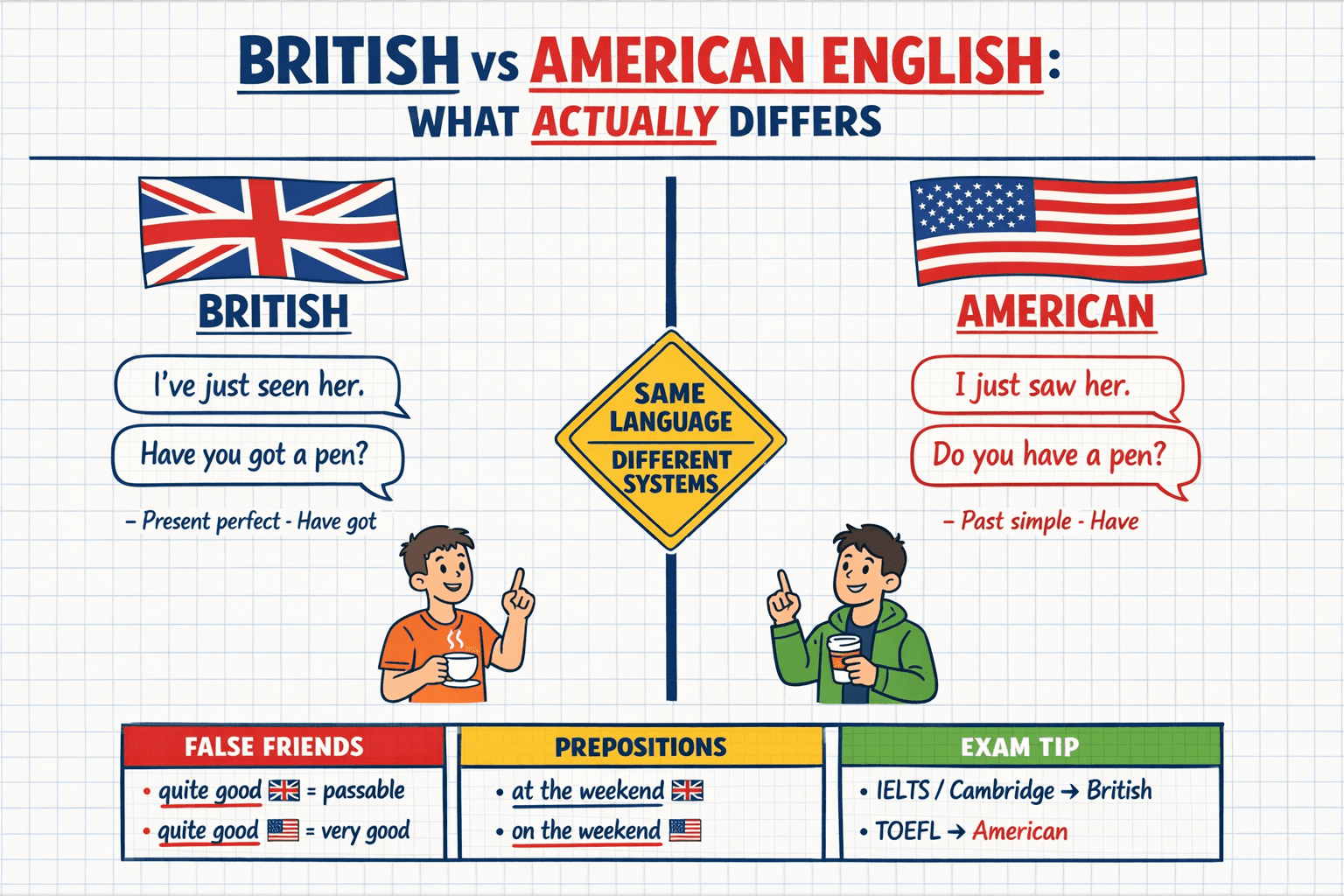
Most English learners know that the British write colour and the Americans write color. That's where the conversation about British and American English usually stops — and that's exactly where the interesting part begins.
Spelling differences are the least of it. They're visible, easy to look up, and rarely cause genuine confusion. What actually trips learners up are the grammar differences that change meaning without warning, the preposition patterns where one variety sounds natural and the other sounds foreign, and the vocabulary gaps where the same word means something completely different on either side of the Atlantic. Those are the differences that matter, and most of them never make it into a spelling list.
The Grammar Differences Nobody Warns You About
Present perfect vs past simple
This is the most significant grammatical difference between the two varieties, and it directly affects how you should approach tense practice depending on which English you're learning.
In British English, the present perfect is the natural choice when an action is recent and connected to the present moment:
- Have you eaten yet?
- I've just seen her.
- He's already left.
In American English, all three of those sentences are commonly said in the past simple:
- Did you eat yet?
- I just saw her.
- He already left.
Both are grammatically defensible. But if you're preparing for a British exam like IELTS or Cambridge, using I just saw her where a British speaker would say I've just seen her will cost you marks. Learners who switch between American and British materials often develop inconsistent tense instincts without realising the two systems are pulling in different directions — the present perfect vs past simple distinction is worth working through with the specific variety difference in mind.
If you're unsure how these grammar differences sit alongside other B2 structures, the B2 grammar tests cover tense use, modal verbs, and formal structures at the level where variety differences start to affect exam performance.
Have got vs have
British English uses have got far more readily for possession and necessity:
- Have you got a pen? (British) / Do you have a pen? (American)
- I've got a meeting at three. (British) / I have a meeting at three. (American)
- You've got to be kidding. (British) / You have to be kidding. (American)
American English uses have alone for possession and prefers have to over have got to for obligation. Neither form is wrong, but the frequency differs considerably — and learners who use have got constantly in American contexts can sound slightly formal or theatrical.
Collective nouns: singular or plural?
British English treats collective nouns as plural. American English treats them as singular. This applies to companies, teams, governments, bands — any noun referring to a group.
- British: The government are planning to raise taxes. Arsenal have won the title.
- American: The government is planning to raise taxes. Arsenal has won the title.
For learners writing in an academic or professional context, this distinction matters. Mixing the two within a single document looks inconsistent rather than internationally fluent.
Shall
British English retains shall for first person offers, suggestions, and mild future statements:
- Shall we go?
- Shall I help you with that?
In everyday American speech, shall is largely replaced by will or should. Shall we go? is understood, but uncommon. The important caveat: in formal American legal and official writing, shall remains standard — contracts, legislation, and formal procedures use it extensively. So if your materials are business or legal English, you'll encounter it regardless of variety.
Prepositions: Small Differences, Large Footprint
Preposition differences sit below the radar for most learners — not dramatic enough to notice as mistakes, but consistent enough that native speakers register them. Getting these right marks you as someone who has absorbed a variety rather than studied it.
At the weekend / on the weekend
British English uses at: What are you doing at the weekend? American English uses on: What are you doing on the weekend?
In hospital / in the hospital
One of the starker differences in everyday speech. British English drops the article: She's in hospital means she's a patient. American English keeps it: She's in the hospital. The British form without the article signals an institutional role — being admitted as a patient. With the article, it simply locates someone in the building.
The same pattern applies to university: British at university vs American in college. And to prison: British in prison (as an inmate) vs American in prison or in the prison (both used).
Monday to Friday / Monday through Friday
British English uses to for ranges: The office is open Monday to Friday. American English uses through: The office is open Monday through Friday.
Different from / different to / different than
All three exist. Different from is standard in both varieties. Different to is common in British English and considered an error by many American readers. Different than is common in American English and appears occasionally in British English before a clause. Using different to in American writing, or different than in formal British writing, will mark you as having absorbed the wrong system.
In the street / on the street
British English: She lives in Oxford Street. American English: She lives on Oxford Street.
More broadly, British English tends to place people in streets and Americans tend to place them on them. The spatial logic is genuinely different — British streets as channels, American streets as surfaces — which is a more interesting way to remember it.
Vocabulary: When the Same Word Means Something Different
This is where things get genuinely hazardous. Some words exist in both varieties but carry completely different meanings — different enough to cause real confusion in professional or social contexts.
Table a proposal: In British English, to table something means to bring it forward for discussion. In American English, it means to postpone it indefinitely. In a meeting with mixed international participants, this single phrase has derailed negotiations — one side believing a proposal has been raised for decision, the other believing it has been shelved. If you're working in international business English, knowing this difference is not optional.
Quite: In British English, quite good is mild praise — passable, decent, not exceptional. In American English, quite good is strong praise — very good, impressive. I thought the presentation was quite good lands very differently depending on which English the speaker is using. The understatement conventions in British English run much deeper than most learners realise: not bad, fairly decent, and reasonably good are all relative compliments in British English that register as near-neutral in American contexts.
Scheme: In British English, a scheme is simply a plan — a housing scheme, a pension scheme, a training scheme. In American English, scheme carries connotations of cunning or deception. Telling an American colleague you've developed a new scheme reads as an accidental admission.
Homely: In British English, homely means warm, comfortable, welcoming — high praise for a house or a person. In American English, homely means plain-looking, unattractive. Complimenting an American host on their homely cottage will not go as intended.
To knock someone up: In British English, to knock someone up means to wake them by knocking on their door. In American English, the phrase is crude slang for getting someone pregnant. The British meaning is so everyday it appears in classic literature; the American meaning is so widely known that the phrase has been effectively retired from casual British use around Americans.
Different Words for the Same Things
Beyond the false friends, a substantial vocabulary layer exists where the two varieties simply use different words. Food produces the most reliable confusion.
A British person orders chips in an American diner and receives a pile of thin, crispy fried potato slices — what they'd call crisps. What they actually wanted (chips: thick-cut, soft inside, what Americans call fries) is on the menu under a completely different name. Then they order biscuits to go with something and receive a warm, soft, savoury bread roll eaten with gravy — not the sweet, crisp thing they were picturing. Two words, two entirely wrong dishes, and the menu gave no warning.
The broader vocabulary differences cover most areas of daily life:
| British | American |
|---|---|
| Flat | Apartment |
| Lift | Elevator |
| Lorry | Truck |
| Motorway | Highway / Freeway |
| Boot / Bonnet (car) | Trunk / Hood |
| Queue | Line |
| Autumn | Fall |
| Holiday | Vacation |
| Post | |
| Solicitor | Attorney |
| Chemist | Drugstore / Pharmacy |
| Trainers | Sneakers |
| Jumper | Sweater |
| Nappy | Diaper |
Punctuation: Two Systems in One Language
Quotation marks and punctuation placement
American English places commas and full stops inside quotation marks, regardless of whether they belong to the quoted material:
She called it "a complete disaster,"
British English places punctuation inside only if it belongs to the quoted material:
She called it "a complete disaster".
The Oxford comma
The Oxford comma — the comma before and in a list of three or more — is standard in American English and in formal British writing, but inconsistently used in British journalism. We invited the speakers, the editor and the director (no Oxford comma) is standard British newspaper style. We invited the speakers, the editor, and the director is standard American style.
Dates
British: day / month / year — 15/03/2025 American: month / day / year — 03/15/2025
The written form is unambiguous; the numerical shorthand is not. 04/05/2025 means the 4th of May in British English and the 5th of April in American English. In international correspondence, writing the month as a word removes the ambiguity entirely.
Which Should You Learn?
Pick the one you'll actually use — and commit to it. Mixed variety produces writing that reads as inconsistent rather than internationally fluent, and most exams penalise it.
If you're taking IELTS or Cambridge (First, Advanced, Proficiency), you're being assessed against British English norms. If you're taking TOEFL, American English norms apply. Both varieties are acceptable on most international exams as long as you're consistent throughout. Where the divide becomes most consequential is in grammar — the present perfect vs past simple difference is an exam marking issue, not just a register one.
Both varieties are more similar than different. They share the same underlying grammar system, the same core vocabulary, and the same rhetorical conventions. And both are far from monolithic — Scottish, Irish, Welsh, and regional British Englishes differ substantially from the RP standard this piece uses as its reference point, just as American English varies across regions. What this piece covers is the standard written form of each, which is what most learners are working toward and what most exams assess.
The differences between the two standards are real, but they operate at the edges — exactly the contexts where precision matters most. The preposition differences are what separate upper-intermediate learners from advanced ones. The false friends are what separate confident speakers from embarrassed ones. And the understanding that quite good spoken by a British person is not the same compliment as quite good spoken by an American is the kind of fluency that no grammar rule will ever teach you.