Passive Voice— B1 Grammar Exercises
Published March 14, 2026
Exercise 1 — Multiple Choice
The book ____ by the author last year.
The cookies ____ by my sister every Sunday.
The project ____ by the team next month.
The song ____ by many artists over the years.
The homework ____ by the students yesterday.
The letters ____ by the postman every day.
The movie ____ by the critics last week.
The flowers ____ by my mother every spring.
The report ____ by the manager before the meeting.
The game ____ by the players every weekend.
A news headline reads: Three people were rescued from the river last night. The report doesn't say who rescued them — the rescue itself is the point. That shift in focus, from who did the action to who or what received it, is exactly what the passive voice does.
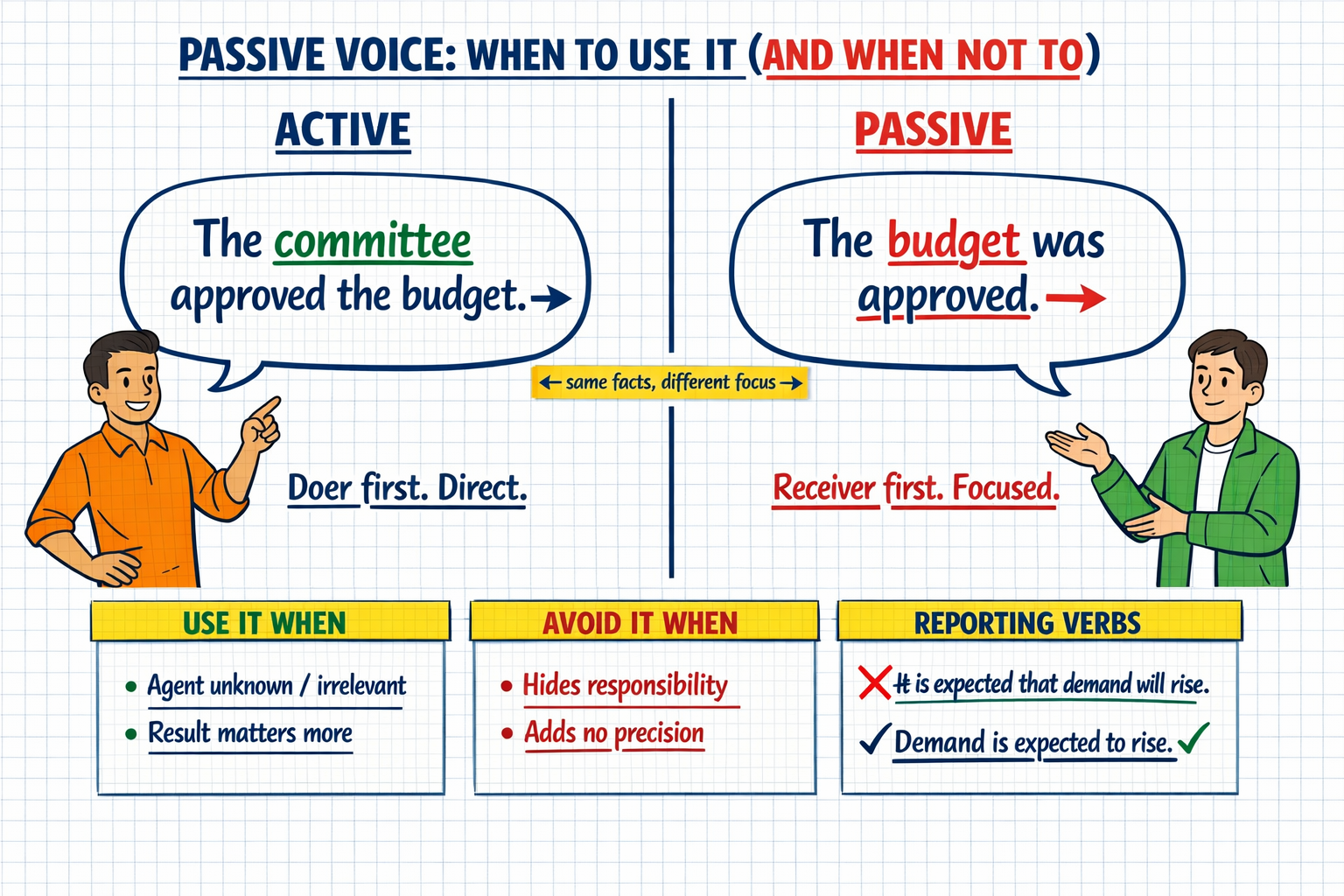
In an active sentence, the subject performs the action: The firefighters rescued three people. In a passive sentence, the subject receives the action: Three people were rescued. The performer disappears or moves to the end. You choose the passive when the action or the result matters more than the person doing it.
Form
The verb be carries the tense. The past participle stays the same regardless of tense. If you're unsure about past participle forms, review irregular verbs first.
| Tense | Active | Passive |
|---|---|---|
| Present Simple | They clean the office every day. | The office is cleaned every day. |
| Past Simple | Someone stole my bicycle. | My bicycle was stolen. |
| Present Perfect | The company has offered her a job. | She has been offered a job. |
| Will (future) | They will announce the results tomorrow. | The results will be announced tomorrow. |
| Modal | You must return these books. | These books must be returned. |
Positive, Negative, and Question
| Present Simple Passive | Past Simple Passive | |
|---|---|---|
| Positive | English is spoken here. | The letter was sent yesterday. |
| Negative | Tickets are not sold online. | The window was not broken by the storm. |
| Question | Is breakfast included in the price? | Were you told about the meeting? |

When to Use the Passive
1. The doer is unknown
When you don't know who performed the action, the passive is the natural choice. Forcing an active sentence here would mean inventing a vague subject like "someone" or "they."
- My car was broken into last night.
- The window has been smashed.
2. The doer is obvious or unimportant
When everyone already knows who does the action, naming them adds nothing. This is common with rules, processes, and general facts.
- Rice is grown in many Asian countries. (farmers — obvious)
- Passengers are requested to fasten their seatbelts. (the airline — obvious)
3. The action or result matters more than the doer
News reports, scientific writing, and formal announcements regularly use the passive because the event is more important than who caused it.
- The bridge was built in 1889.
- Over 500 jobs will be created by the new factory.
4. Formal or impersonal tone
The passive makes sentences sound more formal and objective. Signs, notices, academic writing, and official communication use it heavily.
- Smoking is not permitted in this building.
- Applications must be submitted by 31 March.
Adding the Doer with by
If the doer is important or surprising, add them with by at the end. Only include by when it adds genuine information — not when the doer is obvious.
- Guernica was painted by Picasso. (important — identifies the artist)
- The goal was scored by a 17-year-old substitute. (surprising — worth mentioning)
Active vs Passive — How to Choose
| Choose Active when… | Choose Passive when… |
|---|---|
| The doer is important and known. | The doer is unknown, obvious, or unimportant. |
| You want a direct, personal tone. | You need a formal or impersonal tone. |
| The sentence is clearer with the doer first. | The action or result is the main focus. |
Active The manager approved my request. — Focus on who decided.
Passive My request was approved. — Focus on the result. Who approved it doesn't matter to the speaker.
Verbs That Cannot Be Passive
Only transitive verbs (verbs that take an object) can become passive. Intransitive verbs — verbs with no object — have no passive form.
It was happened yesterday. → It happened yesterday. (happen has no object)
The train was arrived late. → The train arrived late. (arrive has no object)
Other common verbs with no passive: die, sleep, rain, exist, appear, fall.
Common Mistakes
| Wrong | Correct | Why |
|---|---|---|
| The cake was make by Anna. | The cake was made by Anna. | Use the past participle, not the base form. |
| The report written last week. | The report was written last week. | The passive needs a form of be. Without it, there is no verb. |
| English is speak in many countries. | English is spoken in many countries. | Past participle required — spoken, not speak. |
| The match was cancelled by them. | The match was cancelled. | "By them" adds nothing. Drop by when the doer is vague or obvious. |
| My wallet was been stolen. | My wallet was stolen. / My wallet has been stolen. | Don't mix was and been. Choose past simple (was stolen) or present perfect (has been stolen). |
| It was happened a long time ago. | It happened a long time ago. | Happen is intransitive — it cannot be made passive. |
| The house built in 1960. | The house was built in 1960. | Missing was. Every passive sentence needs be + past participle. |
Quick Summary
Passive formula: subject + be (in the correct tense) + past participle.
Use the passive when the doer is unknown, obvious, or less important than the action itself.
Add by only when the doer is important or surprising information.
Only transitive verbs (verbs with an object) can become passive.
Don't overuse it — if the active version is clearer, use the active.
Related Topics
Make sure you are comfortable with irregular past participles — they are essential for forming the passive correctly. For passive structures with get, reporting verbs, and causative have, see advanced passive voice at B2.