
C1 English Level Explained: What It Means, What It Takes, and How to Get There
Published on March 28, 2026 • 6 mins read
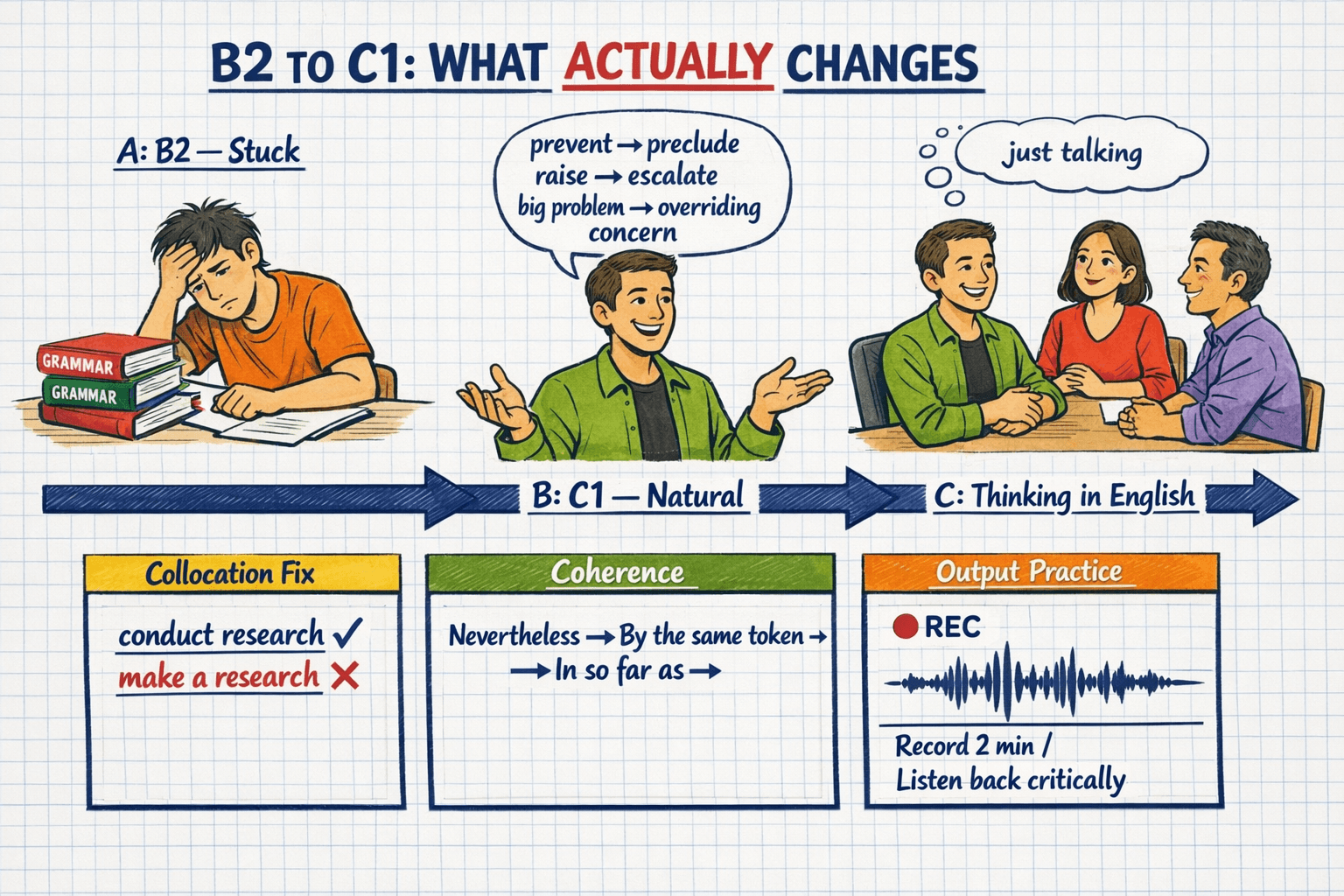
B2 is the most populated level on the CEFR scale. Millions of learners reach it and stay there for years, not because they've stopped trying, but because the thing that got them to B2 stops working. More grammar drills, more vocabulary lists, more comprehension exercises: diminishing returns. Something has to change, and it's not the quantity of study.
The gap between B2 and C1 is qualitative. A B2 speaker handles English correctly. A C1 speaker handles it naturally. That sounds like a small distinction until you try to close it — and then it turns out to be the hardest part of the whole journey.
This post explains exactly what changes at C1, why so many motivated learners plateau just below it, and what it actually takes to cross the line.
What C1 English Level Actually Means
C1 sits near the top of the CEFR scale, above B2 and below the near-native C2. The official description says a C1 speaker can express themselves fluently and spontaneously without much obvious searching for expressions, and produce clear, well-structured text on complex subjects.
The practical version is this: at B2, you can use English to accomplish things. At C1, the language stops getting in the way. The difference shows up in small, consistent moments — choosing between synonyms based on register rather than meaning, restructuring a sentence mid-thought without losing the thread, catching the irony in a headline without needing to pause and decode it.
C1 isn't perfection. C1 speakers make mistakes, encounter unfamiliar vocabulary, and occasionally struggle in fast-moving conversations. What they don't do is break down. They have enough range and flexibility to work around gaps without the conversation stalling — and that robustness is its own skill, distinct from any individual grammar point or vocabulary set.
Where the Gap Actually Shows Up
Grammar: flexible, not just correct
B2 learners know the rules. C1 speakers bend them purposefully.
At B2, you've internalized conditionals, passive voice, reported speech, and most of the tense system. At C1, the question isn't whether you know those structures — it's whether you can use them together, fluidly, without conscious effort. A C1 reader processes Had she known, she would have called without pausing to identify the inverted conditional. A C1 writer reaches for nominalization — the failure of the policy rather than the policy failed — because the context calls for a more formal register, not because they've stopped to apply a rule.
The structures that tend to separate C1 from B2 aren't exotic. They're things like complex participle clauses, advanced modal verb combinations, and inversion with negative adverbials: Not only did she arrive late, she also forgot the documents. These appear constantly in formal writing and professional speech. The C1 benchmark isn't recognizing them — it's producing them automatically, under real conditions, while the rest of your attention is on what you're actually trying to say.
Vocabulary: precise, not just broad
At B2, you have range. At C1, you have precision.
The shift isn't primarily about learning more obscure words. It's about knowing exactly when to use the words you already half-know. The difference between prevent and preclude, between raise and escalate, between relevant and pertinent isn't mainly a matter of meaning — it's register, collocation, and context. C1 learners stop saying "a big problem" and reach for substantial obstacle, overriding concern, or significant setback depending on what the situation calls for.
Collocations are where this plays out most clearly. Native speakers don't choose words one at a time — they pull whole phrases. Draw a distinction, reach a consensus, lend credibility to. Learners who plateau at B2 often have strong single-word vocabulary but still reach for slightly wrong combinations: make a research instead of conduct research, strong rain instead of heavy rain. These aren't grammar errors. They're collocation errors, and they accumulate into a pattern that marks your English as learned rather than lived. The fix is to stop learning vocabulary in isolation and start learning it in chunks — noting not just what a word means but what it habitually sits next to. The C1 vocabulary practice on esl-tests.com focuses specifically on collocations, formal expressions, and phrasal verbs at this level, which is more useful at this stage than general word lists.
Discourse coherence: the skill nobody names
This is the one that B2 learners most often don't know they're missing.
Discourse coherence is about how ideas connect across a whole piece of text or conversation — not sentence by sentence, but paragraph by paragraph. A C1 speaker signals their reasoning explicitly. They use discourse markers (nevertheless, in so far as, by the same token). They can shift between formal and informal registers without losing the thread. Their writing has a logic to it that a reader can follow without effort.
At B2, individual sentences are usually fine. What goes wrong is the connective tissue — the transitions, the topic sentences, the way one idea leads to the next. A B2 writer might produce six grammatically correct sentences that don't quite add up to a coherent paragraph. A C1 writer knows how those sentences need to relate to each other before writing them.
This shows up in speaking too. C1 speakers can hold the floor, redirect a conversation, and give an extended opinion without losing their own thread. That's not a grammar skill or a vocabulary skill. It's a structural one, and it develops through sustained exposure to well-argued English — reading opinion pieces, listening to debates, writing paragraphs that have to persuade someone. Working through C1 reading passages is worth doing even if reading isn't your weakest area, because the analytical habits you build there transfer directly into writing and extended speaking.
Idiomatic language: used, not just understood
At B2, you understand idioms when you encounter them. At C1, you use them — naturally, in the right context, without it sounding like you're demonstrating that you know one.
A lot of B2 speakers have memorized idioms and can identify them in a quiz. Using take something with a pinch of salt at exactly the right moment in conversation is a different skill. It requires a feel for register (idioms are informal — dropping one into a formal presentation lands badly), cultural familiarity, and enough fluency to insert the phrase without disrupting the flow of what you're saying. The same applies to figurative language more broadly: metaphor, understatement, hedging. At C1, you reach for these tools without pausing to think about them.
Speaking: the hardest skill to improve without help
Speaking is where most B2 learners feel the C1 gap most acutely — and it tends to get the least structured attention in self-study.
The issue at this level isn't vocabulary or grammar in isolation. It's accessing both simultaneously while the conversation is moving. A C1 speaker can reformulate when they've started a sentence the wrong way, hold the floor while they're thinking, and keep up with someone who isn't slowing down for them.
The most effective self-study technique available is also the least comfortable: record yourself speaking for two minutes on a complex topic without stopping, then listen back critically. Not for how you sound — for where you reached for the wrong word, where the grammar wobbled, where the argument lost its thread. Most learners find this deeply unpleasant the first few times. That discomfort is the signal that it's working. Without a tutor providing regular feedback, this is the fastest feedback loop you have.
Why B2 Learners Plateau
Most learners who get stuck below C1 aren't studying too little. They're studying the wrong way for this stage — specifically, consuming far more English than they produce, and working at a level of difficulty that stopped challenging them some time ago.
The output shortage is real. Reading and listening are necessary but not sufficient. You can passively recognize grammar structures for years without gaining the ability to produce them under pressure. Speaking and writing regularly, in conditions that stretch you, is what converts passive knowledge into active use. A B2 learner who writes 200 words a day in English and reviews them critically will improve faster than one who watches three hours of English-language TV.
The familiarity trap is just as common. At B2, English becomes comfortable. You can watch films, follow news, have real conversations. That comfort is genuinely earned — and it's also the reason many people stop moving. Consistent contact with material that's slightly too difficult is what drives improvement at this level: texts with words you don't know, speakers who don't accommodate you, topics where your vocabulary runs out before your ideas do.
The correction vacuum compounds both. Without structured feedback, B2 learners repeat the same errors indefinitely. A mistake that's never flagged becomes a habit. Even occasional feedback — from a tutor, a writing exchange, careful self-review of recorded speech — can break that cycle.
How Long Does It Actually Take?
There's no honest answer that applies universally, but based on what learners at this level consistently report, the realistic range for most adult learners is one to two years of genuine engagement — not calendar time, but active study time that includes regular output and challenging input. Learners immersed in English professionally or academically can move faster. Those whose study is mostly passive tend to stay longer. If you're unsure where you actually sit right now, the English level test covers grammar, vocabulary, reading, and listening — useful as a baseline before deciding where to focus.
The variable that matters most isn't hours — it's the ratio of active to passive work. An hour of focused writing with self-correction, or a conversation with someone who corrects you, outweighs several hours of subtitled television.
What C1 Feels Like When You Get There
There's a specific moment many learners describe, though they often don't recognize it at the time. You're in a conversation — maybe with a native speaker, maybe in a professional setting that used to feel high-stakes — and you reach the end of it without the low-level anxiety that's been a background hum for years. You weren't monitoring yourself. You were just talking.
That's not a skill you acquire. It's a habit the brain builds through enough exposure that English stops requiring conscious management. Grammar becomes a background process. Vocabulary retrieval gets fast enough that you stop noticing it's happening. The language gets out of the way.
Getting there isn't about studying harder than you did at B2. It's about producing more, working at higher difficulty, and staying there long enough for the effort to become instinct.