
Why Your English Stops Improving at B2 (And the Specific Habits That Break the Plateau)
Published on March 29, 2026 • 6 mins read
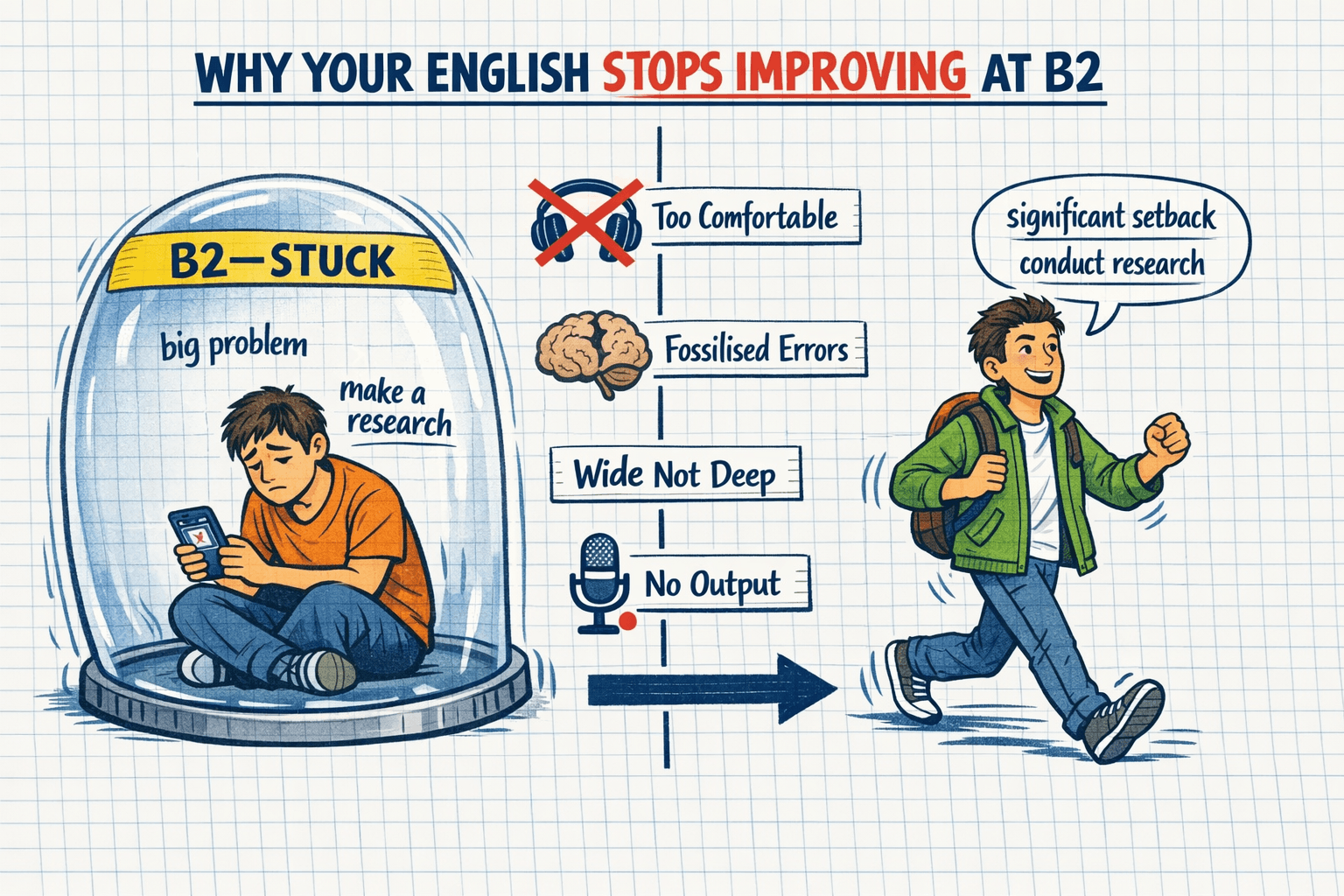
The B2 plateau is hard to diagnose because nothing feels wrong. Your English works. You follow conversations, read articles, make yourself understood in professional settings. The problem is invisible from the inside — you're processing the language perfectly well, which feels like progress but isn't the same thing. Acquisition stops when the brain stops being stretched, and at B2, most learners have arranged their study habits so nothing stretches them anymore.
Three of the four reasons this happens are habit problems — fixable by changing what you do. The fourth is a linguistic phenomenon with its own logic. All four have concrete fixes. Here they are.
Reason 1: Your Input Has Become Too Comfortable
In the 1980s, linguist Stephen Krashen proposed that language acquisition happens primarily through comprehensible input — material pitched just above your current level, where you understand most of it but have to work at the edges. The brain keeps acquiring language when it's being stretched, and coasts when it isn't.
At B2, most learners have stopped being stretched by their input. The podcasts, articles, and films they've settled into are genuinely comprehensible — processed fluently, without effort. That feels like progress because once it felt hard. But fluent processing isn't acquisition. The learning stops when the difficulty does.
The fix requires being specific about what harder input actually means, because "read more challenging material" isn't a method.
At C1, the distinguishing feature of a text isn't mainly vocabulary difficulty — it's structure. C1-level writing uses dense subordination, embedded clauses, and implicit argument. The author's position isn't stated; it's implied through what they include, what they omit, and how they frame both. A B2 reader follows what a text says. A C1 reader tracks what it's doing. That shift in how you engage with written English is one of the central things that changes between the two levels.
Good sources for this: long-form opinion journalism (The Economist, The Atlantic, quality broadsheet editorials), academic abstracts outside your own field, and transcripts of unscripted interviews with intellectually demanding guests. The diagnostic: after one read, can you summarise the author's actual argument — not the topic, the argument — in two sentences? If you can't, the text is doing the right job.
B2 reading practice covers the complex topics and extended argument structures that characterize upper-intermediate English. If those already feel comfortable, your comprehension ceiling is ready to be pushed higher.
Reason 2: Your Grammar Errors Have Fossilised
Fossilisation is a concept from second language acquisition research: the point at which certain errors stop being developmental and become permanent. Not because the learner doesn't know the rule — often they do — but because the wrong form has been produced so many times, without correction, that the brain retrieves it automatically. It's become the default.
B2 is where fossilisation does most of its damage. By now you've been producing English for years. Early errors have had years of repetition to harden. And because your English is functional — people understand you, conversations continue — the errors don't generate the friction that might otherwise flag them.
Common fossilised patterns at this level: wrong prepositions after specific verbs (depend of, interested about), article errors with abstract nouns, and aspect mistakes — reaching for the past simple where the present perfect is more precise. That last one embeds early in speakers of many languages — Romance languages especially — because their equivalent tenses work differently enough that the wrong English form becomes habituated before the distinction is fully internalized. Once the wrong form is habituated, fluency makes it worse: the faster and more naturally you speak, the less chance the monitoring brain has to intervene.
The fix is more complicated than for the other three problems, because fossilisation isn't just a habit — it's a deeply learned incorrect form that has to be noticed every single time it occurs to be overwritten. Occasional awareness doesn't override it. A tutor explicitly tasked with flagging specific recurring errors is the most direct route. But most learners don't have one, so here's what self-study actually looks like.
Start by identifying your specific fossilised forms. Take a piece of your written output — an email, a paragraph, anything you wrote without stopping to edit — and look for three things: preposition choices after verbs you use often, article use before abstract nouns, and past simple vs present perfect in contexts where both feel possible. Note every instance, not just the ones you're uncertain about. Do this across several pieces of writing and patterns will emerge: not random errors, but the same two or three forms going wrong repeatedly.
Once you've named them, build a correction checklist and run every piece of written output through it before considering it finished. This is slower and less efficient than a tutor catching errors in real time. It works anyway, because the mechanism of fossilisation is unconscious production — and a checklist forces conscious review of exactly the forms that have gone underground.
Reason 3: Your Vocabulary Is Wide but Shallow
B2 learners typically have a large passive vocabulary. What they often lack is depth: knowing a word well enough to use it precisely, in the right collocation, at the right register, without reaching.
Here's what shallow vocabulary looks like in practice. You know the word alleviate. But do you know that it collocates naturally with concerns, suffering, tension, and symptoms — and sounds strained next to problem, where address or tackle would be more idiomatic? Do you know it's formal enough that using it in casual conversation lands oddly? Knowing a word means knowing all of that. At B2, most learners know about half of it for most of their vocabulary.
The same gap shows up with fixed expressions. You've encountered sit on the fence, bring something to a head, call something into question. You can understand them. Using them requires knowing not just the meaning but the precise register in which they land naturally — drop one in the wrong setting and it calls attention to itself.
The fix: At this level, the unit of vocabulary learning needs to expand from single words to phrases — the collocation, the fixed expression, the verb-noun pairing in context. Vocabulary lists remain useful for building recognition, but a list of headwords won't tell you that alleviate sits naturally next to concerns and symptoms and sounds strained next to problem. When you encounter draw a distinction, note the whole phrase, find two or three sentences that use it naturally, and test yourself on the chunk. That's what depth looks like in practice.
Reading at C1 level exposes you to these collocations in the sentences where they actually occur — which is harder to replicate with any list, however carefully constructed.
Reason 4: You're Not Under Any Output Pressure
This is the most common reason B2 learners stall, and the least acknowledged, because consumption feels productive.
Reading, listening, watching — all of these help, up to a point. None of them require you to produce language under pressure: retrieve vocabulary in real time, hold a grammatical structure in your head while tracking what you want to say, commit to a sentence when you're not certain it's right. Output pressure is what forces the gap between what you can recognise and what you can use. Without it, passive knowledge stays passive. You can understand the subjunctive for years without ever producing it spontaneously. You can recognise a discourse marker in a text and never reach for it when you write.
For speaking: Record yourself talking on a complex topic for two uninterrupted minutes. Don't script it. Then listen back and note specifically where the vocabulary ran out, where the grammar wobbled, where you stalled or repeated yourself. Track whether the same problems recur across sessions — they will, and that recurrence identifies exactly where your active language is still incomplete.
What the recording technique doesn't replicate is live conversation: the pressure of a real-time exchange where you can't pause, re-record, or choose your moment. Most B2 learners who feel stuck specifically in spoken interaction are stalling not because they lack vocabulary or grammar in the abstract, but because they can't access both simultaneously while the conversation is moving.
The most effective fix for this is a language exchange with someone who has agreed to interrupt and correct — not just to understand you. That explicit permission changes the dynamic entirely. In ordinary conversation, native speakers and polite interlocutors will follow your meaning even when your form is wrong, which means your errors cost you nothing and you never notice them. An exchange partner who has been asked to stop you when something is off — on a specific grammar point you've told them you're working on — creates the friction that normal conversation doesn't. Even one session a week of this, focused on a single structure, will surface errors that years of regular conversation left invisible.
For writing: Don't write about things you can already express comfortably. Write opinions on subjects where your vocabulary runs thin, summaries of arguments that stretch your grammar, formal responses that require a register you don't use naturally. Review the output the next day — not asking "is this correct?" but "is this the most precise version of this sentence?"
The Use of English tests at B2 are useful here as production practice rather than just assessment. The transformation and gap-fill tasks require producing specific structures under constraint — considerably closer to real language use than comprehension exercises, and a reliable way to surface the gap between what you recognise and what you can actually generate.
The Thing These Four Have in Common
Each of these problems looks like a different issue, and in one sense it is — they have different causes and different fixes. But underneath all four is the same dynamic: B2 is functional enough that nothing forces you to improve. The language carries you without breaking down. Nobody corrects you, your input doesn't challenge you, your errors don't cost you anything.
Progress past this point doesn't come from doing more of what got you here. It comes from deliberately reintroducing difficulty into a process that has become too comfortable — harder input, external correction, vocabulary in context, and production that demands more than recognition. That's not a motivational point. It's a structural one.