Present Perfect Continuous— B1 Grammar Exercises
Published March 14, 2026
Exercise 1 — Multiple Choice
She ____ studying for three hours before the exam started.
They ____ waiting for the bus since 8 AM.
I ____ working on this project for a month now.
He ____ playing football since he was a child.
We ____ trying to fix the car all day.
You ____ learning English for two years now.
She ____ working at this company since 2015.
They ____ discussing the project for hours.
I ____ thinking about moving to a new city.
He ____ practicing the guitar every day for a year.
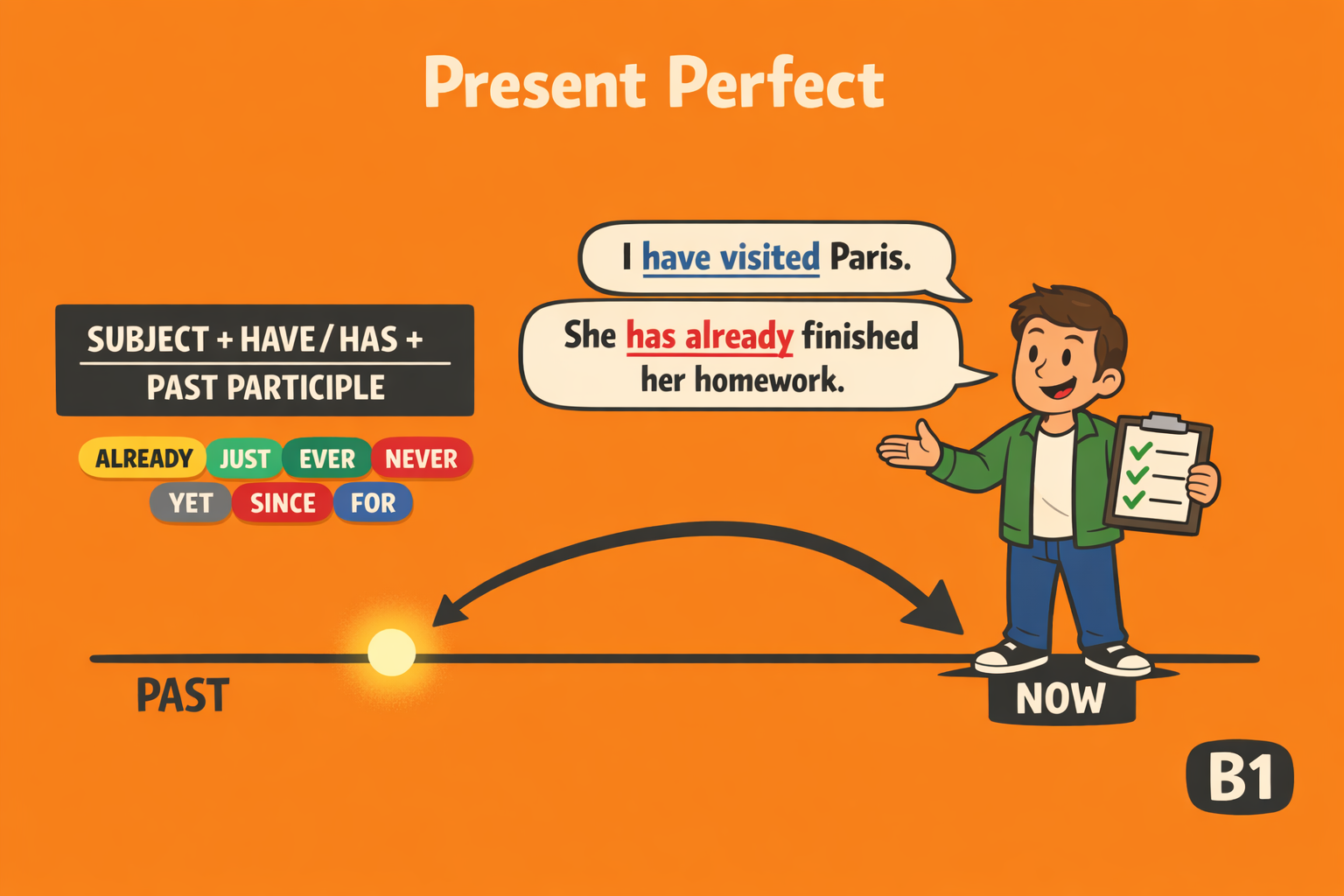
Your friend arrives at your door, completely out of breath. You ask: "What's wrong?" She says: "I've been running for thirty minutes to get here on time." The running started in the past, continued for a period, and the evidence — her breathing, her red face — is right in front of you. That is the present perfect continuous at work.
This tense puts the focus on the activity itself and how long it has been happening. Unlike the present perfect, which focuses on the result or completion, the present perfect continuous emphasises the process and its duration.
Form
Use has been with he, she, it. Use have been with everything else.
| Positive | Negative | Question | |
|---|---|---|---|
| I / You / We / They | I have been waiting for an hour. | We have not (haven't) been waiting long. | Have they been waiting? |
| He / She / It | She has been studying all morning. | He has not (hasn't) been sleeping well. | Has it been raining? |
The -ing form follows the same spelling rules as other continuous tenses: run → running, make → making, sit → sitting.

When to Use the Present Perfect Continuous
1. An action that started in the past and is still happening (with for and since)
This is the most common use. The action began at some point in the past and continues right now. You want to stress the duration or the ongoing nature of the activity.
- They have been living in Madrid since 2020. (They still live there.)
- I 've been learning the guitar for six months. (I'm still learning.)
Use for with a duration and since with a starting point — the same rule as with the present perfect. For a closer look at the difference between these two words, see for vs since.
2. A recent activity that explains a present result
The action has just stopped (or is still going), and you can see evidence of it now. The focus is on the activity that caused the current situation.
- Your shoes are muddy. Have you been walking through the park?
- Sorry about the mess — I 've been painting the kitchen.
3. Repeated actions over a recent period
The action has been happening again and again up to now. The speaker sees this repetition as a continuous pattern.
- She has been calling the office all day, but nobody answers.
- My neighbours have been having parties every weekend.
4. Expressing annoyance or emphasis
The present perfect continuous can carry an emotional tone — frustration, surprise, or emphasis — especially when the duration feels long or unreasonable.
- I 've been waiting for you for over an hour!
- Who has been eating my chocolate?
Signal Words
| Word / Phrase | Use | Example |
|---|---|---|
| for | Duration | He's been working here for three years. |
| since | Starting point | We've been waiting since 9 o'clock. |
| all day / all morning / all week | Extended time period | It's been snowing all day. |
| lately / recently | Unspecified recent period | You've been working too hard lately. |
| How long…? | Asking about duration | How long have you been studying English? |
Verbs You Cannot Use in the Continuous
Stative verbs — verbs that describe states rather than actions — do not normally take the continuous form. With these verbs, use the present perfect instead.
| Category | Verbs |
|---|---|
| Possession | have, own, belong, possess |
| Feelings / Opinions | like, love, hate, want, need, prefer, believe, know, understand |
| Senses / Perception | see, hear, smell, taste (in their state meaning) |
I've been knowing her for years.
I've known her for years.
Know is a state, not an action. It cannot take the continuous form.

Present Perfect Continuous vs Present Perfect
The difficulty here is that both tenses connect the past to the present. The difference lies in what you want to emphasise: the activity and its duration, or the result and completion.
| Present Perfect Continuous | Present Perfect |
|---|---|
| I 've been reading your book. (I'm still reading it — not finished.) | I 've read your book. (I finished it.) |
| She 's been writing emails all morning. (Focus on the activity and time spent.) | She 's written ten emails. (Focus on the number — the result.) |
| It 's been raining. (The ground is wet — evidence.) | It 's rained three times this week. (Counting completed events.) |
| How long have you been working here? | How many projects have you finished? |
A useful shortcut: if the question starts with how long, the answer usually needs the present perfect continuous. If it starts with how many or how much, the answer usually needs the present perfect.
Common Mistakes
She has been written three reports today.
She has written three reports today.
When you state a number or quantity, use the present perfect — not the continuous.
I have been wanting to tell you something.
I have wanted to tell you something.
Want is a stative verb. Use the present perfect for states.
He is been working all day.
He has been working all day.
The auxiliary is has/have, not is/are. Don't confuse this with the present continuous.
We have been lived here since May.
We have been living here since May.
After have been, you need the -ing form — not the past participle.
How long are you studying English?
How long have you been studying English?
Questions about duration from the past to now require the present perfect continuous.
I've been finishing the project.
I've finished the project.
Finish describes a completed action. Use the present perfect when the result — completion — is the point.
- Form: have/has + been + verb-ing. Three parts — don't drop any of them.
- Use it for ongoing actions, recent activities with visible evidence, repeated actions over time, and to express emphasis or annoyance.
- Key signal words: for, since, all day, lately, recently, how long.
- Stative verbs (know, like, own, believe) cannot take the continuous form — use the present perfect instead.
- How long? → present perfect continuous. How many? → present perfect.
Related Topics
Present Perfect — the tense this is most often compared with. Make sure you understand both before moving on.
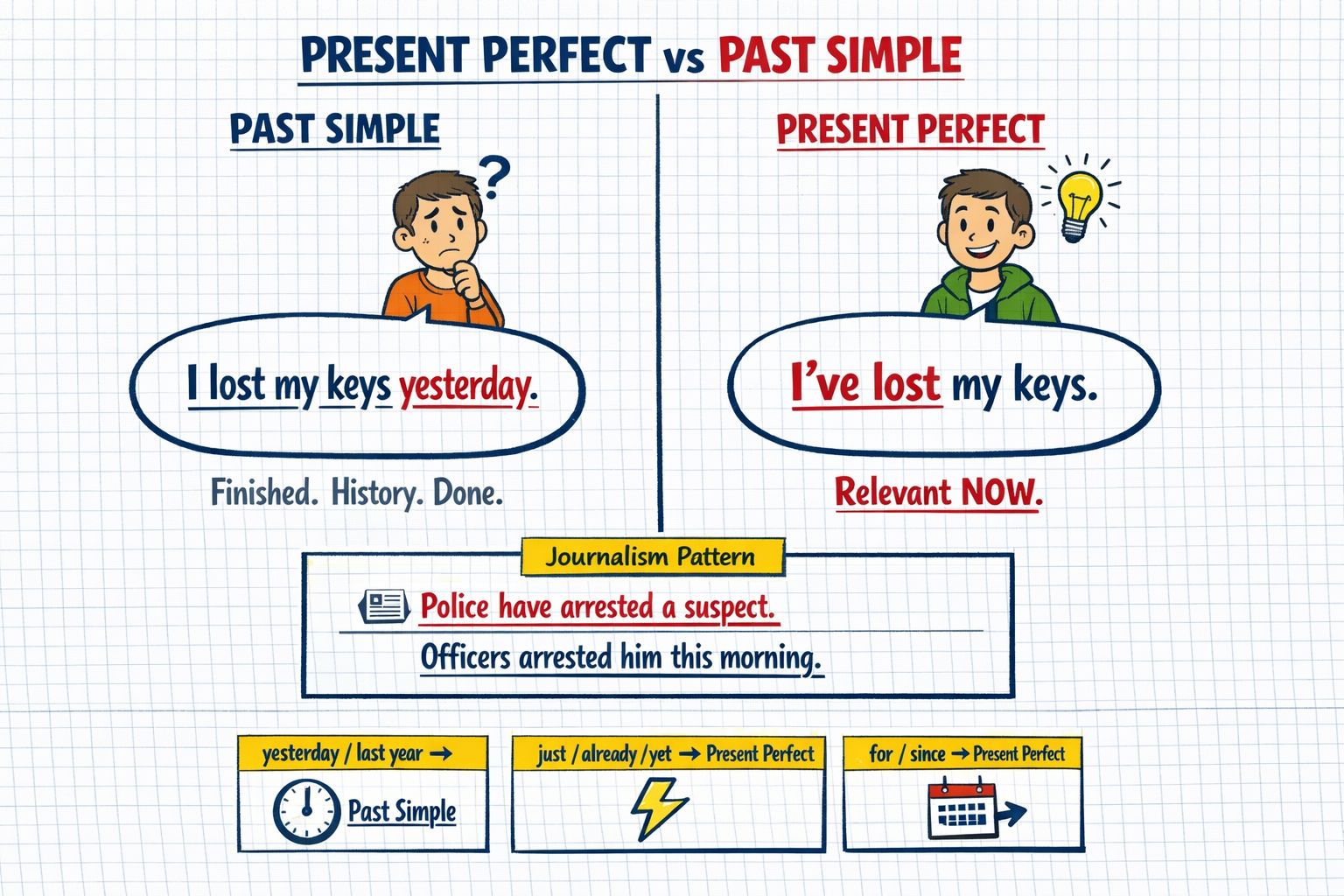
Present Perfect vs Past Simple — a broader comparison that helps place all three tenses in context.
For vs Since — essential for both the present perfect and the present perfect continuous.