Present Perfect— B1 Grammar Exercises
Published March 14, 2026
Exercise 1 — Multiple Choice
I ____ my homework already.
She ____ to Paris three times.
They ____ the movie yet.
We ____ in this city for five years.
He ____ his keys again.
I ____ my friend since last year.
They ____ their project yet.
She ____ her phone at home.
We ____ to the new restaurant yet.
He ____ his homework before dinner.
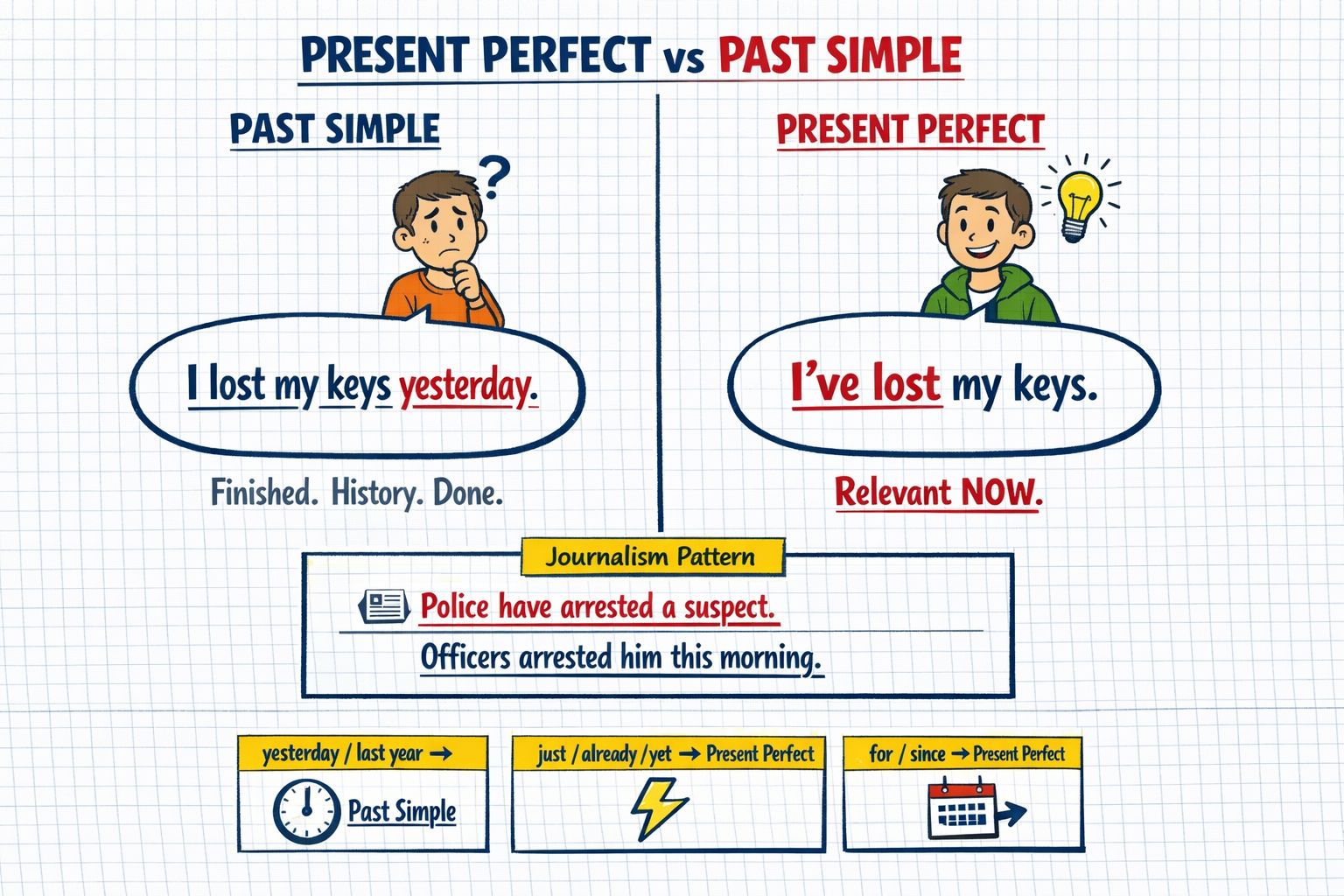
Someone asks you: "Have you ever been to Japan?" They don't care when you went. They care whether the experience exists in your life — right now, looking back. That connection between a past event and the present moment is exactly what the present perfect does.
Unlike the past simple, which places an action at a finished point in time, the present perfect leaves the time open. The action matters because of its result, its duration, or its relevance now.
Form
Use has with he, she, it. Use have with everything else.
| Positive | Negative | Question | |
|---|---|---|---|
| I / You / We / They | I have finished the report. | We have not (haven't) finished the report. | Have they finished the report? |
| He / She / It | She has moved to Berlin. | He has not (hasn't) moved to Berlin. | Has it changed? |
The past participle of regular verbs is the same as the past simple form: worked, played, visited. Irregular verbs have their own forms: gone, seen, written, taken. If you're unsure about irregular forms, review past simple irregular verbs — the third column of those verb tables is what you need here.

When to Use the Present Perfect
1. Life experience (with ever and never)
Use the present perfect to talk about experiences at any time in your life up to now. The exact time is not important — only whether the experience happened.
- Have you ever tried Korean food?
- My parents have never flown in a helicopter.
2. Recent actions with a present result (with just)
Something happened a short time ago, and you can see or feel its effect right now.
- Tom has just left the office — his computer is still warm.
- I 've just finished cooking. Dinner is ready.
3. Unfinished actions or states (with for and since)
The action or state started in the past and continues now. This is one of the most important uses — and a common source of confusion with the past simple.
- Maria has lived in London for three years. (She still lives there.)
- We have known each other since 2019. (We still know each other.)
Use for with a duration (for two hours, for a long time) and since with a starting point (since Monday, since I was a child). For a deeper look, see for vs since.
4. Change or progress over time
The present perfect shows how a situation has developed from the past to the present.
- Your English has improved a lot this year.
- The company has grown from 10 to 200 employees.
5. Incomplete time periods (with today, this week, this year)
When the time period is still open — still happening — use the present perfect. When it's closed, use the past simple.
- I 've had three meetings today. (Today isn't over.)
- She hasn't called this week. (The week is still going.)
Signal Words
| Word / Phrase | Position | Example |
|---|---|---|
| ever | Between subject and past participle | Have you ever seen a whale? |
| never | Between subject and past participle | He has never been late. |
| just | Between auxiliary and past participle | They've just arrived. |
| already | Between auxiliary and past participle | I've already eaten. |
| yet | End of negatives and questions | Has the train left yet? |
| for | Before a duration | We've waited for two hours. |
| since | Before a starting point | She's worked here since March. |

Common Mistakes
I have seen him yesterday.
I saw him yesterday.
Yesterday is a finished time. Use the past simple with specific past times. For a full comparison, see present perfect vs past simple.
She has went to the shop.
She has gone to the shop.
You need the past participle (gone), not the past simple form (went).
I live here for five years.
I have lived here for five years.
An action that started in the past and continues now requires the present perfect, not the present simple.
Did you ever visit Rome?
Have you ever visited Rome?
Life-experience questions use the present perfect. The past simple would only be correct if you're asking about a specific, finished trip.
I have already ate lunch.
I have already eaten lunch.
After have/has, always use the past participle — eaten, not ate.
He has been to Paris last summer.
He went to Paris last summer.
Last summer pins the action to a closed time period. Switch to the past simple.
Present Perfect vs Past Simple
This is the comparison that causes the most trouble at B1. The core difference: the present perfect connects to now; the past simple does not.
| Present Perfect | Past Simple |
|---|---|
| I 've lost my keys. (I still can't find them.) | I lost my keys yesterday. (Specific time.) |
| She has worked here for six years. (She still works here.) | She worked there for six years. (She doesn't work there anymore.) |
| Have you been to Japan? (Any time in your life.) | Did you go to Japan last year? (Specific time.) |
A useful test: if you can add a specific past time (yesterday, in 2020, last week) and the sentence still makes sense, you probably need the past simple. If the time doesn't matter — only the result or the fact — use the present perfect.
- Form: have/has + past participle. Always the participle — never the base form or past simple form.
- Use it for life experiences, recent results, unfinished situations, change over time, and incomplete time periods.
- Key signal words: ever, never, just, already, yet, for, since.
- Specific past time (yesterday, last year, in 2010) → past simple, not present perfect.
- If the situation is still continuing now, you need the present perfect (or present perfect continuous).
Related Topics
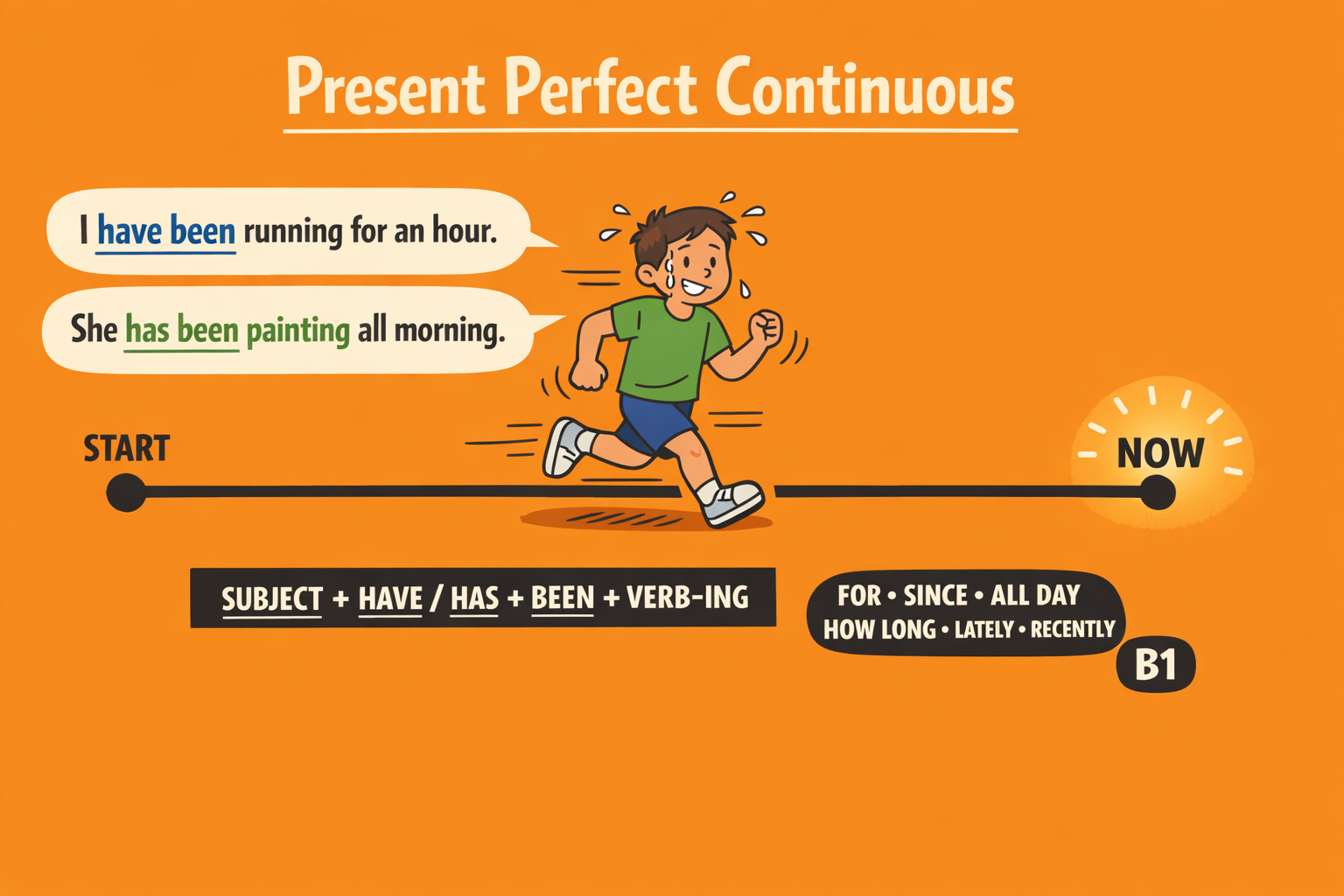
Present Perfect Continuous — for actions that started in the past and are still happening, with emphasis on duration or the activity itself.
Present Perfect vs Past Simple — a detailed comparison of the two tenses with more examples and practice.
For vs Since — how to choose between these two time expressions.