
50 Most Commonly Misspelled English Words (and How to Finally Get Them Right)
Published on April 19, 2026 • 11 mins read
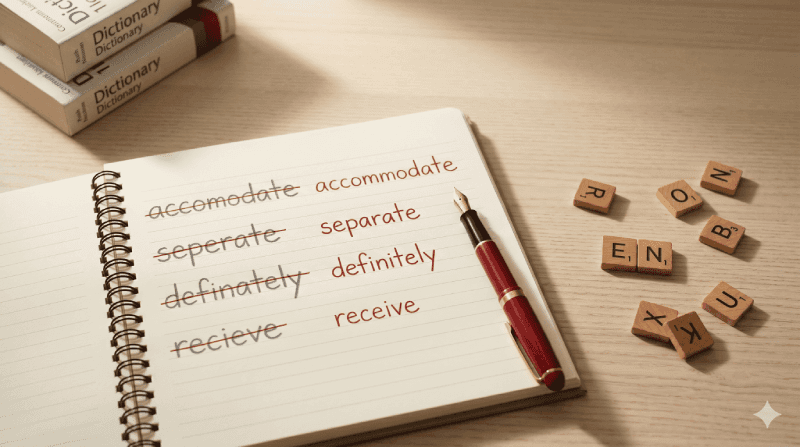
Most ESL learners stumble on the same core set of English words — and honestly, so do a lot of native speakers. The reason isn't intelligence or effort. It's that English spelling follows patterns until it suddenly doesn't, and the words you use most often are exactly the ones with the nastiest traps: silent letters, doubled consonants that don't sound doubled, vowel combinations that could go either way.
This list covers the 50 words that show up most frequently as spelling errors in essays, emails, and exams. Each entry gives you the correct spelling, the common wrong versions, a quick explanation of why it's tricky, and a memory hook to make it stick. If you want to drill these actively — listen, type, get instant feedback — you can practice all 50 as an interactive spelling test.
Jump to a section:
Double-Letter Traps · Silent Letters · Vowel Mix-Ups · Tricky Endings · Words That Just Won't Stick
Double-Letter Traps
The hardest thing about English double consonants is that you can't hear them. Nobody pronounces both m's in "accommodate" or both r's in "embarrass." You just have to know they're there.
1. accommodate · ✗ accomodate, acommodate · Two c's AND two m's — most people remember one but forget the other. · Trick: Think of two Cots and two Mattresses — cc, mm. · "The hotel can accommodate up to 200 guests."
2. address · ✗ adress, addres · Double d AND double s — people tend to get one right and miss the other. · Trick: You ADD your address, then Send it twice — dd, ss. · "Please confirm your email address."
3. committee · ✗ comittee, commitee, comitee · Double m, double t, double e — a triple threat. · Trick: MM meet TT for a committEE — double letters in that order: m, t, e. · "The committee approved the budget unanimously."
4. embarrass · ✗ embarass, embarras, embaress · Two r's and two s's. · Trick: You go Really Red and Start Sweating — rr, ss. · "I didn't mean to embarrass you in front of everyone."
5. exaggerate · ✗ exagerate, exaggarate · One g or two? Two. · Trick: EX + AGGravate — both "agg" words take double g. · "Don't exaggerate the risks."
6. harass · ✗ harrass · Only one r — the opposite of what most people write. · Trick: Harass has one r, embarrass has two. Learn them as a pair. · "It's illegal to harass someone at work."
7. interrupt · ✗ interupt, interrup · Double r in the middle, not where you'd expect. · Trick: It's really rude to interrupt — double r for really rude. · "Sorry to interrupt, but there's a call for you."
8. millennium · ✗ millenium, milenium · Double l AND double n. · Trick: A millennium is 1,000 years — ll + nn = lots of letters for lots of years. · "We celebrated the new millennium in 2000."
9. occurrence · ✗ occurence, occurrance, ocurrence · Double c, double r, then -ence. · Trick: It occurs with cc and rr. · "Food poisoning is a common occurrence in summer."
10. possession · ✗ posession, possesion · Four s's total. · Trick: Possession is obsessive about the letter s. · "The document is in my possession."
11. questionnaire · ✗ questionaire, questionairre · Double n, not double r. · Trick: A questionnaire needs more n's for more questions. · "Please complete the questionnaire before your appointment."
12. recommend · ✗ recomend, reccommend · One c, two m's. · Trick: I recommend you remember: one c, then mm. · "I'd recommend the seafood pasta."
13. successfully · ✗ succesfully, sucessfully, successfuly · Three pairs of doubles: cc, ss, ll. · Trick: Success already has cc + ss; add -fully (with ll) and you've got three doubles in a row. · "She successfully defended her thesis."
14. colleague · ✗ collegue, colleage, collaegue · Double l, then -eague (not -ege). · Trick: Your colleague is in a league of their own — it ends like "league." · "A colleague recommended me for the position."
Silent Letters
A huge chunk of English spelling irregularity comes from history — words borrowed from French, Latin, and Greek arrived with letters that were once pronounced and then went quiet over centuries. The k in "knowledge," the g in "foreign," the first r in "February" — they're fossils of older pronunciation. Your ear can't help you here. You have to learn to see the letters your mouth no longer uses.
15. conscience · ✗ concience, consience, conshence · The sc makes a "sh" sound — easy to scramble the letters. · Trick: Your conscience involves science — both have sc. · "My conscience wouldn't let me stay quiet."
16. environment · ✗ enviroment, envirnoment · That second n is silent in fast speech. · Trick: The environ-ment has iron in it. · "We need to protect the environment."
17. February · ✗ Febuary, Febrary · Almost everyone drops the first r because it's barely pronounced. · Trick: Say "Feb-ROO-ary" in your head when spelling — exaggerate that first R. · "The deadline is 15 February."
18. foreign · ✗ foriegn, forein · The g is silent, and the vowel order is counterintuitive. · Trick: A foreign REIGN — both end in -eign. · "She speaks three foreign languages."
19. government · ✗ goverment, govenment · The n before m vanishes in speech. · Trick: Govern + ment — don't drop the n when you add the suffix. · "The government announced new regulations."
20. knowledge · ✗ knowlege, noledge · Silent k, silent d-before-g combination. · Trick: You KNOW the LEDGE — know + ledge. · "Her knowledge of the subject is impressive."
21. library · ✗ libary, liberry · The first r gets swallowed in speech. · Trick: A lib-RAR-y is RARE and valuable — don't drop the first r. · "I borrowed three books from the library."
22. parliament · ✗ parlament, parliment · The ia combination is unstressed and easy to skip. · Trick: "I AM" sits inside parliament — parlIAMent. · "Parliament will debate the bill next week."
23. rhythm · ✗ rythm, rythym, rhythym · No real vowel — two y's doing all the work. · Trick: Rhythm Has Your Two Hips Moving. · "The rhythm of the music was infectious."
24. Wednesday · ✗ Wensday, Wendsday · The d is completely silent. · Trick: WED-NES-DAY — say all three syllables when you spell it. · "The meeting is on Wednesday afternoon."
Vowel Mix-Ups
English has roughly 20 vowel sounds but only 5 vowel letters (6 if you count y) to represent them. That means unstressed vowels — the ones you rush past in normal speech — could plausibly be spelled with almost any letter. Is it "a" or "e" in "separate"? Your ear hears a vague "uh" sound and shrugs. The "i before e" rule helps with some of these, but it has enough exceptions to keep you guessing. If you're also mixing up whole words that sound alike — affect/effect, principal/principle — our commonly confused word pairs practice covers those separately.
25. achieve · ✗ acheive, achive · ie, not ei — follows the standard "i before e" pattern. · Trick: You can achIEve if you belIEve — both use ie. · "She worked hard to achieve her goals."
26. believe · ✗ beleive, belive · ie, not ei. · Trick: Don't beLIEve a LIE. · "I believe we've met before."
27. receive · ✗ recieve, receve · ei after c — the classic rule actually works here. · Trick: i before e, EXCEPT after c → receive. · "Did you receive my email?"
28. weird · ✗ wierd · One of the most common exceptions to the "i before e" rule — ei with no preceding c. · Trick: Weird starts with "we" — so E comes before I. · "That's a weird coincidence."
29. experience · ✗ experiance, expirence · The second e sounds like an a. · Trick: Experience ends like existence — both use -ence. · "Do you have any experience with Python?"
30. calendar · ✗ calender, calander · The vowels alternate: a-e-a. · Trick: cAl-End-Ar — the vowels spell A-E-A. · "Mark it on your calendar."
31. category · ✗ catagory, catigory · The second vowel is e, not a. · Trick: CatEgory — E, not A, in the middle. · "Which category does this fall under?"
32. cemetery · ✗ cemetary, cematery · Three e's, zero a's. · Trick: A cemetery is all E's — eee, like a scream. · "The old cemetery dates back to the 1700s."
33. privilege · ✗ priviledge, privelege · No d, and the second vowel is i, not e. · Trick: It's a priVILege to have VIL, not a "ledge" to stand on. · "Education is a privilege, not a right."
34. separate · ✗ seperate · One of the most commonly misspelled words in English — the first vowel sounds like e but is a. · Trick: There's A RAT in sepARAte. · "Please separate the documents by date."
Tricky Endings
Is it -ance or -ence? -ible or -able? -ely or -ately? English suffix rules are inconsistent enough that even advanced writers second-guess themselves. If you're prepping for IELTS, these endings are exactly the kind of errors examiners flag — our IELTS spelling practice drills the 28 words they mark most often.
35. definitely · ✗ definately, definatly, defiantly · The -ite- in the middle, not -ate-. · Trick: It's definITE-ly — there's "finite" in there. · "I'll definitely be there by six."
36. independent · ✗ independant · Ends in -ent, not -ant. · Trick: Independent ends like "dent" — you can see DENT at the end. · "She's financially independent."
37. maintenance · ✗ maintainance, maintenence · -enance, not -ainance. · Trick: You mainTAIN, but the noun is mainTENance — the vowel shifts. · "The building needs regular maintenance."
38. necessary · ✗ neccessary, necesary, neccesary · One c, two s's. · Trick: A shirt has one Collar and two Sleeves — one c, two s's. · "Is it really necessary to attend?"
39. perseverance · ✗ perserverance, perseverence · sever in the middle, -ance at the end. · Trick: You SEVER obstacles through perseverance. · "Her perseverance paid off in the end."
40. pronunciation · ✗ pronounciation · No "ounce" — the verb is "pronounce" but the noun drops the o. · Trick: You proNOUNce, but it's proNUNciation — the noun loses the O. · "Your pronunciation has improved a lot."
41. conscientious · ✗ concientious, conscientous · sci + ent + ious — three tricky clusters in a row. · Trick: Break it into chunks you can say: con-sci-en-ti-ous — five syllables, each short enough to hold in your head. · "She's the most conscientious worker on the team."
42. disappear · ✗ dissapear, disapear · One s, two p's. · Trick: dis + appear — one prefix, then the full word "appear." · "The stain will disappear after washing."
43. disappoint · ✗ dissapoint, disapoint · Same pattern as disappear: one s, two p's. · Trick: dis + appoint — the same prefix rule. · "I don't want to disappoint anyone."
Words That Just Won't Stick
Some words don't fit neatly into pattern categories — their spelling traps are one-off quirks inherited from French, Latin, or just centuries of inconsistent usage. These are the words where pattern recognition won't save you; you need to learn them individually through deliberate repetition. If you're at A2 level and some of these feel out of reach, start with the 50 easier commonly misspelled words designed for beginners. If you're already nailing this list, challenge yourself with the C1 advanced misspelled words — think bureaucracy, mnemonic, and playwright.
44. acquire · ✗ aquire, accuire · The c before q catches people off guard. · Trick: ACQ — the C and Q always travel together: acquire, acquaint, acquit. One c, then q. · "We plan to acquire the smaller company."
45. consensus · ✗ concensus, consencus · No c in the middle — it's all s's. · Trick: ConSENSus — there's SENSE in the middle. · "We reached a consensus after two hours."
46. exercise · ✗ excercise, exersize · No extra c after x, and -cise at the end (not -size). · Trick: EXER-CISE — starts like "exert," ends like "precise." No extra letters in either half. · "Regular exercise improves concentration."
47. guarantee · ✗ garantee, guarentee · The u after g is silent, and the second vowel is a, not e. · Trick: I GUARANTEE there's a U in it. · "We guarantee delivery within 48 hours."
48. liaison · ✗ liason, liasion, liaision · Two i's, and the ai combination is unusual in English. · Trick: Liaison is French — the unusual "ai" cluster is a French fingerprint. Think of liAISon like "aisle" without the L: AIS in the middle. · "She's the liaison between the two departments."
49. occasion · ✗ ocassion, occassion, ocasion · Two c's, one s — the opposite of "necessary." · Trick: Occasion and necessary are mirror images: occasion = cc + s, necessary = c + ss. · "It was a special occasion."
50. restaurant · ✗ restaraunt, restraunt, resturant · The au is buried in the middle where nobody expects it. · Trick: A restAUrant serves AU gratin — au is in the middle. · "Let's try that new restaurant downtown."
What to Do Next
Reading a list helps you recognize these words. But recognition isn't the same as recall — and it's recall you need when you're typing an email, writing an exam, or filling in a form. The only way to build that is active practice: hear the word, type it from memory, find out instantly if you got it right.
That's exactly what our 50 commonly misspelled words spelling test does. You listen to each word, type your answer, and get immediate feedback. Easy mode shows the first letter to help you start. Hard mode plays the audio only — pure dictation, no hints.
Want a quick-reference version you can keep on your desk or print out before an exam? Download the free one-page PDF cheat sheet — all 50 words, correct spellings, and memory tricks in a single printable page.
Once you've cleared this list, your next step depends on what you need. If spelling shows up in your work life — reports, client emails, proposals — the business spelling practice covers the 20 words professionals misspell most often. Or if you want to explore the full spelling practice collection, there are exercises sorted by level, topic, and exam type.
Frequently Asked Questions
Is it "a lot" or "alot"?
Always two words: a lot. "Alot" isn't a word in standard English — it's one of those errors that's so widespread it looks right, but no dictionary accepts it. If you catch yourself writing "alot," think of "a little" — you'd never write "alittle," and the same logic applies.
Why is English spelling so irregular?
English borrowed heavily from French, Latin, Greek, Norse, and dozens of other languages over more than a thousand years — and it kept the original spelling of many borrowed words even as pronunciation shifted. The word "knight" was once pronounced with a hard k and a guttural gh. The spelling stayed; the sounds left. Add in the fact that English never had a central language academy standardizing things (unlike French or Spanish), and you get a system where "cough," "through," "though," and "rough" all end in -ough but none of them rhyme.
What's the fastest way to stop misspelling words?
Active recall beats passive reading every time. Don't just look at a word and think "okay, I know that." Cover it up and write it from memory. Better yet, use dictation-style practice where you hear the word and type it without seeing it first. Research on memory consistently shows that the effort of retrieving information — not just reviewing it — is what makes it stick long-term. Even ten minutes a day of active spelling practice will outperform an hour of reading word lists.
Do spelling mistakes affect my IELTS score?
Yes. In IELTS Writing, spelling errors count against your "Lexical Resource" band score. A few minor slips won't tank your grade, but repeated misspelling of common words — especially words you're using as key vocabulary in your argument — signals weak control and can pull you down a half-band or more. In IELTS Listening and Reading, a misspelled answer is marked wrong, period. There's no partial credit.
Does American vs. British spelling matter on English exams?
Most international exams (IELTS, Cambridge, TOEFL) accept both American and British spelling. TOEFL, administered by ETS, accepts British spelling as long as you're consistent throughout the test. The same rule applies across all three exams: pick one system and stick with it. If you write "colour" in paragraph one and "color" in paragraph three, that inconsistency can cost you. Choose whichever system you're more comfortable with and don't switch mid-paper.
Fifty words. That's all it takes to eliminate the most common spelling errors from your writing. Learn them once, practice until they're automatic, and stop second-guessing yourself every time you type "necessary."
Comments