
How to Study English Vocabulary So It Actually Sticks: Spaced Repetition, Context and the Methods That Work
Published on March 23, 2026 • 8 mins read
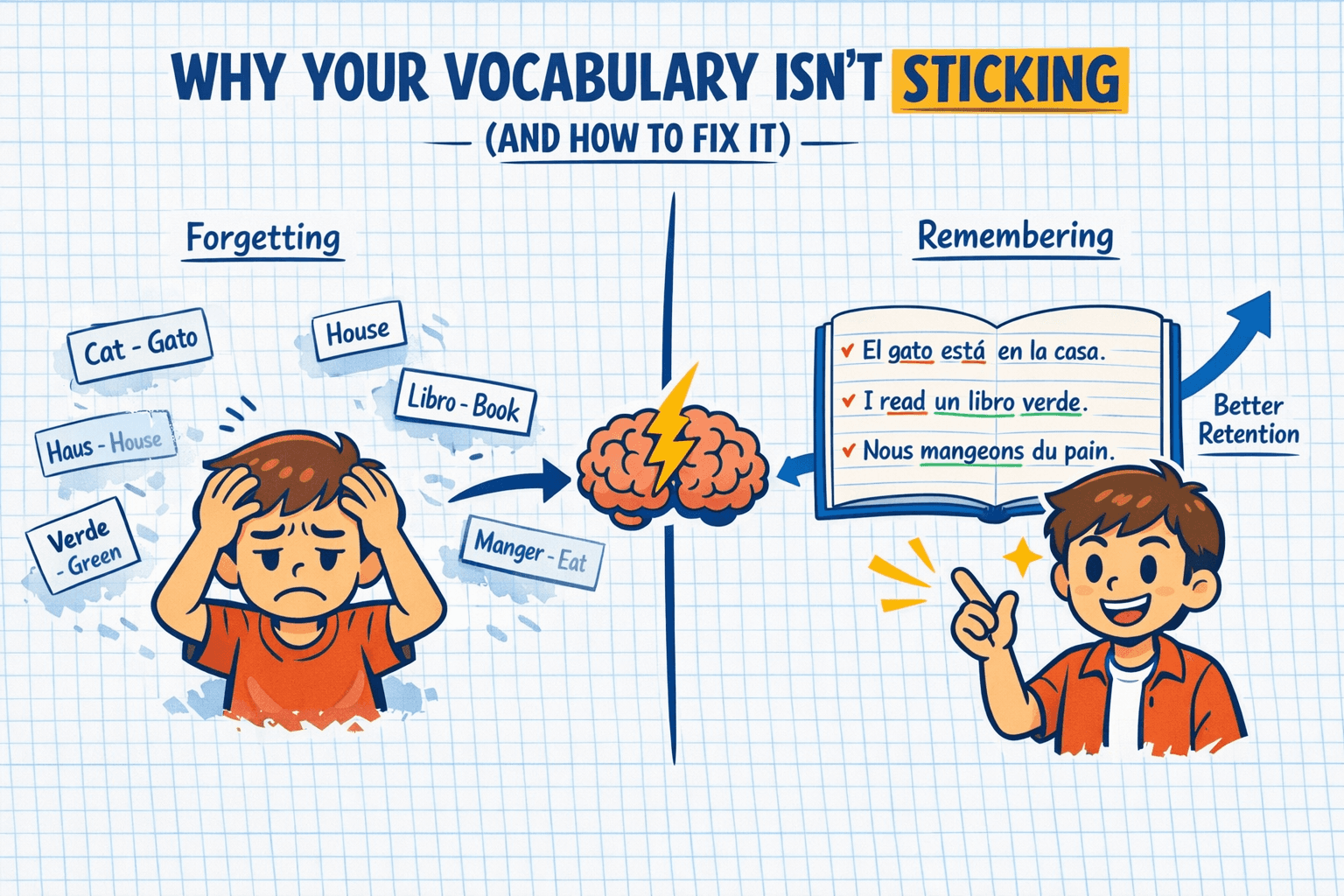
You've studied hundreds of words. You've made flashcards, highlighted lists, written definitions in a notebook. And yet, the moment you need to say something in English — in a meeting, in a conversation, in an exam — the words just aren't there.
This is one of the most common frustrations in language learning. Not because the learner is lazy or incapable. But because the method is wrong. Most people study vocabulary in a way that produces recognition without retention. You see a word, it looks familiar, and the brain says "yes, I've seen this." That feeling of recognition gets mistaken for knowledge. It isn't.
This post is about what actually works — why context and spacing beat repetition and word lists, and how to build a practical daily habit that moves vocabulary from your notebook into your head for good.
The Flashcard Trap (and Why Your Brain Forgets So Fast)
Here's what happens when most people study vocabulary. They encounter a new word, write it down with its translation, review the list a few times, and consider it learned. Two weeks later, the word is gone.
This isn't a memory problem. It's a timing problem.
In the 1880s, a psychologist named Hermann Ebbinghaus mapped what he called the "forgetting curve." Under typical conditions, without reinforcement, we forget roughly half of new information within a day, and most of the rest within a week. The uncomfortable truth is that a single review session — no matter how focused — is almost never enough to make a word stick long-term.
What actually slows the forgetting curve is spacing: reviewing information at increasing intervals, each time just before your brain is about to lose it. The first review might come 24 hours after you first encounter a word. Then three days later. Then a week. Then two weeks. Each time you successfully retrieve the word, the memory trace gets stronger and the next review interval grows longer.
This is spaced repetition in a nutshell. It's the single most research-backed technique in vocabulary learning, and most learners never use it deliberately.
Why Learning Words in Isolation Backfires
Even if you apply perfect spacing, there's a second problem: studying words as isolated items.
When you memorise serendipity = a happy accident, you're training your brain to recognise one word in one context. What you're not learning is how the word actually behaves in English — what it collocates with, what register it belongs to, whether a native speaker would say "it was a serendipity" or "it was a moment of serendipity."
The answer is the second one. Serendipity is an uncountable noun in most of its common uses — you can't put a directly in front of it any more than you'd say "a happiness." You wouldn't pick that up from a flashcard.
Native-level fluency is mostly built on chunks — phrases, collocations, and set expressions that function as single units. "Make a decision" not "do a decision." "Take responsibility" not "give responsibility." "Run a risk" not "make a risk." These small things trip up even advanced learners, because they learned words without learning how words live together.
So the rule is this: whenever you learn a new word, learn it inside a sentence. Better yet, learn it inside two or three sentences that show it doing different jobs. The word reluctant, for instance:
- She was reluctant to admit she'd been wrong.
- He gave a reluctant nod and left.
- There's a reluctant charm to the city in winter.
Three sentences, three slightly different uses. That's a word you'll actually remember — and use correctly.
How Many Words Do You Need — and Where to Start?
This question matters more than most learners realise, because studying the wrong words at the wrong level is one of the most common ways to waste time.
Research on vocabulary and reading comprehension suggests that you need to know roughly 95% of the words in a text to read it comfortably, and around 98% to read it fluently. For most practical English use, that means the highest-frequency vocabulary — the 2,000 to 3,000 most common words in English — should come first. After that, academic vocabulary. Then domain-specific vocabulary depending on your goals.
If you're at A2 or B1, you're not ready to study C1 idioms yet. If you're at B2, drilling basic A1 words is a poor use of time. Getting the level right matters — and the vocabulary you need changes significantly at each stage. At B1, the priority is general topic vocabulary: work, health, education, the environment. At B2, it shifts toward collocation, idiom, and more precise academic language. At C1, the gaps are often subtler — register, connotation, near-synonyms.
If you're not sure where you currently stand, the free English level test gives you a solid baseline across grammar, vocabulary, and reading. Once you know your level, you can go straight to the vocabulary sets built for it: B1 vocabulary, B2 vocabulary, or C1 vocabulary — rather than studying at random and hoping the right words show up.
Vocabulary Learning Techniques That Actually Work: A Three-Phase Method
Here's a practical framework. It's not complicated, but it does require consistency.
Phase 1: Encounter (daily, 15–20 minutes)
Find a source at your level — an article, a podcast, a graded reader — and work through it actively. When you hit an unfamiliar word, don't stop to look it up immediately. Try to guess the meaning from context first. Then look it up. Write the word down not as an isolated item but in the sentence where you found it, plus any important notes about usage or collocation.
Aim for 8–12 new words per session, not more. Cramming too many words per session is the enemy of retention — your brain consolidates new information during rest, and flooding it with 40 words at once means most of them won't survive the night.
Phase 2: Review (daily, 10 minutes)
This is where spaced repetition comes in. A simple card system works fine: split your cards into today's review, this week's review, and this month's review. Move cards forward when you recall correctly, move them back when you don't. If you want to automate the scheduling, tools like Anki do it for you, but the principle matters more than the tool.
The goal at this phase is active recall — covering the answer and forcing yourself to retrieve the word from memory. Not reading the word and nodding. Actually producing it. This is fundamentally different from recognition, and that difference is important: recognition means you can identify a word when you see it; recall means you can retrieve it when you need it. Exams and real conversations demand recall, not recognition.
An even faster way to test yourself: our vocabulary quizzes by level put words into context and force you to choose, which trains both recognition and recall at the same time.
Phase 3: Use (weekly, any format)
This is the phase most learners skip, and it's the most important. Phase 2 tests whether you can retrieve a word. Phase 3 tests whether you can actually deploy it — which is a harder and different skill entirely.
Once a week, write a short paragraph — five or six sentences — deliberately using five words you've been studying that week. The paragraph can be about anything. If you've been studying B2 business vocabulary, write about a fictional job interview. If you've been working on C1 collocations, describe a news story you read. The topic doesn't matter. What matters is that you generate original sentences, not copy examples.
Here's what a Phase 3 exercise might look like for someone studying B1 vocabulary around work and careers (target words in bold):
I've been working at the same company for three years, but lately I've been considering a career change. My current role is quite repetitive, and I find it hard to stay motivated. I recently applied for a position that requires more communication skills, which I'm trying to improve. My manager gave me some useful feedback on my presentation last week, which I found very helpful. I'm hoping to get an interview by the end of the month.
Five target words, woven into natural sentences, nothing forced. That's the exercise. It takes ten minutes and does more for long-term retention than an hour of passive reading.
Study by Topic, Not by Alphabet
One more principle worth building into your system: cluster your vocabulary learning by topic.
Words that belong to the same semantic field reinforce each other. When you're studying business English, learning revenue, expenditure, profit margin, and fiscal quarter together means each word provides a memory hook for the others. Studying them scattered randomly across a list means each one has to stand alone.
Topic-based practice also tends to be more directly useful. If your goal is to use English at work, you need meeting vocabulary, email vocabulary, negotiation phrases — not a random mix of everything at once.
Our vocabulary sections are organised exactly this way. At B1, you'll find focused topic sets covering things like work and the workplace and phrasal verbs in context. At B2, the topics get sharper — collocations in everyday contexts, common idioms, word formation with prefixes and suffixes. And at C1, there are sets for advanced collocations, language and linguistics, and euphemisms and hedging language — the kinds of nuanced vocabulary that separate B2 from near-native use.
Each set comes with quiz questions. Use them as your Phase 2 review tool.
How to Remember English Vocabulary When Progress Feels Invisible
At some point — usually around B1 going into B2 — vocabulary learning starts to feel frustratingly slow. You're putting in the hours but not noticing improvement. New words feel harder to absorb. This is normal, and it has a name: the intermediate plateau.
Part of what's happening is that the easy, high-frequency words are already in place. What's left is more complex, more context-dependent vocabulary. Words that only appear in specific situations. Words whose meaning shifts depending on register. Words with subtle differences from near-synonyms — like the difference between reluctant and unwilling, or affect and influence.
The solution isn't to study harder. It's to change your input. If you've been learning primarily from textbooks, start reading authentic English — news articles, essays, long-form journalism. If you've been learning from reading, add listening. The more varied the contexts in which you encounter a word, the more stable your memory of it becomes.
This is also a good time to pay serious attention to collocation. One of the best investments at the B2–C1 transition is deliberately studying which verbs go with which nouns, which adjectives sit naturally before which nouns. It's not glamorous work, but learners who do it sound noticeably more natural.
One Thing to Do Differently Starting Today
The next time you learn a new word, write it in a full sentence. Not a translation. Not a definition. A sentence — one you've found in the wild or built yourself — that shows the word doing real work.
That single change, applied consistently, will do more for your retention than doubling your daily word count.
From there, pick your level and start testing. The B2 vocabulary section and the C1 vocabulary section each give you immediate feedback on the gaps — which means you'll know exactly what to put in your Phase 1 notebook tomorrow.
Vocabulary isn't a finish line. Every level you reach just reveals the next one. But the learners who make consistent, visible progress aren't studying more words — they're using better methods and letting time do the compounding. Build the system. Work it daily. The words follow.