
CEFR to IELTS, TOEFL and Duolingo Score Conversion: The Complete 2026 Guide
Published on March 24, 2026 • 8 mins read
You've found a score requirement — say, "IELTS 6.5 or equivalent" — and now you need to know what that means on TOEFL or Duolingo, or whether your current CEFR level is close enough to start preparing.
Here's everything in one place: a verified conversion table, what the levels mean in practice, and — more usefully than any table — a clear guide to which test you should actually take based on your specific goal.
One honest note before you use the numbers below: these are concordance approximations, not exact equivalencies. They reflect group-level statistical alignment across large test populations. A TOEFL 4.5 and an IELTS 6.5 are treated as equivalent by most admissions offices, but an individual learner who is strong in writing and weaker in live speaking may score differently on each. The conversion tells you what to aim for; only a practice test tells you where you actually stand.
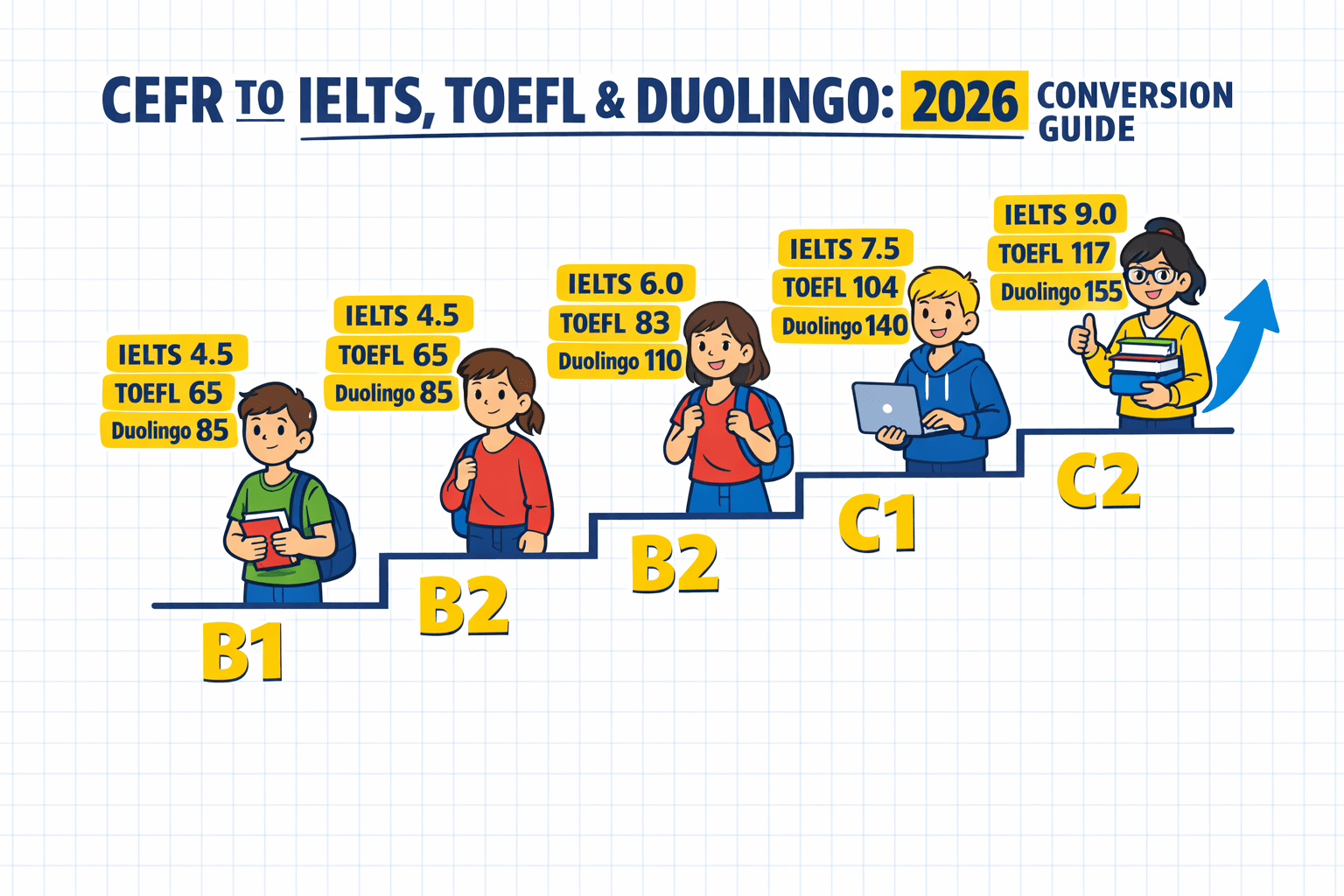
The Complete 2026 Conversion Table
| CEFR Level | IELTS Band | TOEFL iBT (1–6 scale) | TOEFL iBT (0–120 scale) | Duolingo (10–160) |
|---|---|---|---|---|
| A1 | Below 3.0 | 1.0–1.5 | Below 30 | Below 60 |
| A2 | 3.0–3.5 | 2.0–2.5 | 30–57 | ~55–74 * |
| B1 | 4.0–5.0 | 3.0–3.5 | 58–71 | 75–95 |
| B2 | 5.5–6.5 | 4.0–4.5 | 72–94 | 100–125 |
| C1 | 7.0–8.0 | 5.0–5.5 | 95–113 | 130–150 |
| C2 | 8.5–9.0 | 6.0 | 114–120 | 151–160 |
Sources: IELTS–CEFR mapping from Cambridge Assessment English and IELTS Partners. TOEFL–CEFR mapping and old-to-new scale conversion from ETS's official score guidance (updated January 2026). Duolingo–CEFR ranges from Duolingo's 2023 external validation study, reviewed and approved by the Chartered Institute of Linguists (CIOL); results consistent with Cardwell et al. (2024), published in Language Testing.
* Duolingo's validated CEFR study covers B1 through C2. The A2 figure is extrapolated from the B1 lower boundary and should be treated as approximate.
On the TOEFL scale change: ETS replaced the 0–120 scale with a new 1–6 scale (in 0.5 increments) on January 21, 2026, confirmed on ETS's official scoring page. All TOEFL tests taken from that date use the new scale. During a two-year transition window (through early 2028), every score report shows both scales. The official ETS quick reference: 5.0 new = 95+ old; 4.5 new = 86+ old; 4.0 new = 72+ old; 3.5 new = 58+ old.
On the B2/C1 boundary at IELTS 6.5: This is the most commonly misunderstood point in the whole table. An IELTS 6.5 sits at the top of B2 — some institutions accept it as C1 entry, others map it firmly to B2. Whether 6.5 counts depends entirely on the program. If a requirement explicitly states C1, aim for IELTS 7.0.
What Each Level Means in Practice
Numbers on a table don't tell you much until you understand what they represent in real use. This matters especially when deciding whether your current level is genuinely sufficient for a specific goal.
B1 (IELTS 4.0–5.0 / TOEFL 3.0–3.5 / DET 75–95) You can handle familiar everyday English — conversations about work, travel, and common topics. Following a fast academic lecture or writing a structured formal argument is still difficult. B1 is generally not sufficient for English-medium university admission, but it meets the bar for many practical employment settings where interaction is primarily spoken and informal.
B2 (IELTS 5.5–6.5 / TOEFL 4.0–4.5 / DET 100–125) The threshold most undergraduate admissions sit at. At B2 you can read complex texts with some effort, write structured arguments, follow most lectures, and function professionally in English. IELTS 6.0–6.5 meets the language requirement for the majority of English-medium bachelor's programs. B2 is also sufficient for most skilled worker and study visa routes in the UK, Australia, and Canada — though immigration requirements vary significantly by visa category and occupation.
C1 (IELTS 7.0–8.0 / TOEFL 5.0–5.5 / DET 130–150) You're a confident, precise user of English in complex contexts. You can follow fast, nuanced speech, write formally and fluently, and navigate register shifts — irony, implication, professional formality. Most postgraduate programs require at least C1. In practice, IELTS 7.0 is the score you'll see most often on graduate admissions pages — though top-tier programs at LSE, Oxford, and similar institutions often require 7.5 or higher. C1 is also the minimum for most professional registration bodies — nursing boards, medical councils, legal societies — that require a language certificate.
C2 (IELTS 8.5–9.0 / TOEFL 6.0 / DET 151–160) Near-native proficiency. Very few academic programs formally require C2 — it's more relevant for certain professional certifications, diplomatic roles, and some European public sector positions. For most applicants: if your target institution sets IELTS 7.0 as the threshold, a higher score doesn't strengthen your application for language purposes, though some competitive scholarship programs and selective research-led programs do weigh higher scores positively. Always check whether your specific program or funding body rewards scores above the stated minimum.
What Is CEFR? (If You Need a Quick Primer)
The Common European Framework of Reference for Languages — CEFR — is a six-level scale developed by the Council of Europe, published in 2001. It describes language ability from A1 (complete beginner) through C2 (near-native proficiency) and is now the international benchmark that virtually every major language test maps itself against.
IELTS, TOEFL, and Duolingo all use different scoring systems and measure language in somewhat different ways. CEFR is the shared reference point that lets universities, employers, and immigration authorities compare results across tests they'd otherwise have no way to equate. It's also why the conversion table above works at all.
If you're not sure which CEFR level you're currently at, the free English level test covers grammar, vocabulary, reading, and listening and gives you a reliable CEFR baseline — which you can then map to any of the three test scales above. Knowing your actual level before you start prep changes your study plan significantly.
Which Test Should You Take? A Goal-by-Goal Guide
This is what most conversion guides skip, and it's more useful than the table. The test you choose matters — different tests suit different goals, different budgets, and different skill profiles.
Studying abroad (undergraduate or postgraduate)
IELTS Academic is accepted by virtually all universities in the UK, Australia, Canada, New Zealand, and Ireland, and by a large share of US institutions. TOEFL is dominant in the US and widely accepted in Canada and the UK. Duolingo is now accepted by over 5,400 institutions globally, including many highly-ranked ones — but it's not universally accepted, and some programs specifically request IELTS or TOEFL.
The practical rule: Check your specific program's admissions page, not just the university homepage. Departments often set requirements that differ from the university default. If the program accepts all three tests, Duolingo is the cheapest and fastest option by a significant margin — roughly $59 compared to $200–$300+ for IELTS or TOEFL. If you're applying to multiple programs across multiple countries, IELTS Academic is the safest universal choice.
For reading practice tests at the right level of complexity, the IELTS-style reading tests on this site closely mirror the passage length and question types in IELTS Academic. At B2 level, the B2 reading section builds the sustained comprehension skills both IELTS and TOEFL demand.
Immigration and residency visas
For UK Skilled Worker and Student visas, and most Australian immigration categories, IELTS Academic or IELTS General Training is almost always required. The UK Home Office does not accept TOEFL or Duolingo for immigration purposes. TOEFL is accepted for some Canadian immigration streams. Duolingo is not currently accepted for most immigration routes.
IELTS Academic vs IELTS General Training: Both use the same 0–9 band scale, but they are not interchangeable. Academic is required for university admissions and professional registration; General Training is for immigration and some secondary education programs. Immigration authorities and universities specify which version they require. Taking the wrong format means your score is invalid for that purpose, regardless of how well you performed.
Professional registration and licensing
Medical councils, nursing boards, and legal registration bodies in the UK and Australia almost universally require IELTS Academic at specific band scores — often with minimum scores in each section, not just overall. Some professional bodies accept OET (Occupational English Test) as an alternative to IELTS. TOEFL is occasionally accepted for US-based professional licensing but rarely in UK or Australian professional registration contexts. Duolingo is not currently accepted by any major professional regulatory body.
Employment — no specific institution requirement
If your goal is a job application, CV, or employer requirement where no specific test is mandated, any of the three tests works. Duolingo is fast (under one hour), affordable ($59), and increasingly recognised in corporate and professional contexts. For a C1 result that you want to show on a CV or LinkedIn profile, the DET score of 130–150 is well-supported by the external validation evidence. For employers in continental Europe who refer specifically to CEFR levels rather than test brands, any validated score maps cleanly onto the framework.
What IELTS 6.5 Equals on Other Tests
IELTS 6.5 is the most common single threshold in English-medium admissions, so it's worth spelling out exactly what it maps to:
- IELTS 6.5 ≈ TOEFL 4.5 (new scale) / 87–94 (old scale)
- IELTS 6.5 ≈ Duolingo 115–120
- IELTS 6.5 = upper B2, treated as C1 entry by some institutions
If a requirement states "IELTS 6.5 or equivalent," these are your targets on the other tests. One practical note: some programs that list "equivalent scores accepted" still have an unstated preference for IELTS in practice. When in doubt, confirm directly with the admissions office.
The Gap Between Where You Are and Where You Need to Be
The conversion table shows your target. Getting there is a different problem — and the most common mistake is starting prep before knowing which specific skills are holding you back.
Listening is consistently the most underestimated section by learners who have strong reading and writing. It's also the hardest to improve without varied, regular practice at the right level of difficulty. The intermediate listening section works well for B1→B2 candidates, and the advanced listening section for anyone targeting C1.
For vocabulary gaps — which show up across all four sections of both IELTS and TOEFL — the B2 vocabulary section and C1 vocabulary section are organised by topic, which mirrors how vocabulary is tested in context rather than in isolation.
One thing worth noting on test choice: TOEFL's finer increment scale (0.5 bands across the full 1–6 range) means scores differentiate more granularly at B2 and C1 than IELTS does. For learners sitting near a borderline — say, somewhere between B2 and C1 — TOEFL may give you a more precise read of exactly where you stand.
A Note on What These Conversions Can't Tell You
No conversion table can predict which test you'll score highest on. Some learners consistently outperform their IELTS-equivalent on TOEFL because the computer-based format suits them, or because their writing is significantly stronger than their speaking. Others find IELTS's face-to-face speaking component less stressful than TOEFL's recorded speaking tasks. These differences are real, and they can shift your effective score by half a band or more.
If you genuinely have a choice of test, take a timed practice test for both before committing to registration. The format you're more comfortable in is likely the one where your English ability will be most accurately reflected — which is, after all, the whole point.
The table gives you the targets. Your English level test result tells you the gap. What you do between those two points determines the score.